Showing posts with label craving. Show all posts

Tuesday, November 1, 2011

"Nothing Higher To Live For" (video)

A Buddhist View of Romantic Love
Bhikkhu Nyanasobhano (BPS, Bodhi Leaves No. 124)
"Like Crazy" (trailer)

IF IT IS possible to live with a purpose, what should that purpose be? A purpose might be a guiding principle, a philosophy, or a value of sovereign importance that informs and directs our activities and thoughts.

To have one is to live seriously -- though not necessarily wisely -- following some track, believing in a hub to the wheeling universe or a sea toward which we flow or an end before which all the hubbub of civilization subsides.

What is your purpose, friend, or what should it be? Perhaps most of us do not come to a clear conclusion in the matter. But this does not mean we have no purpose, only that we do not recognize it or admit it or even choose it for ourselves.

In the unhappiest case nature simply takes its course, which is a turbid meandering through the swamps of desire. If life means nothing then only pleasure is worthwhile; or if life has meaning and we cannot get at it then still only enjoyment matters -- such is the view of brutes and some sophisticated philosophers.

It slips into the unconscious by default when we hold no other. But we are reluctant to entertain it and will rather, if we think about it, take as our purpose support of family, search for beauty, improvement of society, fame, self-expression, development of talent, and so on.

But it might be fair to say that apart from these or beneath these the fundamental purpose of many of us is the search for love, particularly romantic love. The love of a man for a woman and a woman for a man is often the floor to which people fall after the collapse of other dreams. It is held to be solid when nothing else is, and though it frequently gives way and dumps them into a basement of despair, it still enjoys a reputation of dependability.

No matter that this reputation is illogical -- it still flourishes and will continue to flourish regardless of what is said in any book. Love, or possibly the myth of love [with its knights in shining armor and falling angels], is the first, last, and sometimes the only refuge of uncomprehending humanity.

What else makes our hearts beat so fast? What else makes us swoon with feeling? What else renders us so intensely alive and aching?

The search for love -- the sublime, the nebulous, the consuming -- remains sacred in a world that increasingly despises the sacred.


When the heroic and the transcendental are but memories, when religious institutions fill up with bureaucrats and social scientists, when nobody believes there is a sky beyond the ceiling, then there seems no other escape from the prison of self than the abandon of love.

With a gray age of spiritual deadness upon us, we love, or beg for love, or grieve for love. We have nothing higher to live for.

Indeed, many take it on faith that romantic love is the highest thing to live for. Popular literature, movies, art, and music tirelessly celebrate it as the one truth accessible to all.

Such love obliterates reason, as poets have long sweetly lamented, and this is part of its charm and power, because we want to be swept up and spirited out of our calculating selves.

“Want” is the key word, for in the spiritual void of modern life the wanting of love becomes increasingly indistinguishable from love itself.

So powerful, so insistent is it that we seldom notice that the gratification is rare and the craving relentless. Love is mostly in anticipation; it is an agony of anticipation; it is an ache for a completion not found in the dreary round of mundane routine.

That we never seem to possess it in its imagined fullness does not deter us. It hurts so bad that it must be good.

Practically nobody questions the supremacy of romantic love, which is good enough reason to do a little poking around the foundations of its pedestal. More

Wednesday, October 5, 2011

After the Enlightenment (Inspired Utterances)

The Buddha's All-Seeing Eyes at the great stupa of Boudanath, just outside of Katmandu, Nepal

After the Great Enlightenment
Wisdom Quarterly translation (Udana, Chapter 1)
1. Thus have I heard. On a certain occasion the Buddha, soon after the attaining supreme enlightenment (buddhahood), was dwelling at Uruvela, on the banks of the river Neranjara, at the foot of the bodhi tree. At that time, remaining in a sitting posture for seven days, he experienced the joy of emancipation.

When the seven days came to a close, the Exalted One arose from that state of jhana (meditative absorption). And in the first watch of the night, he thoroughly intuited/thought out the chain of conditionality in order: "When this (state) is, that (state) comes to be; by the arising of this, that is produced. That is to say (in detail):

Tibetan monk and novice under an enormous quilted thangka

"From Ignorance spring formations, from formations springs consciousness, from consciousness spring mind and material form (mentality-materiality), from mind and material form, the six sense bases [the sensitive portion of bodily organs capable of receiving impressions], from the six sense bases, contact [the meeting of stimuli, impression, and consciousness], from contact, sensations, from sensations, craving, from craving, attachment, from attachment, being, from being, rebirth, from rebirth spring decay, death, sorrow, lamentation, pain, grief, and despair [all of which are collectively referred to as dukkha, which we translate as suffering, distress, or unsatisfactoriness]. Thus this whole mass of suffering originates." And the Buddha in this connection, on that occasion, breathed forth this solemn utterance:

"When the conditions of existence dawn upon the mindful
meditative ennobled person, when one understands the nature
of the
conditional arising of things, then all doubts depart."

2. [Conversely,]..."When this is not, that does not come to be; by the non-arising of this (state), that (state) is not produced. That is to say:

By the dissolution of ignorance, formations are undone, by the dissolution of formations, [the base of] consciousness is undone, by the dissolution of consciousness, mentality-materiality are undone, by the dissolution of mentality-materiality, the [bases of the] six sense organs are undone, by the dissolution of the six sense bases, contact is undone, by the dissolution of contact, sensations are undone, by the dissolution of sensations, craving is undone, by the dissolution of craving, attachment [clinging] is undone, by the dissolution of attachment, [coming into illusory] being is undone, by the dissolution of being, rebirth is undone, and by the dissolution of rebirth, decay, death, sorrow, lamentation, pain, grief, and despair are undone. Thus this entire mass of suffering is brought to an end.

And the Exalted One, in this connection, on that occasion breathed forth this solemn utterance:

"When the conditional constituents of being dawn upon the
mindful meditative ennobled person, when one understands
the dissolution of the causes, then all doubts depart."

3. When the seven days had come to a close, the Buddha One arose from that meditative state. And during the last watch of the night thoroughly intuited/thought out the chain of conditionality from start to finish and back.... Now by the complete dissolution of ignorance, there is a cessation of formations. And the Buddha in this connection, on that occasion, breathed forth this solemn utterance:

"When the conditional constituents of being dawn upon
the mindful, meditative, ennobled brahmin, that person
stands scaring off Mara's armies just as the Sun
diffusing its rays throughout space [scatters the darkness]."


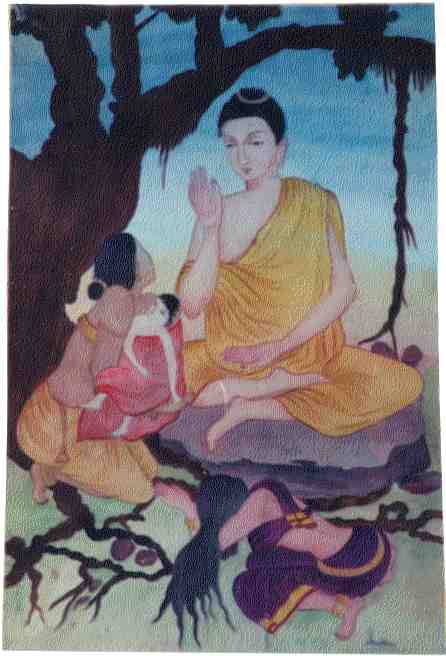
Many came seeking the Buddha's advice after his great awakening, such as Kisagotami (depicted here) asking him to bring her baby back to life. Clever brahmin priests came dispute with a renowned wanderer (shraman) or right their views.

4. Thus have I heard. On a certain occasion the Buddha, soon after attaining buddhahood, was dwelling at Uruvela on the banks of the Neranjara river, at the foot of the Goatherd's Banyan tree. At that time, after remaining in a sitting posture for seven days, experiencing the bliss of emancipation, arose from that meditative state (jhana) at the end of the seventh day.

Now a certain brahmin with a haughty disposition came there and, drawing near, saluted the Buddha. After exchanging compliments of friendship and civility, he stationed himself respectfully at one side. And while standing respectfully at one side said to the Buddha:

"What, Venerable Gautama, is the standard of excellence for a brahmin, and what is the nature of the works he should perform?

The Buddha in this connection, on that occasion, breathed forth this solemn utterance:

"One who has put away doing harm, who is humble, free from
impurity [of mind/heart], self-restrained, versed in knowledge,
leading the high life [not by birth but by one's own actions in
this life], that person may rightly be referred to as a 'brahmin.'
For such a person there are no desires anywhere in the world."

Friday, September 16, 2011

Sugar Shock: It's a "Drug"! (video)

Wisdom Quarterly, Nutrition by Natalie,
(weheartit.com)

How much sugar do we consume? Americans might be surprised just how much sugar there is in everyday drinks and foods. I reveal the shocking truth about how much sugar we are eating.


Sugar is a highly processed chemical

Common things like soft drinks, Starbucks, McDonald's, fast foods, alcohol -- they are all FULL of addictive sugar.


Let's look closely at how much sugar there is in "healthy" orange juice, blueberry muffins, Pop Tarts, Lucky Charms, BBQ sauce, Coca Cola, Gatorade, frappuccino mocha coffee, chocolate cake desserts, and more.


Top 10 Worst Foods

There is a relationship between sugar/high fructose corn syrup to hunger, weight gain, obesity, low energy, inflammation, digestive troubles, depression, exhaustion, brittle bones, bad teeth, diabetes, cancer, and bad health. This is an eye-opener even for people not on a diet.


Sugar: a Class A drug?
BodyMindSuccess.com
We know the effects of sugar are not good. But to what degree do we know? I thought I had a pretty good understanding, but after watching this video and the series of videos listed below, it has become clear that there is much more I didn’t know. For example, sugar is the Number One addiction -- above cocaine and other addictive drugs. Sugar contributes to weight gain, sure, but “sugar” is disguised in many forms. Sugar affects many things (cancer, low sugar, diabetes, insulin insensitivity, inflammatory conditions, hunger, vision, insomnia, malnutrition, aging...). More

Wednesday, September 14, 2011

The Lesbian Subversives of Iran (video)

Wisdom Quarterly (ANALYSIS)
() Sundance Audience Award winner "Circumstance" -- a wealthy Iranian family struggles to contain a teenager's growing sexual rebellion and her brother's dangerous obsession.

Homosexual acting out is common in religions/cultures that strictly segregate boys and girls. The very desire for purity leads to guilt, shame, and makes one wonder if that is not the point. Christianity (Catholicism), so vehemently opposed to gays, seems most famous for this. And Pres. Ahmadinejad seems as in denial about what is going on as an American mom.


() Meet the Artists: Maryam Keshavarz on her [Iranian lesbian]
film "Circumstance" premiering at the 2011 Sundance Film Festival.

But Buddhism where monasticism is prodded or where monastics deny and prevent the natural affinity of young people to commingle is not immune to this phenomenon. Macho Iran, Afghanistan, and enclaves like the US military and American prisons and seminaries and Republican caucuses (and other segregated environments) are havens for homosexual acting out.


Do Iranians make funny clips of American leaders' hypocrisy?


Hypocrisy comes with high morals.

And we are all in denial, hoodwinked by the hyper-masculinity and poorly veiled misogyny. Maybe eroticizing the issue focusing on Muslim lesbians (surely an oxymoron in Islam as it would be in fundamentalist Christianity) will bring the issue to light. Let gays be gay, but it might be nice to spare non-gays the guilt and shame of youthful indiscretions because they are given precious few alternatives just when their hormones are raging.

American Bacha Bazi (NAMBLA-style B4U-ACT)
[Bacha bazi is the Middle Eastern custom of what in the West is regarded as child molestation and pederasty.] Along with venerable child advocate Dr. Judith Reisman, I attended a conference hosted by the American pro-pedophile group B4U-ACT. Conference highlights: Pedophiles are “unfairly... demonized,” “Children are not inherently unable to consent” to sex with an adult, “in Western culture sex is taken too seriously,” “Anglo-American standard on age of consent is new [and ‘Puritanical’]. In Europe it was always set at 10 or 12. Ages of consent beyond that are relatively new and very strange, especially for boys. They’ve always been able to have sex at any age.” And an adult’s desire to have sex with children is “normative.”

American Bucha Bazi: Warden David Wise (6:35) would not want to work in a prison without vices that keep the prisoners busy and make control easier for authorities.

Thursday, September 8, 2011

"Friends with Benefits"? (video)

Amber Dorrian, CC Liu (Wisdom Quarterly)


Make love, not war. If there is "war in the" air around 9/11 commemorations and prison planet survivalism, where is the love?

"Love" can mean so many things. Sex is one of them, usually the euphemistic meaning. But there is a better Greek word, agape. Oddly, English is not lacking. English-speakers are. Buddhism speaks of metta, "loving-kindness," as one of the most important qualities to develop.

If there is light in the soul,
There will be beauty in the person.
If there is beauty in the person,
There will be harmony in the house.
If there is harmony in the house,
There will be order in the nation.
If there is order in the nation,
There will be peace in the world.
-Chinese proverb

Lust, sensual craving, thirst, greed are all less than profitable expressions of this impulse in the Sense Sphere (kama-loka). Mara Devaputra is either Cupid or Lucifer in this sense, an evil or a messenger of light... maybe both.

Can Buddhists talk about sex -- one of the worst things one can do in this society which is all about war, defense, security, and resistance? Yes, Buddhists can do anything. With greedy intentions, we make our way and our world. With loving intentions, it is immediately a different world.
The world we see outside changes instantly from changes inside. Whether the world is ever a way or ever changes, who can know? It is about what we notice, what we bring forward as evidence (or what is shoved in our face by mainstream media), what we talk about/focus on.

Love and kisses for everyone, enemies, soldiers, elderly, corporate capitalists, tea baggers, meditators... We can curse the darkness or light a candle. And what we choose is important.

Our beliefs become our thoughts.
Our thoughts become our words.
Our words become our actions.
Our actions become our habits.
Our habits become our values.
Our values become our destiny.
- Gandhi


Killer life coach James Ray on belief and RAS

Sunday, July 24, 2011

Amy Winehouse: Drugs vs. "Rehab" (video)

In 2006, Amy Winehouse (1984-2011) became a star, the voice of a new generation, by insisting she would not be going to "Rehab." She would be dead within five years.
Already a star in the U.K., Winehouse makes her debut on U.S. TV with "Rehab."

Singer Found Dead in Apartment
LONDON, England - Troubled British singer Amy Winehouse [with her violent partner in prison] was found dead at her flat in north London, police said. She was 27 years old. The Grammy award-winning [neo-]soul singer struggled with well-documented drink and drug addictions. Her death is being treated as unexplained. "Police were called by London Ambulance Service to an address in Camden Square shortly before 4:05 pm (local time) today, Saturday 23 July, following reports of a woman found deceased," a police statement said. "On arrival officers found the body of a 27-year-old female who was pronounced dead..." More

Drunk and/or stoned, Amy Winehouse is booed during comeback tour, live in Belgrade on June 18, 2011. She then launches into "Back To Black."

Rehab without a "Higher Power"
Recovery from addictions of all kinds is possible in a Buddhist context. Buddhism is nontheistic (not dependent on a God for "salvation"/enlightenment). Many Buddhists are theists, but many others are atheistic, agnostic, or undecided.

Not recognizing a supreme being as a higher power makes traditional 12-Step programs unpalatable. (Of course, the nature of the "higher power" one chooses need not be a god, but that is definitely how most participants treat it as part of their recovery.

Thanks to mavericks like Kevin Griffin, who wrote One Breath at a Time: Buddhism and the Twelve Steps it is quite possible to successfully overcome addiction and unrelenting craving in a nontheistic context.

A Buddhist Version of the 12 Steps
Step 1 - We admitted we were powerless over our addiction -- that our lives had become unmanageable.
Step 2 - Came to believe that spiritual practice could restore us to sanity.
Step 3 - Made a decision to turn our will and our lives over to the power of the Dharma.
Step 4 - Made a searching and fearless moral inventory of ourselves.
Step 5 - Admitted to ourselves and to another human being the exact nature of our suffering.
Step 6 - Were entirely ready to let go of all these defects of character.
Step 7 - Humbly asked for our shortcomings to be removed through prayer and meditation.
Step 8 - Made a list of all persons we had harmed and became willing to make amends to them all.
Step 9 - Made direct amends to such people wherever possible, except when to do so would injure them or others.
Step 10 - Continued to take personal inventory, and when we were wrong promptly admitted it.
Step 11 - Sought through prayer and meditation to improve our conscious contact with reality and to live a life with more wisdom and compassion.
Step 12 - Having had a spiritual awakening as the result of these steps, we tried to carry this message to other addicts and to practice these principles in all our affairs.

Friday, July 8, 2011

Some Buddhist advice on lust

Key passages from Buddhist texts translated by Wisdom Quarterly
(Wonderlane/Flickr.com)

What household-Buddhists do is one thing. What Sangha-members (Buddhist monastics) do is another. The Buddha advised renunciates (monks, nuns, novices, and those training intensively) to be extremely careful to avoid the snare of lust.

Of great advantage is restraint in body, of great advantage is restraint in speech. Of great advantage is restraint in mind, of great advantage is restraint everywhere. The renunciate restrained in everything is freed from all sorrow.

It would be far better to bore out your eyes with red-hot irons than encourage yourselves in sensual thoughts or look upon a man or woman's form with lustful desire.

The renunciate who has retired to a quiet of place [seclusion of heart/mind but not necessarily of body, unless that is needed], who has calmed mind/heart, who clearly perceives the Dharma experiences a joy transcending that of humans.

O renunciates, if you must speak with a [member of the other sex], let it be with pure heart, and think to yourself, “As a renunciate I will live in this corrupting world as the spotless leaf of the lotus, unsoiled by the mud it grows out of.”

If the [person] be old, regard that person as your [parent]; if young, as your [sibling]; if very young as your child.

O renunciates, cover your heads with the helmet of right intention, and abandon with fixed resolve the five [strands of sense] desire.

Lust clouds one's heart when it is confused with [form's] beauty and the mind is dazed.

One who is controlled in hand, foot, speech, and in the highest [head], one who delights in meditation and is composed, one who is solitary and contented -- that person is called a renunciate.

One who holds neither “I” nor “me” at all towards mind and body [a stream enterer or other noble disciple], who grieves not for that which one does not have -- that person, indeed, is called a renunciate.

As the jasmine creeper sheds withered flowers, even so, O renunciates, totally shed lust and hatred. More

(discovermagazine.com)

Gratification, Danger, and Escape – 1

Based on Bhikkhu Bodhi's translation in Anthology of Discourses
Before my enlightenment, O disciples, when I was still a bodhisatta (being striving for supreme enlightenment), this thought occurred to me:

“What is the gratification in the world, what is the danger in the world, and what is the escape from the world?”87

Then I thought:
  • “Whatever joy and happiness there is in the world [and there is plenty], that is the gratification in the world;
  • That the world is impermanent, pervaded by disappointment, and subject to change, that is the danger in the world;
  • The removal and abandoning of [sensual] desire and lust for the world, that is the escape from the world.”
So long, disciples, as I did not fully understand as they really are the world’s gratification as gratification, its danger as danger, and the escape from the world as escape, for so long I did not claim that I had awakened to the unsurpassed perfect enlightenment in this world with its devas, māras, and brahmās [light beings, adversaries, and divinities], in this generation [a biological not chronological reference] with its ascetics and brahmins, its [earthbound-] devas and humans.

But when I had fully understood all this, then I claimed that I had awakened to the unsurpassed perfect enlightenment in this world with…its devas and humans. The knowledge and vision arose in me:

“Unshakable is the liberation of my mind; this is my last birth; there is now no further re-becoming [rebirth].”
  • 86. Ajjhupekkhati. This refers to the third itemupekkhā (equanimity, impartiality, unbiased observation], which literally means “onlooking,” that is, detached observation or examination.
  • 87. These three terms, which often appear together in the texts, are in Pāli: assāda, ādīnava, nissaraṇa. The commentaries relate them to the Four Noble Truths in this way: “Danger” indicates the truth of suffering [dukkha or disappointment]; “gratification,” the truth of the origin (for pleasure is the stimulus for craving, the true origin of suffering); and “escape,” the truth of the cessation of suffering, or Nibbāna (Sanskrit, nirvana). Although the fourth truth, the truth of the path, is not explicitly mentioned in this triad, it is implied as the means or way of escape.

Friday, June 17, 2011

"Sex Addicts" (Pandakas) in the News

Wisdom Quarterly (shocking exposé)
Oh, that Quagmire! Peter Griffin and Brian the dog walk in on Glenn Quagmire (R) committing adultery with his best friend Cleaveland's wife, Loretta Brown ("Family Guy")

Pandaka: lechery, perversion, transgression
Wisdom Quarterly (based on Religion and Homosexuality)
References to pandaka ("pervert"), a deviant gender category usually interpreted to include transgressive sex addicts, can be found in ancient Buddhist texts (Pali and Sanskrit).

The term, however, does not have a fixed meaning over time. It is generally (mis-)translated as "eunuch," which most pandakas are certainly not.

Far from neutered, they are consumed with acting out in perverse, extraordinary, transgressive, and deviant (unethical, even illegal) ways.

Leonard Zwilling (1992)* refers extensively to Ven. Buddhaghosa's Samantapasadika, where pandakas are described as being filled with defiled passions and insatiable lusts dominated by libido. The Abhidharma states that due to the obstruction of being obsessed with sexuality, a pandaka is unable to achieve enlightenment in that lifetime. In the future, of course, change and rebirth means it is not a permanent obstruction.

The cartoon character Quagmire (in Seth MacFarlane's "Family Guy") is the poster child to explain what this term means. He could be renamed "Glenn Pandaka" in the Hindi/Sanskrit-dubbed Indian version of the show, although they might not see the humor in such aberrant sexual misconduct.

A pandaka is not a eunuch, homosexual, adulterer, or transgendered individual -- but may manifest in all of these ways and more. "Pervert" may be too harsh in that in modern American usage it connotes a judgmental attitude. But "sex addict" brings peels of laughter because most of do not believe sex can possibly be an "addiction," or if it is, then we imagine we all are such "addict."

Sex addiction (satyrism and nymphomania or pansexuality) is, in fact, very real. But it is not what it seems and not what we imagine. Sex for the "sex addict" is not enjoyable; it is compulsive and terribly unsatisfying.

Dr. Gabor Mate (In the Realm of Hungry Ghosts: Close Encounters With Addiction) gives an excellent explanation of one characteristic of addiction: "Acting out" is what one does while playing the game Charades exactly because of an inability to talk it out.

Unable to grasp or express what is happening, our psyches behave in odd and compulsive ways we can hardly begin to explain. So "acting out" has come to mean misbehavior, particularly sexual misconduct, rooted in childhood trauma, confusion about sexual orientation, and an apparent inability to inhibit impulses.

This inability leads to cheating (violating one's own relationships), adultery (violating others' relationships), indiscriminate sexual practices, promiscuity, the insatiable need for novel stimulation... all the while being unable to tamp down the fire that is in fact being fed by everything that is being thrown at it.

Repression and denial are not healthy solutions since pushing it down here only causes it to pop up there with greater force.

Pornography, pansexuality, molestation, transgression, seduction, betrayal, sexting -- things we sometimes take rather lightly are in fact serious lapses in conduct (karma) that get us in a lot of trouble, particularly if we're in the spotlight.

More sex is not a solution when it brings distress, humiliation, self-loathing, low self-esteem, ignominy, jail time, ostracism. Even when it is rooted in having been molested or otherwise traumatized as a child, which of course is unfair, our actions still bring results for us.

In spite of the fact that so many of us are victims (of verbal, emotional, religious, ritual, psychological, physical, and sexual) abuse, part of the condition is to blame ourselves. Caught in a cycle of shame, we "act out." It is hardly sexy.

One addiction is often accompanied by another -- alcoholism to mask painful memories and unpleasant feelings associated with buried memories, drug abuse that makes appearing in porn seem like a good idea, thrill seeking and body art to try to get feeling from something (combating anhedonia, subclinical depression, bipolar disorder, etc.).

Dr. Mate points out that he has never met a sex addict who was not molested, which is not to say that all molested children will become sex addicts.

Sexual anorexia and bodily dissociation are also common expressions of what is coming to be recognized as PTSD (post traumatic stress disorder) resulting from incest, abuse, assault, rape, and other forms of trauma.

We have a taboo around incest and rape. But the taboo is actually not against committing incest. It is about talking about it, particularly by victims.

There are many degrees of affliction. And nearly all of us have been "traumatized" in life in some way or another. So what makes a free spirited enjoyer of sex a "sex addict"?

The answer is very simple. It is explained by America's favorite sexologist, Dr. Drew Pinsky (addiction medicine specialist and board-certified internist) from Loveline radio, "Celebrity Rehab," and his own CNN blog:

When in the face of increasing consequences and distress, you continue to act out and feel unable to stop...you just might be a sex addict.
  • *Leonard Zwilling (1992), "Homosexuality As Seen In Indian Buddhist Texts" in Buddhism, Sexuality & Gender (Jose Ignacio Cabezon, editor, State University of New York, pp. 203-214).
  • PHOTOS: Rihanna S&M (idolator.com), Congressman Weiner (npr.org), Governor Schwarzenegger (seeker401.wordpress.com), Lady Gaga (wikipedia.org), PM Silvio Berlusconi with Pope Benedict head of an army of pedophile priests (bilgrimage.blogspot.com), Charlie Sheen (dabxblogger.com), Ke$ha (dipity.com), Dominique Strauss-Kahn (guardian.co.uk), sex vampire (disclose.tv), Dr. Drew Pinsky (guardian.co.uk), Hugh Hefner (gossiprocks.com).
Anyone who thinks "sex addiction" is "sexy," funny, or fake might ask to visit an SAA meeting then try to keep from cringing as they hear what addicts go through.

Hugh Hefner, "Playboy" or Pandaka?
(Huffington Post) Hugh Hefner has gleefully enjoyed a sexually liberated life. But few know it all started with a little erotic dabbling within the Playboy czar's own family.

In his book, Mr. Playboy: Hugh Hefner and the American Dream, Steven Watts writes how after Hefner wed his first wife, Millie, in 1949... Hef then went further, trying a foursome out on his own family....

The book also claims Hef once tried a gay tryst. "Hefner's thirst for sexual experience became so strong that he even had a one-time homosexual experience," Watts writes.

Larry Flynt?
Superhero Hef and his superheroine playmates may just be living the American dream revved up after marriage. But Larry Flynt, of Hustler and Flynt Publications fame? He confessed to bestiality and a harsh childhood with difficult parents -- reminiscent of a grown up Cartman ("South Park"). This would go a long way to explaining how he went off the rails from compulsion to obsession to the creation of a pornography empire comparable to Playboy, Inc. only more prurient with its "Chester the Molester" comic strip (echoed in Family Guy's character "Herbert") and accusations of molesting his biological daughter.

Thursday, June 16, 2011

"Playboy" and Men's Dreams

Crystal left Playboy's founder to make beautiful music with someone else, planning to cash in on a post "runaway bride" spectacle interview (FOX). Men's dream comes undone: Girls not included? Hefner a gay pandaka? Has "Playboy" been nothing but false advertising?

LOS ANGELES (Reuters) - Playboy founder Hugh Hefner, dumped by his fiancee days before their wedding, said Wednesday he is affixing "Runaway Bride" stickers over her picture on the cover of the magazine's upcoming issue.

Hefner, 85, announced a day earlier that 25-year-old Crystal Harris had "a change of heart," and that Saturday's wedding ceremony for 300 people at the Playboy Mansion in Los Angeles had been canceled.

In an unfortunate coincidence, Harris appears on the cover of the July Playboy issue, hitting newsstands Friday, described as "America's Princess ... Introducing Mrs. Crystal Hefner."

In the interests of journalistic accuracy, Hefner has moved quickly to remedy the situation. More
  • The story, of course, is much funnier and stranger. Crystal Harris planned on abandoning Hugh Hefner at the altar -- in view of cameras for a big pay off selling her interview afterward. And she may have been having an affair with Dr. Phil's son all along.
Mend's Dreams: Runaway Bride uses Porn King
Wisdom Quarterly (COMMENTARY)
The sad thing is that Hugh Hefner has essentially been living the life most men want. He has:
  • a castle in Los Angeles
  • millions coming in annually from destructive but exciting work
  • potency-inducing pharmaceuticals
  • gala parties
  • and, best of all, an endless bevy of newly nubile "playmates" and "bunnies," Scandinavian twins in open marriages and group activities...
If Hef can't get it to work, what hope is there for the rest of us?

When lust (kamachanda, or tanha and lobha, "craving" and "greed") fails us, it suggests that maybe, just maybe, the Buddha was right:

Investing our energies and dreams in developing sensual desires -- and trying to satisfy them -- is not actually the way to happiness.

Craving, in fact, may be the problem causing our "suffering" -- our dissatisfaction, disappointment, and distress.

If that were true, freedom-from-craving would be the solution -- freedom-from-suffering (nirvana).

But what could be the path leading to such freedom? These four assertions are the centerpieces of Buddhism as a path to perfect liberation. But who will strive to be free without first realizing the disappointment of being enslaved to craving?

Monday, May 30, 2011

Sexed, Stressed, and Sick (addictions)

Gabormate

For Memorial Day Democracy Now! presented special programming combining the amazing contributions to understanding the root of diseases many think are genetic. He also exposes the complicity of the pharmaceutical industry: Americans, who comprise only 5% of the world's population, are prescribed 66% of the world's psychoactive medications such as Prozac.

Sex addiction is one of the main compulsions in America today, largely stemming from our traumatic childhoods, exposure to ubiquitous porn, our craving for comfort, and religious oppression. (Image: a scene from "Choke," nytimes.com).

They are actually due to childhood trauma, diet, and stress. Canadian physician, disease and addiction expert, and bestselling author Dr. Gabor Maté presents his findings together on one program.

The screen, the screen, we're as addicted to our screens as children are to candy.

This includes his groundbreaking Buddhist work In the Realm of Hungry Ghosts: Close Encounters with Addiction on sex, computer screen, workaholism, drug, excitement, and fast food cravings, which drive feel good brain chemicals.

Internet porn, masturbation, adultery, alcoholism, "acting out," what's at the root of our compulsive/self-soothing behaviors?

From disease to addiction, parenting to childhood ADD (attention deficit disorder), Dr. Maté’s work focuses on the centrality of early childhood experiences on the development of the brain and susceptibility to a wide array of "incurable" diseases and addictions.

Early childhood experiences such as being sexually mole

sted or emotionally traumatized impact everything from behavioral patterns to physical and mental illness. The relationship between emotional stress and disease -- and mental and physical health more broadly -- is often considered controversial within medical orthodoxy.


But Dr. Maté convincingly argues that many doctors seem to have forgotten what was once a commonplace assumption -- that emotions are deeply implicated in the development of illness, addictions, and psychological disorders and, more importantly, in their healing.