Showing posts with label dependent origination. Show all posts

Wednesday, October 5, 2011

After the Enlightenment (Inspired Utterances)

The Buddha's All-Seeing Eyes at the great stupa of Boudanath, just outside of Katmandu, Nepal

After the Great Enlightenment
Wisdom Quarterly translation (Udana, Chapter 1)
1. Thus have I heard. On a certain occasion the Buddha, soon after the attaining supreme enlightenment (buddhahood), was dwelling at Uruvela, on the banks of the river Neranjara, at the foot of the bodhi tree. At that time, remaining in a sitting posture for seven days, he experienced the joy of emancipation.

When the seven days came to a close, the Exalted One arose from that state of jhana (meditative absorption). And in the first watch of the night, he thoroughly intuited/thought out the chain of conditionality in order: "When this (state) is, that (state) comes to be; by the arising of this, that is produced. That is to say (in detail):

Tibetan monk and novice under an enormous quilted thangka

"From Ignorance spring formations, from formations springs consciousness, from consciousness spring mind and material form (mentality-materiality), from mind and material form, the six sense bases [the sensitive portion of bodily organs capable of receiving impressions], from the six sense bases, contact [the meeting of stimuli, impression, and consciousness], from contact, sensations, from sensations, craving, from craving, attachment, from attachment, being, from being, rebirth, from rebirth spring decay, death, sorrow, lamentation, pain, grief, and despair [all of which are collectively referred to as dukkha, which we translate as suffering, distress, or unsatisfactoriness]. Thus this whole mass of suffering originates." And the Buddha in this connection, on that occasion, breathed forth this solemn utterance:

"When the conditions of existence dawn upon the mindful
meditative ennobled person, when one understands the nature
of the
conditional arising of things, then all doubts depart."

2. [Conversely,]..."When this is not, that does not come to be; by the non-arising of this (state), that (state) is not produced. That is to say:

By the dissolution of ignorance, formations are undone, by the dissolution of formations, [the base of] consciousness is undone, by the dissolution of consciousness, mentality-materiality are undone, by the dissolution of mentality-materiality, the [bases of the] six sense organs are undone, by the dissolution of the six sense bases, contact is undone, by the dissolution of contact, sensations are undone, by the dissolution of sensations, craving is undone, by the dissolution of craving, attachment [clinging] is undone, by the dissolution of attachment, [coming into illusory] being is undone, by the dissolution of being, rebirth is undone, and by the dissolution of rebirth, decay, death, sorrow, lamentation, pain, grief, and despair are undone. Thus this entire mass of suffering is brought to an end.

And the Exalted One, in this connection, on that occasion breathed forth this solemn utterance:

"When the conditional constituents of being dawn upon the
mindful meditative ennobled person, when one understands
the dissolution of the causes, then all doubts depart."

3. When the seven days had come to a close, the Buddha One arose from that meditative state. And during the last watch of the night thoroughly intuited/thought out the chain of conditionality from start to finish and back.... Now by the complete dissolution of ignorance, there is a cessation of formations. And the Buddha in this connection, on that occasion, breathed forth this solemn utterance:

"When the conditional constituents of being dawn upon
the mindful, meditative, ennobled brahmin, that person
stands scaring off Mara's armies just as the Sun
diffusing its rays throughout space [scatters the darkness]."
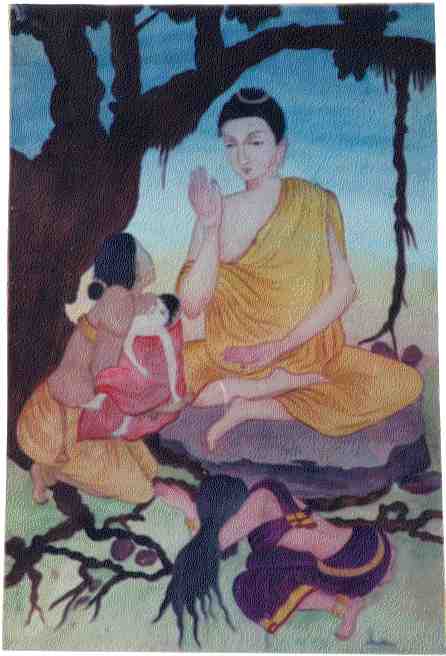

Many came seeking the Buddha's advice after his great awakening, such as Kisagotami (depicted here) asking him to bring her baby back to life. Clever brahmin priests came dispute with a renowned wanderer (shraman) or right their views.

4. Thus have I heard. On a certain occasion the Buddha, soon after attaining buddhahood, was dwelling at Uruvela on the banks of the Neranjara river, at the foot of the Goatherd's Banyan tree. At that time, after remaining in a sitting posture for seven days, experiencing the bliss of emancipation, arose from that meditative state (jhana) at the end of the seventh day.

Now a certain brahmin with a haughty disposition came there and, drawing near, saluted the Buddha. After exchanging compliments of friendship and civility, he stationed himself respectfully at one side. And while standing respectfully at one side said to the Buddha:

"What, Venerable Gautama, is the standard of excellence for a brahmin, and what is the nature of the works he should perform?

The Buddha in this connection, on that occasion, breathed forth this solemn utterance:

"One who has put away doing harm, who is humble, free from
impurity [of mind/heart], self-restrained, versed in knowledge,
leading the high life [not by birth but by one's own actions in
this life], that person may rightly be referred to as a 'brahmin.'
For such a person there are no desires anywhere in the world."

Thursday, July 7, 2011

Seeking a Path: Dependent Origination

P.A. Payutto (trans. from Thai by Bruce Evans), intro. edited by Wisdom Quarterly Himalayan path along Phoksundo Lake (lasochres.se)

The Buddhist Law of Conditionality
The teaching of causal interdependence is the most important of Buddhist principles.

It describes a law of nature that exists as the natural course of things. The Buddha was not an emissary of heavenly "commandments." He was a discoverer of this liberating-principle of the natural order, and he proclaimed its truth to the world.

The progression of causes and conditions is the reality that applies to all things: from the natural environment, which is an external and physical condition, to the events of human society, ethics, life events, and the happiness and suffering that manifest in our minds.

Causal relationships are part of one natural truth. Our happiness within this natural system depends on having some knowledge of how it works and practicing correctly within it. With knowledge we are able to address problems on personal, social, and environmental levels.

Given that all things are interconnected, all affecting one another, success in dealing with the world lies in creating harmony within it.

(Kevin-McGuiness/Flickr.com)

The sciences, which have evolved with human civilization and are influencing our lives so profoundly, are said to be based on reason and rationality. Their storehouse of knowledge has been amassed through interacting with these natural laws of conditionality. ...

But the human search for knowledge in modern scientific fields has three notable features...

  • Underneath it all, we tend to interpret concepts like happiness, freedom, human rights, liberty, and peace in ways that preserve the interests of some and encroach on others. Even when controlling other people comes to be seen as a blameworthy act, this aggressive tendency is then turned in other directions, such as the natural environment. Now that we are beginning to realize that it is impossible to really control other people or other things, the only meaning left in life is to preserve self interests and protect territorial rights. Living as we do with this faulty knowledge and these mistaken beliefs, the natural environment is thrown out of skew, society is in turmoil, and human life, both physically and mentally, is disoriented. The world seems to be full of conflict and suffering.

All facets of the natural order -- the physical world and the human world, the world of conditions (dharma) and the world of actions (karma), the material world and the mental world -- are connected and interrelated; they cannot be separated. Disorder and aberration in one sector will affect other sectors. If we want to live in peace, we must learn how to live in harmony with all spheres of the natural environment, both the internal and the external, the individual and the social, the physical and the mental, the material and the immaterial.

...This is why, of all the systems of causal relationship based on the following law "Because there is this, that arises; when this ceases, that ceases," the teachings of Buddhism begin with, and stress throughout, the factors involved in the creation of suffering in individual awareness.

"Because there is ignorance, there are volitional formations..." is the first link of the Dependent Origination formula. Once this system is understood on the inner level, liberating us from suffering, we are then in a position to see the connections between inner factors and the causal relationships in the external environment. This is the approach adopted in this book. More

1. An Overview of Dependent Origination
Types of Dependent Origination found in the texts

1. The general principle

2. The principle in effect

2. Interpreting Dependent Origination
The essential meaning

3. Man and Nature

4. The Standard Format
The main factors

1. Ignorance and craving-clinging

2. Volitional impulses and becoming

3. Consciousness to feeling, and birth, aging and death

5. Other Interpretations
Preliminary definition

How the links connect

Examples

An example of Dependent Origination in everyday life

6. The Nature of Defilements

7. Dependent Origination in Society

8. The Middle Teaching

9. Breaking the Cycle

Monday, June 27, 2011

A Very Buddhist Summer

Ashley Wells (Wisdom Quarterly)
Hotei Bodhisattva, the Japanese Zen "Santa Claus" often mistaken for a buddha, hanging ten (Emerson Rauth/Flickr.com)

SANTA MONICA, California - While Republicans vote and gays parade on the east coast, summer is heating up on Southern California's beaches.

I used to think I understood Buddhism. Four of these, eight of those. It was easy. And good. I didn't always realize each item had an exact meaning.

It was when my religious studies professors and Buddhist friends (kalyana-mitras) started to point directly to sutras (discourses) that were used to make these handy lists that I realized there was a lot I might not know.

One day Seven, one of our editors, was vividly talking about Buddhism's "Dependent Origination." The rest of us thought that was a Buddhist explanation, or speculation, about the origin of the universe. First cause of this illusory separate-existence? Ignorance. Easy!

But that's not what the 12 links of the formula are actually about. It's not a treatise on a First Cause, prime mover, origin, prakriti, or nurturing birthing Goddess concept who gave rise to the universe.

There's actually a reason to meditate, to cultivate calm-and-insight. It's actually something personally verifiable, which in my book makes it better than physics. I don't have a Large Hadron Collider. I don't even have a small one.

I'll never know for sure if there's a "God particle," a boson, muon, gluon, or comicon, even if I had a degree from Atheist College. at NCHUM. Speaking of atheism, I always liked the Buddha for being an atheist. But he wasn't. I'm not. He was a nontheist. And that's what we've become around here. There is? There isn't? Doesn't matter to the attainment of enlightenment and liberation.

Even the "gods" and goddesses (devas and devis), Gods (brahmas), and other higher-order beings throughout space are trapped. Most do not have the Dharma, they certainly have no Sangha, or sufficient incentive to practice. They don't see disappointment (dukkha).

And without insight-wisdom to break free of the fetters and defilements that bind us all to rebirth, there is enlightenment for them. God, who is often credited with omniscience, is not enlightened. That's amazing. I would have thought that God was.

The Buddha was a "teacher of gods and men." But in the original wording, it's devas and humans. The Gods (brahmas) won't listen. They're proud, and jealous, wrathful, subject to defiled states like lower-order beings. They don't mind calling themselves the Ultimate, the beginning and end, the All. In fact, in Buddhist cosmology, which we're always talking about at Wisdom Quarterly, they're just very well placed in the grand scheme of things... for now. Nontheism freed me from worrying about it. Good for God. Good for devas. But humans might be luckiest of all.

That's the way it seems on the beach. In California. Under the Sun as summer begins and I've stopped watching MTV. I merge with the sea on a surfboard and practice the rest of the time on a skateboard. I just wish I looked better in a bathing suit after being tattooed. And meditated more regularly.

Saturday, June 18, 2011

What a Beautiful Tree! Is that Lust?

Amber Dorrian, Wisdom Quarterly response to Figleafforum.com
Bodhisattva under a redwood tree, Sequoia Nat'l Park, CA (AllegoryImaging/Flickr.com)

"Lust" (kama- or raga-chanda, sensual-craving) is a strong desire to possess something. (Desire can seem neutral, but in Buddhism it is translating terms with a negative aspect since there are certainly "good" desires like the will and zeal to realize the liberating truth).

Christians and Muslims have a similar word in is covet. Christians learn that lust and covetousness are "sins" often without considering how or why. What about admiration, the wish to understand, the desire to find harmony? Love, compassion, altruism, and impartiality all express a desire but with a free and happy heart: It does not possess the object of our admiration.

Of course, it is impossible to "possess" things. But what is possible are the harmful mental actions of grasping and clinging, obsession and attachment. The heart is unable to let go. It binds itself. It does not have the object of its craving, yet it does have all the worries and costs of possession.

In a conventional sense, a person may be described as being possessed by objects one clings to. But who -- other than the Five Aggregates -- is clinging? Ultimately, "we" cling to the "factors of clinging." Those factors are called the Five Aggregates. But ultimate truth eludes us.

The title of this article may seem absurd; the story behind the article is even stranger. Our nude Christian friends at Fig Leaf Forum first asked the question in a theistic context. It was like an episode of the Daily Show's "This Week in God." It's beautiful the way things are explicable even with different assumptions about this world.

Do beautiful objects in our perceptual field -- like trees, sunsets, newly nubile gals/guys/ponies -- come about as acts of heavenly Creation or evolve along Evolutionary lines? There's truth in both views, except the polarities won't budge a whit. They thereby turn a blind eye to what is real and what is not. Taking sides is easy, reconciling why the sides exist is less easy but more beneficial. "It's a trap!" we can Admiral Ackbar and Cherry say. Both views are a trap.

No peace is coming between camps, just a few conversions, mostly of sciencey types turning churchy. The truth stands apart, and there would be much more peace if we could see what is right about each pole rather than dismissing one side as kooks and lauding ourselves as the great non-kooks. It's kooky. Keep your view, but keep all eyes open and investigating. Any bias, even a well intended one, causes us to look for confirmation not information. It's our confirmation seeking tendency.

If a particularly stunning tree or model or mountain or magazine cover comes into view, there is great pleasure in taking it in and enjoying its proportions, symmetry, interactive bits, and pleasing fullness (abstract concepts explaining why something strikes us as beautiful that, for less abstract thinkers might just be termed, oh who knows, "God's" handiwork).

Musicians appreciate well performed works and composing skills, jewelers are impressed by well set gems, nature buffs love natural (fractal, Fibonacci, golden mean) beauty. And the wise derive joy from truth, however counterintuitive the Truth may be.

As human beings we find other human beings most beautiful of all -- attractive, creative, evolved, faithful, or intelligent, it hardly matters.

When the mind/heart first hits upon the idea of possessing, we're in line for disappointment and dissatisfaction (dukkha). What if we could be mindful instead, mindfulness being fully aware without thinking, judging, evaluating, planning, or measuring. "It is what it is," people foolishly say, but there's great wisdom in this foolishness. Of course, it itself doesn't say anything, yet something is being said.

Bare awareness means not becoming attached or enmeshed but just seeing, just knowing, just accepting, just allowing. It's very peaceful. It allows the right brain (our silent co-consciousness) to have a say. Of course, it won't speak, but it will communicate with feelings and a bodily sense we react to. ("We" being the left brain thinking portion that thinks, judges, and tries to possess). "Let it be, let it be," the Beatle said.

Will lust help or harm? We can have all that is, but we can possess none of it. What will we choose to try to do?

To carry this analogy further, beauty appears in all sorts of ways. Beauty is not to blame when lust arises. It's not even the reason for admiration. If it were, how would Buddhas, bodhisattvas, and arhats ever be freed from lust (craving, thirst, bondage, disappointment)?

Objects there, responses here. The world is the world; the heart/mind looking out on it can choose to notice this about it or that (the beautiful or the disappointment inherent in it), and then choose to either attempt to possess it or not.

Buddhism is very pleasing because it syncs up with psychology. And we modern Americans love all things psychology. It's no coincidence so many psychologists, therapists, neuroscientists, and the like are Buddhists. The Buddha focused on our internal experience of the external world far more than he spent talking about physics. As interesting and elegant as physics is, it can hardly hold an atomic candle to cognition, perception, emotion, motivation...


The Buddha gave physics its due ("form" means materiality, fine and gross, basic and derivative, four interdependent qualities or characteristics of material bodies). But he elaborated on our experience of the physical by giving psychology the lions share: sensations, perceptions, volitions, and consciousness are what beings cling to and what they can be freed from clinging to.

That freedom comes with enlightenment, is brought on by enlightenment, so much so that many well intentioned teachers and even monastics think nirvana and bodhi are synonyms. But bodhi is enlightenment, insight, awakening, whereas nirvana is complete freedom, peace, the end of suffering.

Oh to be free! Sex is sex. But clinging, attachment, obsession, possession, being consumed instead of consuming, that's just sad. Naturally, in the Sense Sphere (kama-loka) we like sense objects. That's normal. Is it normal to imagine we can "possess" or "keep" or "own" the composed and decaying object of person, be it tree or person, wealth or self?

All are falling away every moment. And in the meantime, we miss what is available -- enlightenment and freedom.

We can't live without trees. Maybe some people can. But we can't. The trees, the trees, rooted in earth, reaching for the sky. Casting shade, dropping figs (and fig leaves), holding my back while I meditate. What meditation? I'm mindful. There is no straining in my striving. I'm just watching. Eventually I'm seeing things as they truly are. Ahhh. No words for it. The right brain knows. It's the left brain that conceives and tries to capture just the right wording.

But completely "detached from sensual objects, O meditators, detached from unwholesome states of mind/heart, a meditator enters into the first absorption, which is accompanied by applied attention and sustained attention, is born of detachment [withdrawal of the senses, samadhi, intensified-concentration opposing workaday dissolute-distraction] and filled with rapture and happiness" [the Buddha defining the first "absorption" or in Pali jhana, Sanskrit dhyana, Japanese zen, Chinese ch'an, Tibetan samten].

Turning this mind to objects of insight -- vipassana practices -- is suddenly fruitful. Loving-kindness! The breath having become a nimitta takes me to equanimity. The factors-of-absorption (jhana-anga) become my best friends. As such where have "my"
  • sensual desire (lust)
  • ill will
  • sleepiness and laziness
  • restlessness and worries
  • doubts
gone? Hindrances fall and opposing states come in peace:
  • applied attention (on my object of meditation)
  • sustained attention
  • rapture
  • happiness
  • concentration.
Turning the wheel (cycle) of "Dependent Origination" in mind, it becomes clear that this is the way to enlightenment. One persisting in this practice, strengthening absorption then applying that laser focus to insight practices, can see freedom in the distance.

Going, going, going beyond, going altogether beyond, O what an awakening, so it is!

It's a nice mantra not learned rote and repeated with bell and drum but uttered spontaneously -- as words fail and contentment overtakes me.
  • Thanks to the editors at Wisdom Quarterly for helping me putting into words.

Lust is discussed in Fig Leaf Forum revisited by Mark Roberts in a debate published in Issue 55/56 of their newsletter. This article is responding to Issue 59.

Fig Leaf Forum realizes that "Lust is a problem of the heart, not of the mind." But in Buddhism heart is mind (citta). Lust is a problem of both. If we were speaking the same technical English, we would agree. Lust does not help perception; it twists (kinks, perverts, distorts) it. "Love others as ourselves," yes! Love everyone! Choose lust at your peril. For what is possible here and what impossible is often found out too late. What is possible? Freedom from the bonds of craving.What is impossible? Actually possessing and controlling what we crave.