This revealing and touching film asks, What happens when a generation's ultimate anti-authoritarians -- punk rockers -- become society's ultimate authorities: dads?
With a large chorus of punk rock's leading men -- Blink-182's Mark Hoppus, Red Hot Chili Peppers' Flea, Rise Against's Tim McIlrath -- THE OTHER F WORD follows Jim Lindberg, a 20-year veteran of the skate punk band Pennywise, on his hysterical and moving journey from belting his band's anthem "F--k Authority" anthem to embracing his ultimately authoritarian role in mid-life as the other F word, father.
Other dads featured include skater Tony Hawk, Jack Grisham (TSOL), Art Alexakis (Everclear), Mark Mothersbaugh (Devo), Tony Adolescent (The Adolescents), Fat Mike (NOFX), Lars Frederiksen (Rancid), and many others.
Ellen Kobe, The Oregonian (OregonLive.com) Fabi Reyna played rock 'n' roll for four years before she made it into the spotlight. But it wasn't a lack of talent that kept her from it -- it was boys.
Attending music camps as a child in her hometown of Austin, Reyna was often forced to play back-up guitar for boys her age. When she was, on a rare occasion, given the chance to play lead guitar, she says boys would get so mad they would sometimes cry. And once, when she was 12, a boy told her that her gender prevented her from being a good musician.
Mini-summer session called Rock Camp Studio has the girls working with their instructors and bands.
Reyna says she timidly backed down from the insult. But she came to Portland the next summer, in 2006, to attend the Rock 'n' Roll Camp for Girls, and her perspective changed: She realized being female didn't mean she couldn't rock out.
"I was like, 'Yeah, what am I doing listening to dudes and holding myself back?'" says Reyna, now 19. Now she lives in Portland and tours with two bands -- Fabi and Sexhair -- and runs a record label, Talking Helps Records, with two friends. This week, Reyna will attribute much of her success to girls rock camp when she performs at a ceremony in honor of the organization's 10th anniversary.More
David Kaiser (Scientific American) (W.W. Norton & Company)
Loose hippiessave stiff science? A new book documents the overlooked contributions of a loose-knit, unconventional bunch of 1970s physicists called the Fundamental Fysiks Group.
Rarely can we date with any precision the ebbs and flows of scientists’ research styles or intellectual approaches. Yet these transitions -- the how’s and why’s behind major shifts in a scientific field’s reigning questions and methods -- have long held a special fascination for me. We see laid bare in these moments a messy alchemy, intermixing the world of institutions with the world of ideas. Brilliant insights and dazzling discoveries take their place alongside political decisions, funding battles, personal rivalries, and cultural cues. These many ingredients combine to make one agenda seem worth pursuing in a particular time and place -- and worth teaching to students -- while quietly eclipsing other questions or approaches that had beckoned with equal urgency only a few years earlier. More
Buddhist/comedian Jim Carrey loved Cannibal Corpse so much that he asked them to perform their megahit "Hammer Smashed Face" in Ace Ventura: Pet Detective.
My girlfriend and I were miserable in samsara. She was at the University of Hawaii and more miserable than I, asking: "When will the suffering end?" "We'll go East in search of enlightenment," I would answer. "You better finish school first and body surf more. Or we can go to a concert?"
In the meantime, we soothed ourselves with the idea of starting a wholesomegrindcore band. I look Tibetan (like Gomo Tulku), and she is Scandinavian (like Alissa White-Gluz), and we were vegans. (I still am).
With our crazy mops, we were either going to be called Zen Zero or Decorticated Disenchanted Strands (DDS), because we wanted to cut our long sun kissed hair down to the skin with revulsion or grow very long yogi dreadlocks like the guys in Carcass (see below).
Devi and dragon (angel and titan), we would jointly sing the lyrics she wrote in a special notebook in class along the lines of Carcass (classic British vegan grindcore) coroner jargon, girl bands, Cannibal Corpse (a comedic, carnivorous American band made famous by their appearance in Ace Ventura: Pet Detective), Cradle of Filth (dark British death metal), Dimmu Borgir (reptilian Norwegian black metal and our first concert experience), Deicide (darker American metal), Kittie, Dead Kennedys (San Francisco punk rock), and smaller wannabee bands of ALL kinds in Los Angeles.
If Carcass and other vegans could sing that meat eating is as gross as cannibalism with no one noticing, surely we could certainly extol the Dharma without anyone caring. And we'd feel good about it.
There's a way to rage at the universe with themes of disgust, dukkha, mindfulness of death, craving for liberation from samsara, and corporeality in general. Dress Goth, date around, and have music soothe the savage breast.
Sometimes renunciation grows to a fever pitch and becomes aversion (dosa) wanting nothing more than magical powers (abhinna) and enlightening everyone that things are empty and repulsive.
Female death metal singing lessons (Angela Gossow)
Carcass taught us that things "reek of putrefaction" in a "jigsaw quandary," and it seemed so Buddhist/tantric/yogic to cover their song "Carneous Cacoffiny." That's a song from their hyperintelligent album/medical tome "Necroticism: Descanting the Insalubrious." We had a really good sense of humor back then. I guess I was a bad influence on her. But she won complete freedom, so it all worked out. And they were her lyrics after all.
The latest entry from the ever-expanding realm of metal/Buddhism crossovers is the cover and title of the new EP by the great doom/drone band, Queen Elephantine:
The Tibetan-thangka-style art is one thing, but it doesn’t really get more metal than “Garland of Skulls,” does it?* (Queen Elphantine has dabbled in imagery from world religions and cultures, what with album titles like Surya and Kailash, and song titles like “Search for the Deathless State.” And you can download their record, Yatra (as in the Hindu term for “pilgrimage”) for free here.)
Hear the slow, dirgy, powerful track, “Potency,” from Garland of Skulls, here.
(See here for another recent — and recommended — Buddhism/metal crossover.)
For a while now I’ve wondered about the band Yob. (Their name refers to a classic Warner Brothers cartoon; I distinctly remember being a teenager in bands and seeing the cartoon and thinking, Good band name.)...
The last words in the shorter version of the sutra are “Gaté Gaté Paragaté Parasamgaté Bodhi Svaha!” The basic translation, as I understand it, is “gone (or ferried) with everyone to the other shore right now!”
A little more Googling about Yob and Buddhism turns up a quick reference in a Rebel Extravaganza interview with vocalist and guitarist Mike Scheidt, in which he responds to the interviewer’s question about the use of the word bardo in the song “Ball of Molten Lead” from 2004’s The Illusion of Motion LP:
I’m surprised that one jumped out at you, man! A bardo is a term used in Buddhism. A bardo is a segment of life. The Tibetan Book Of The Dead goes into it, the bardos of life… the stages of life and death. More in depth, when you get into the places where the book deals with learning how to die. We go through time periods of trying to understand and remember who we are outside of this life.
And the band has a track called “Asleep in Samsara” on 2002’s “Elaborations of Carbon.” Is all this a coincidence? And more important: does it matter?
I’m not saying that Scheidt is a Buddhist or that YOB is in some way a “Buddhist band.” (And either way, they get points for clearly not trying to cash in on Buddhism’s cultural cachet. They’re hardly hitting us over the head with the references here.) They probably wouldn’t want to be identified as a Buddhist band, even if they were. And I’m not saying they are. All I am saying is this:
1) Metal can be a lot smarter than some would ever think.
2) Buddhism can be way more metal-confluent than some would ever think. (It can also be way more punk- or hip-hop- or baseball- or business- or whatever-confluent than some would ever think, too.)
Even though she chanted daimoku, she remained addicted, suicidal, and on a self-destructive path. Does that mean daimoku doesn't "work?" That depends what one means by "work." If we think namu-myoho-renge-kyo is a magic phrase that makes us happy and is a get-out-of-death-and-suffering-free card, no, it doesn't "work." Nichiren Buddhism is a life-long practice -- even if our life turns out to be heartbreakingly short. It's not a quick fix or magic cure. More
Just Chant This and That's It?
Wisdom Quarterly (COMMENTARY)
Is it possible that Brahminical-style chants that mimic Sanskrit hymns (gathas) do not have magical power?
The Vedas gave the ancient Indus Valley Civilizations, which Adi Shankara's Hinduism claims as its inheritance, mantras for everything.
These enchantments first focused the minds of seers (rishis) and were then used by brahmins to enhance their temple-bound priesthood that the Buddha (and other spiritual wanderers or shramans) rejected.
But the technique is sound -- repetition that cuts off normal consciousness and gives way to an elevated state. Simply chanting never works anymore than saying "Abracadabra" or "Open Sesame."
But sincere, persistent, and devoted utterance of special sounds is widely accepted as being effective IF it is consistent and in integrity with one's life. Living one way and chanting another is working at odds with one's professed intention. For example, trying to quit drugs while chanting Nichiren Buddhism's hallmark hymn might really help.
But getting high to enhance the elevation brought on by dedicated chanting is only mocking the process. Or, worse, using the chant as a quick shortcut to material riches -- why, IF that worked, who wouldn't do it? Nichiren goes much deeper than a pretty mantra and a cultish appearance.
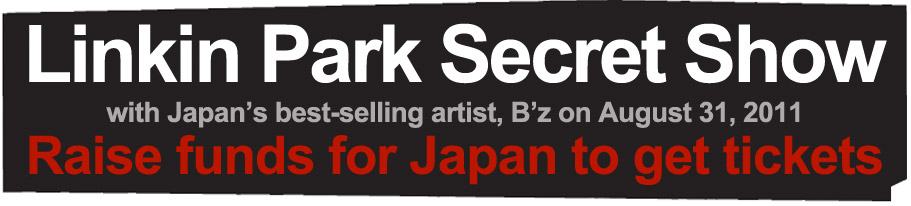
Linkin Park is raising relief funds for Japan and playing a secret show for those who help.
Click Take the Challenge to create a page, raise $500, and earn two tickets to the show.
Use the tools provided to promote the cause to your friends and family.
Don't stop at $500. We will award special prizes and experiences to the top fundraisers, including meet & greets, VIP access and signed memorabilia.Click here for more details
Tickets are limited, only the first 500 people to reach the fundraising goal will receive tickets.
100% of net proceeds benefit children affected by the earthquake & tsunami to provide child care services and financial support to children at risk of not continuing their studies, psychological support as well as play zones for those who cannot play outside due to radiation fears.
Old Japanese painting warns of tsunamis, "harbor waves," that surge when funneled
Create a page -- add a photo or a short video and explain the fundraising
Ask friends and followers for Japan relief donations.
Click "share" to promote the cause via Facebook, Twitter, email.
Create a Page, then...
Go back to personalized page by clicking "My Page" at top right. Click "ASK FOR DONATIONS." There are three tabs:
Send a post to friends via Facebook, Twitter, or Google+
Click "send a message" tab to send direct messages to friends on Twitter, Linkedin, Yahoo, Facebook, and other networks.
Click the "send e-mail" tab to email friends, family, followers, and coworkers. Just click "add contacts," add a few email addresses, or import them from Gmail or Hotmail, select the friends to send a personalized email, then click "send." Check the box, and click "send" to send yourself an email to forward to contacts.
"They can take EDC out of Los Angeles, but they can't take Los Angeles out of EDC" (insomniac.com)
LAS VEGAS, Nevada - Wisdom Quarterly has covered this rave with the question of whether marathon dancing to techno, electronica, house, or any other music has any residual spiritual benefits -- losing the illusory sense of limited and separate ego,* meditation, urban shamanism, yoga...
The Electric Daisy Carnival is a massive corporate rave. It makes so much money through ticket sales and generates so much more residual profit for cities that it has grown to include multiple cities in the same year:
While it certainly can feel "spiritual," largely due to dissociating from a limited sense of individuality and realizing the inter-connectedness of all living beings. This is hampered by drug abuse, which is rampant at raves. It's easy to become seduced by sensuality -- hard not to be -- and dangerous to think shortcuts to a spiritual sense of Oneness (advaita, non-duality).
There are transcendent moments -- the beats, the fast friends, the lights, the thrill of spectacle. But ultimately raves can only be a mind and heart opening. They cannot be the path. In and of themselves, they are not the practice. Even yoga in Los Angeles, which is far more about looks and status markers -- is no spiritual practice, even if a spiritual motivation leads one to explore it. It's a nice adjunct, as dance, exercise, and endurance can be.
Dance, but it won't take anyone as far as a dedicated Buddhist practice. It's fun, but it won't even take one as far as listening to Eckhart Tolle. And the aftermath -- broke, hung over, craving excitement just like the Buddha's advice to young Sigala:
"There are, young householder, these six unprofitable consequences that result from frequenting shows: "One is ever thinking: (1) Where is there dancing? (2) Where is there singing? (3) Where is there drums? (4) Where is there recitation? (5) Where is there playing? (6) Where is there diversion?"(DN 31)
*Advaita philosophy, or Vedantic Nondualism, has become along with Buddhism one of the most popular spiritual paths being pursued by those interested in enlightenment today. During the past three decades, Advaita has become more widely recognized in the West through the ever-growing popularity of Ramana Maharishi, considered by many to be modern India's greatest spiritual giant.
LA-based Insomniac, Inc. announced that EDC, originally scheduled to be held at the LAs Memorial Coliseum, has been postponed until June 24-25, 2011 and moved to Las Vegas. “Without an executed contract in place at this time, it has become impossible to guarantee to all of the fans and talent that EDC can be produced at this venue this year,” said Pasquale Rotella, CEO of Insomniac. “We are grateful for all of the events we’ve been able to produce at the Coliseum and Sports Arena over the years, and for the support of the fans, Los Angeles, the Coliseum Commission and everyone who has contributed to those events.”
HOLLYWOOD, California - American life, particularly in Los Angeles, is a kaleidoscope of possibilities. Sitting in the heart of the Empire, like ancient Romans wondering what else to dominate, it's our duty to speak out against American abuses all over the world declaring, "Not in our name!"
But never mind. There's rock 'n roll. Los Angeles is awash in concerts this summer. It starts Friday at Against the Stream (Melrose) for mindful music and meditation. Here's an amazing sampling that dredges up the past and dumps it in SoCal this summer:
Led Zeppelin (Jason Bonham)
The Grateful Dead (Furthur at the Greek)
Jethro Tull, Deep Purple, Yes, Styx, Frampton, Steely Dan, Roxy Music (Bryan Ferry), Iggy and the Stooges, Peter Gabriel...
And there are modern-rock festivals galore:
L.A. Rising
Mayhem Festival
Sublime/311 Unity
Warped Tour, Hard Summer Festival, Ink-n-Iron, Hootenany, Reggae 'Pon the Mountain, Rock the Bells (hip hop), Sunset Strip Music Fest, Summer Soulstice, Wango Tango, Powerhouse 2011 (Power 106 hip hop festival)...
These are not the most interesting shows, just the kick start. Music of all stripes is here as if this were the heart of American music, Nashville (not). There's no telling where it ends. See for yourself with the Los Angeles Weekly 6th Annual Summer Concert Guide 2011.
But Los Angeles isn't all music festivals and meditation sessions:
 This revealing and touching film asks, What happens when a generation's ultimate anti-authoritarians -- punk rockers -- become society's ultimate authorities: dads?