Thursday, September 29, 2011

Insight Meditation in Business

(dhamma.org)

Learn how senior business leaders in India across various industries and sectors cope with uncertainty and change in a challenging market environment. In a series of candid interviews, senior executives discuss how the practice of insight meditation (vipassana) enables them to more effectively:
  • manage their stress
  • increase employee engagement of competition
  • make decisions from a base of personal wisdom and authenticity


Vipassana Meditation as Taught by S.N. Goenka
in the tradition of Sayagyi U Ba Khin

There is a special Website related to meditation courses conducted from time to time by S.N. Goenka and his assistant teachers specially for business executives and government officials. For most of his life Goenka worked as a prominent international businessman based in Burma and India. He was a keynote speaker on the subject of spirituality in business at the World Economic Forum in Davos, Switzerland. It was held on January, 2000. He also addressed the World Peace Summit held at the United Nations in August, 2000 and was the keynote speaker at the Spirit in Business Conference (SiB) held in New York City in April 2002. More

Wednesday, September 28, 2011

Doubt and the Buddha's Advice (Kalama Sutra)

Wisdom Quarterly
() Animation begins at Minute 0:36

This is not what the Buddha said to the Kalamas in Kesaputta, India (AN 3.65). But this is how he is commonly quoted.

Buddhism is a call to free inquiry. It is not a free for all, no rules, Zen hipster, polymorphous mess.

Believe something -- but what and why?

(Leashcolon26/Flickr)

We are responsible for what we believe (think), what we understand (know), what we feel (experience as emotion) in response to things, and what we do (karma). It is all a re-action to something. And action is karma.

The Buddha clearly said that those decisions should not come from simply being told something, or because it is tradition, or because it is attributed to some authority.

Moreover, it should not be believed simply because it agrees with reason (which is based on our assumptions about reality). One should not simply buy into a theory one likes. That is no way to know. And what "common sense" would we resort to other than views we prefer?

The Buddha asked the Kalamas, What do you think: When greed, hate, or delusion arise, does it arise for one's own good? No, the Kalamas answered. Does it arise for the good of others? No. Does it arise for the good of both? No.

Therefore, the Buddha responded, since you know this to be true for yourselves, abandon it. You do not need an authority or prophet, a seer or scholar to tell you that. He went on to teach them, reminding them not to abdicate responsibility. We are responsible. Our advice?

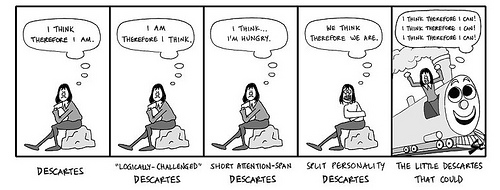
"I think therefore I am"? Descartes was wrong

Wisdom Quarterly
(Leashcolon26/Flickr)

By the way, Rene Descartes was wrong. He is a famous philosopher in the Western tradition. He is most famous for deducing the maxim, "I think therefore I am."

He was wondering and reasoning and questioning. What is true? Do I exist? How can I know? What can I be sure of? As he thought and pondered, he realized that the only thing he could be sure of what that he was thinking.

If I am thinking then I am. I think therefore I am (exist). But it is not true. Based on the evidence, he should only have concluded: "I think therefore there's thinking."

In a sense thoughts think themselves. It is actually more complicated than that: They are dependently-originated. What's that? Dependent Origination is a teaching so subtle that the Buddha declared that it was on account of not seeing, not penetrating this teaching that both he and we had wandered on in this round of suffering.


Wisdom and insight are better than knowledge and thinking.

The "I" he posited was assumed. There was identification with the thinking. And viewing it as personal, he was logically trapped: A self exists. And it has all of these problems, thinking being one of them.

Had he meditated under a tree like Newton or Siddhartha, Descartes might have realized: This is a mess. Thinking is no escape. It leads to logical dead ends and fundamental assumptions. What if I were to let go of thinking and just being?

By not identifying, I might be freed because I have heard said by many, "The Truth shall set us free." It does. Thinking is not the way to enlightenment and liberation. Stillness, samadhi, and insight are.


Meditation is letting go, allowing stillness, then systematically
investigating reality with the Four Foundations of Mindfulness (DN 22).