Showing posts with label liberation by wisdom. Show all posts

Saturday, November 5, 2011

Wisdom Wide and Deep: Jhana and Insight

Shaila Catherine (imsb.org), Wisdom Quarterly


Wisdom Wide and Deep: A Practical Handbook for Mastering Jhana and Vipassana
Wisdom Wide and Deep is an extended introduction to an in-depth training. It emphasizes the application of concentrated attention to profound and liberating insight.

With calm, tranquility, and composure -- established through a practical experience of deep concentration (jhana) -- meditators are able to halt the seemingly endless battle against meditation hindrances, eliminate distraction, and facilitate a penetrative insight into the subtle nature of matter and mind.

It was for this reason that the Buddha frequently exhorted his students, "Develop concentration, for one who is concentrated understands things as they really are."

Wisdom Wide and Deep follows and amplifies the teachings in Shaila Catherine’s first book, Focused and Fearless: A Meditator’s Guide to States of Deep Joy, Calm, and Clarity.

Readers learn to develop this profound stability, sustain an in-depth examination of the nuances of mind and matter, and ultimately unravel deeply conditioned patterns that perpetuate suffering.

This is a practical guide, a fully detailed manual for dealing with the mind. It is sure to become a trusted companion for inner-explorers.

  • Wisdom Quarterly can say without reservation that Shaila Catherine is an extraordinary teacher of the highest order, a consummate practitioner of the Buddha's instructions, and a rare treasure in the world. Her two books set right teachings that had long been upset. She has benefited tremendously by practicing under one of the world's greatest living Buddhist scholar-practitioners, the most venerable Pa Auk Sayadaw. We are not alone in our praise:

Praise from Buddhist authors and teachers

This is a handbook that respects both the ancient tradition and the needs of contemporary lay practitioners, without compromising either. Shaila Catherine presents the Buddha's teaching by blending scriptural references, personal examples, and timeless stories with detailed meditation instructions. More

—Pa Auk Sayadaw, author of The Workings of Kamma

In Wisdom Wide and Deep, Shaila Catherine has laid out a path of practice from the simplest beginnings to profound and subtle insights. Her writing is beautifully lucid, making accessible the inner depths of the Buddha's teachings. This book is a powerful inspiration both for those who would like a glimpse of..." More

—Joseph Goldstein, author of A Heart Full of Peace and One Dharma: The Emerging Western Buddhism

Shaila’s new book converts theory to practice, ideas to application, knowledge about meditation to direct experience. She has written a manual in clear, practical language. It is an excellent follow up to her previous book, Focused and Fearless. The strength of Shaila’s new book is... More

—Christopher Titmuss, author of Light on Enlightenment and An Awakened Life

Shaila's book, Wisdom Wide and Deep is far more than just a handbook -- it is an in-depth, piece-by-piece examination of many of the specific teachings of jhana and insight. It is book that you will study, as opposed to sit down and read through. It is reference book that you will... More

—Phillip Moffitt, author of Dancing With Life: Buddhist Insights for Finding Meaning and Joy in the Face of Suffering.

Shaila Catherine has managed a difficult feat -- to be simultaneously encyclopedic and charming. Her extraordinary clarity and step-by-step approach will embolden some readers to attain jhanic absorption, while others may simply gain... More

—Kate Lila Wheeler, Dharma teacher and author of When Mountains Walked, editor of In This Very Life and The State of Mind Called Beautiful.

The whole spiritual path concerns attitudes and perspectives that we have on things. From there, actions spring up and life unfolds. Shaila Catherine leads us to a completely different way of seeing things by skillfully guiding us through an array of traditional Suttanta and Abhidhamma methods. The precision with which she... More

—Ven. U Jagara

Wisdom Wide and Deep is a clear and comprehensive account of a path of meditation leading to profound levels of concentration and insight. Based primarily on the teachings of the Burmese master Ven. Pa Auk Sayadaw, it also includes a helpful collection of references from classical Theravadan sources. Shaila Catherine has clearly... More

—Guy Armstrong, insight meditation teacher

All of us in our lives need to find the ways to cultivate a mind which is a friend -- calm, clear, insightful and pervaded with kindness. In this book Shaila Catherine has outlined an ancient way to train the mind in stillness and wise attention. More

—Christina Feldman, author of Compassion: Listening to the Cries of the World

Thursday, November 3, 2011

Meditating on Inner Light

Wisdom Quarterly
photo (Sammyundead/Flickr)

The "counterpart sign" (patibagha nimitta) is literally an inner light produced by prolonged attention in meditation. "Where attention goes energy flows" has become a popular slogan of the Law of Attraction movement. Nowhere is it more evident than during sitting practice.

We can worry ourselves sick by focusing on stimuli (thoughts, memories, ideas) that produces alarm. We can lull ourselves into fantasy by reflecting on the pleasant aspects of something. But the way of mindfulness is to take things just as they are without evaluating, judging, or resisting them.

Dispassionate observation leads to detachment and liberation, a temporary release of the heart from the burdens it takes as its own the rest of the time.


Gently, non-judgmentally, serenely bringing the mind back to the meditation object again and again as many times as it wanders will eventually produce a meditation sign. Whether using the breath or a candle flame, an image of the Buddha or a photo (perhaps of oneself) to project loving-kindness (metta) towards are all suitable.

Why does the light not come, and what can be done to invite and encourage it?

First, it is necessary to establish oneself in VIRTUE (five or more precepts) so that the mind/heart are free from reproach. One neither has cause to worry about or regret what one has done or left undone.

Second, it is necessary to focus, collect, and CONCENTRATE the mind on a single object. This means purposely excluding all distractions and other concerns. This is when the light comes as a side effect of purification.

Third, the light itself is not important. But with it one is able to cultivate liberating insight called WISDOM. This is done by applying the mind on four "foundations."

Tuesday, October 18, 2011

Karma, Karma (explained)

Seven, Pa Auk Sayadaw, Bhikkhu Bodhi (Wisdom Quarterly)
The seeds of deeds are in other deeds. From a world to a world, we are led to a world. Mind precedes all states. Mind is their forerunner. From a word to a word, from a deed to a deed, we go on reaping. Every moment holds the possibility for realization/liberation. But with this rare opportunity to awaken, mostly we prefer to go on suffering.

Karma (intentional action capable of yielding results in the future) is very misunderstood. What we do in one life affects us in others. If people refuse to entertain the possibility of having lived countless lives, they are forced to explain everything within one life. We know "what goes around comes around."

But we insist that we know everything that went around in our lives. And most of us claim we are not responsible for anything before the age of 7 (the age of responsibility in various spiritual traditions) or 18 (or whenever society says adulthood begins). This is clearly nonsense.

We do not know what we have done. We are not a single "I." The person who was before is not now, yet the results keep coming. We ask no questions when what comes is pleasant and pleasurable. But whenever it is unpleasant, hard to bear, or terribly painful, we cry foul! We say there is NO reason for it simply we do not know the reason and cannot deduce it from our memory or understanding of how things SHOULD be.


Most motivations are mixed, and karmic results are convoluted.


Karma Works in Mysterious Ways
Things are not as we think they "should" be. And all the world is unfair. But it is fair, in a sense. It plays out according to laws, axioms, regularities. It is orderly in the grand scheme. (It seems terribly disordered in the short term however). If we develop serenity (samatha), absorption (jhana), and mindful-insight (vipassana) we can KNOW and SEE it (karma playing out in an orderly way) for ourselves.

It is directly visible, and always has been, to the uncontaminated mind. Depending on no one and nothing but our own direct knowledge, we can verify that karma as the Buddha explained it (which is quite different than the Vedic brahmin yogis were explaining it or how Hinduism and other traditions now try to explain it) is true. It is amazing.

It works in "mysterious ways" and most of the world simply attributes this "mysterious" force to God. God works in mysterious ways, they say. The God is inscrutable. This is no explanation, but it satisfies the need to know, like the "God of the Gap" atheists decry. Karma is imponderable in detail, but it is very ponderable, very knowable in individual instances. What one deed will go on to cause and be the effect of, that gets very complicated.

The trajectory of a deed (karma) -- what it goes on to cause, contribute to, or serve as a condition for -- is as complex and unpredictable as this neutrino track.

Secret to Abundant Happiness
If we want good (welcome, longed for, pleasant experiences) now and in the future, the motivations of our actions will be rooted in these broad categories: nongreed, nonaversion/nonfear, and nondelusion.
  • These words should not be clung to or debated as to their English meaning because they are simply approximations of the ancient Pali/Sanskrit Buddhist terms alobha, adosa/abhava, and amoha.
There is no need to fool ourselves and say our motivations are good. Karma knows. There is no fooling karma anymore than fooling "God" in a monotheistic tradition.

Is that amazing? Then this should be more amazing. There is no suffering (dukkha, the range of unpleasant sensation ranging from agitation to agony) that is not rooted in craving, aversion/fear, delusion. Bringing these to an end is called realizing nirvana (the end of all suffering).
  • Workings of Karma (paauk.org)
  • The Law of Karma (panel discussion)
  • The Buddha taught that because of karma beings are bound to the ever-turning wheel of rebirth. Only when a person stops [clinging to the deeply held belief in] the existence of a permanent and [independent] self can he or she become free from karma. Westerners often have trouble with this doctrine, for although they can easily believe that selfishness or ego-clinging causes suffering, it is harder to accept the existence of an invisible system of moral causality called karma. Likewise, since the dawn of the Christian era few Westerners have taken seriously the idea of many lifetimes, even though it was present in Pythagoras and some of Plato [and in original Christian doctrine and Shakespeare]. The word "karma" literally means "action." It is cognate with the most ordinary Sanskrit words for "to make" or "to do." ...And there is the famous Hindu practice of seeking liberation through selfless work, which is called karmayoga -- the yoga of activity.

Thursday, October 13, 2011

The Buddha defines "Right View"

Translation and notes based on Maurice O'Walshe, translator, from The Connected Discourses (Samyutta Nikaya, SN 12:15), Wisdom Quarterly


SAVATTHI, Ancient India - [Ven. Kaccayana asked the Buddha:] "'Right view [Note 1], right view,' it is said, venerable sir. In what way is there right view?"

"Kaccayana, the world in general inclines to two extremes in view -- existence [2] and non-existence [3].

"But for one with highest wisdom [from the perspective of ultimate truth] who sees the arising of the world as it really is [4], 'non-existence of the world' does not occur.

"Likewise, for one who sees with highest wisdom the passing away of the world as it really is, 'existence of the world' does not occur.

"Kaccayana, the world, in general, grasps after systems and is imprisoned by dogmas [5]. But one [6] does not go along with that system-grasping, that mental obstinacy and dogmatic bias, does not grasp at it, does not affirm: 'This is my self.' [7]

"One knows without doubt or hesitation that whatever arises is merely dukkha [8], that what passes away is merely dukkha, and such knowledge is one's own, not depending on anyone else.

"This, Kaccayana, is what constitutes right view.

"'Everything exists [9],' this is one extreme [view]; 'nothing exists,' this is the other extreme. Avoiding both extremes the Tathagata [10] teaches a doctrine of the middle: Conditioned by ignorance are the formations... [as § 13]... So there comes about the arising of this entire mass of suffering.

"But from the complete fading away and cessation of ignorance, there comes the cessation of the formations, from the cessation of the formations comes the cessation of consciousness... So there comes about the complete cessation of this entire mass of suffering." Source

NOTES

1. Samma Ditthi: "Right Seeing," the first step of the Noble Eightfold Path, is also rendered "Right Understanding," but the connotations of this are too intellectual. The rendering "Right Views" (plural) is to be rejected, since it is not a matter of holding "views" (opinions), but of "seeing things as they really are."
2. Atthita: "is-ness," the theory of "Eternalism" (sassatavada), the view that the self/soul/ego survives death.
3. Natthita: "is-not-ness," the theory of "Annihilationism" (ucchedavaada), the view that the self/soul/ego is annihilated at death. All forms of materialism come under this term. See discussion in Bhikkhu Bodhi's translation of DN 1 in The All-Embracing Net of Views (cf. Note 51, pp. 30-33.)
4. Yathabhutam: cf n. 57.
5. What we might today call "ideologies" or "isms."
6. I take this to mean the person who sees "with the highest wisdom" mentioned above. Mrs. CAF Rhys Davids seems to have gone slightly astray here [in her translation of this text].
7. Cf. n. 32. Feer's edition of SN reads here "this is not myself"
(atta na me ti), which would also make sense but is contradicted, not only in SA, but also when the story is repeated at III, 90.
8. The usual translation "suffering," always a makeshift, is inappropriate here. Dukkha in Buddhist usage refers to the inherent unsatisfactoriness and general insecurity of all conditioned existence.
9. Sabbam atthi. From the Sanskrit form of this expression, sarvam asti (though used in a slightly different sense) the Sarvastivadin school got its name. They held that dharmas existed in "three times," past, present, and future. It was mainly to this early school that the label Hinayana ("Lesser Career or Vehicle") was applied and later illegitimately transferred to the Theravada (see n. 77).
10. Lit. probably either "Thus come" tatha-agata or "Thus gone (beyond)" (tatha-gata): the Buddha's usual way of referring to himself. For other meanings see The All-Embracing Net of Views (n. 51), pp. 50-53, pp. 331-344.

Monday, October 3, 2011

The Fastest Enlightenment in History (audio)

Audio: Sangharakshita (), Text: Seven (Wisdom Quarterly)


Many jokes and much confusion surrounds enlightenment. Can it be sped up? Or does it come about on its own?

In ancient India there was a radical wrong view that seems to be alive and well in America today with our feelgood New Age views (Guru Oprah, Wayne Dyer, Eckhart Tolle, Byron Katie, The not-so Secret, and clinging to our own wrong views by habit over countless lives).

That radical wrong view is that samsara (the sense of separate or independent existence and suffering in the long cycle of rebirth) is like a ball of yarn: It will unravel and run out by itself. The view is that things will resolve themselves by themselves with no necessity of good effort on our part. But it will not run out on its own.

Samsara, in a sense, is endless. That is not to say that it will never end, but only to point out that it will never end on its own. How is this possible? Imagine a hamster on a wheel. When will the wheel stop turning, stop cycling -- when will the hamster stop "wandering on"?

Never, because there is no end to cycling to such a wheel. Or right now, just as soon as the hamster stops causing the wheel to turn. Samsara does not cycle by itself. Nirvana is available right now.


In ancient India in the Buddha's time, Bahiya of the Barkcloth (Daruciriya) did not know that. He assumed he was enlightened. A deva corrected him. Bahiya was surprised and retorted, Well if I'm not, who is? The deva told Bahiya about the Buddha. Bahiya did everything he could to get to the Buddha right away.

Thus must you train yourself:
In the seen, [let] there...be just the seen
In the heard, just the heard
In the otherwise sensed, just the otherwise sensed
In the cognized, just the cognized [by the sixth sense, mind]...

The Buddha with this one cryptic stanza -- releasing his heart from craving/clinging -- gave Bahiya just what he needed to gain enlightenment right on the spot. It happened so quickly that the monks living with the Buddha, who were not enlightened, were confused.

When did Bahiya have time to gain the liberating vision, knowing-and-seeing things just as they are? The Buddha explained to them what happened to Bahiya and uttered a famous inspired verse of uplift (Udana) partially defining the inscrutable term "nirvana."

Where water, earth, fire, air no footing find
There shine no stars, no sun is there displayed
There gleams no moon, no darkness there is seen
So when the sage, a noble one, by wisdom
[From illusion] hath pierced unto the Truth
From form and no-form, pleasure and pain
S/he is freed!

Friday, September 30, 2011

Occupy Los Angeles (Oct. 1, 2011)

Wisdom Quarterly, Kloncke.com, OccupyLA.org
Let's our country back from bankers and police state officials by occupying it from coast to coast, from Wall Street and downtown Los Angeles. We are the 99% being destroyed by 1%.

[Kloncke] began gathering some friends into a group we call Bay Area Radical Sangha (BARS). BARS is a space for meditators with "radical" politics. How is that defined? Structural critiques of our racist, hetero-patriarchal, war-reliant, capitalist system.
Instead, we support one another in contemplative practice and development. Having met and talked with many of you, I know for a fact that everyone has something wonderful to contribute.

If you are established in some sort of contemplative practice (it does not have to be Buddhist, although this is the foundation of the group) and would like to join in building a committed, holistic center of radical struggle, you are warmly welcomed and appreciated. The first BARS meets in the San Francisco Bay Area. New groups are forming in New York at Occupy Wall Street and Los Angeles at this weekend's launch.

All are welcome to stand up in a peaceful demonstration (occupyla.org)

() Consider donating $9.17 to a Media Fund to continue reports from the front line. OccupyWallStreet.org

Police State Brutality on Wall Street

() This is a slow motion video analysis of the NYPD's mace/pepper spray deployment near Wall Street on Sept. 24, 2011. Alternate angle analyses indicate that this crime was retaliation for an immediately preceding interaction between an officer and some individuals on the sidewalk. More information and updates.

Wednesday, September 28, 2011

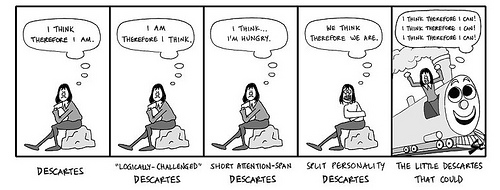
"I think therefore I am"? Descartes was wrong

Wisdom Quarterly
(Leashcolon26/Flickr)

By the way, Rene Descartes was wrong. He is a famous philosopher in the Western tradition. He is most famous for deducing the maxim, "I think therefore I am."

He was wondering and reasoning and questioning. What is true? Do I exist? How can I know? What can I be sure of? As he thought and pondered, he realized that the only thing he could be sure of what that he was thinking.

If I am thinking then I am. I think therefore I am (exist). But it is not true. Based on the evidence, he should only have concluded: "I think therefore there's thinking."

In a sense thoughts think themselves. It is actually more complicated than that: They are dependently-originated. What's that? Dependent Origination is a teaching so subtle that the Buddha declared that it was on account of not seeing, not penetrating this teaching that both he and we had wandered on in this round of suffering.


Wisdom and insight are better than knowledge and thinking.

The "I" he posited was assumed. There was identification with the thinking. And viewing it as personal, he was logically trapped: A self exists. And it has all of these problems, thinking being one of them.

Had he meditated under a tree like Newton or Siddhartha, Descartes might have realized: This is a mess. Thinking is no escape. It leads to logical dead ends and fundamental assumptions. What if I were to let go of thinking and just being?

By not identifying, I might be freed because I have heard said by many, "The Truth shall set us free." It does. Thinking is not the way to enlightenment and liberation. Stillness, samadhi, and insight are.


Meditation is letting go, allowing stillness, then systematically
investigating reality with the Four Foundations of Mindfulness (DN 22).

Friday, September 2, 2011

The Cow Sutra! (AN 9.35)

"The Cow," Gavi Sutta (AN 9.35), derivative translation by Seven (Wisdom Quarterly)


[The Buddha:] "Suppose there were a mountain cow -- foolish, inexperienced, unfamiliar with its field, unskilled in roaming on rugged mountains -- and it were to think, 'What if I were to go in a direction I have never gone before, eat grass I have never eaten before, drink water I never drank before?'


"It would lift its hind hoof without having firmly placed its front hoof and [as a result] would not go in a direction it had never gone before, eat grass it had never eaten before, or drink water it never drank before.


"And as for the place where it was standing when the thought occurred, 'What if I were to...' it would not return there safely.


"Why? It is because it is a foolish, inexperienced mountain cow, unfamiliar with its field, unskilled in roaming on rugged mountains.


"In the same way, there are cases where a meditator -- foolish, inexperienced, unfamiliar with his or her field, unskilled in withdrawing from sensuality, withdrawing from unskillful states, and entering and remaining in the first absorption, which is characterized by rapture and happiness born of withdrawal, accompanied by applied and sustained attention -- does not stick with a meditation object, does not develop it, pursue it, or become firmly established in it [i.e., does not learn and practice the mastery of each absorption].


"The thought occurs to that meditator, 'What if I, with the stilling of applied and sustained attention, were to enter and remain in the second absorption, which is characterized by rapture and happiness born of concentration, intensification of awareness free from applied and sustained attention.'


"That meditator is not able... to enter and remain in the second absorption... The thought occurs, 'What if I... were to enter and remain in the first absorption... [but] is not [even] able... to enter and remain in the first absorption.


"This is called a meditator who has slipped and fallen on both sides, like the mountain cow, foolish, inexperienced, unfamiliar with its field, unskilled in roaming on rugged mountains.


SMART COW

"But suppose there were a mountain cow -- wise, experienced, familiar with its field, skilled in roaming on rugged mountains -- and it were to think, 'What if I were to go in a direction I have never gone before, eat grass I have never eaten before, drink water I never drank before!'


"It would lift its hind hoof only after having firmly placed its front hoof and [as a result] would go in a direction it had never gone before... drink water it never drank before. And as for the place where it was standing when the thought occurred, 'What if I were...,' it would return there safely.


"Why? It is because it is a wise, experienced mountain cow, familiar with its field, skilled in roaming on rugged mountains.


FOUR MATERIAL JHANAS

"In just the same way, there are cases where a meditator -- wise, experienced, familiar with the field, skilled in withdrawing from sensuality, withdrawing from unskillful states, entering and remaining in the first absorption, which is characterized by rapture and happiness born of withdrawal, accompanied by applied and sustained attention -- stays with a meditation object, develops it, pursues it, and becomes firmly established in it.


"The thought occurs, 'What if, with the stilling of applied and sustained attention, I were to enter and remain in the second absorption, which is characterized by rapture and happiness born of concentration, intensification of awareness, free from applied and sustained attention?'


"Without yet ascending to the second absorption -- but with the stilling of applied and sustained attention -- that meditator enters and remains in the second absorption, which is characterized by rapture and happiness born of concentration, intensification of awareness, free of applied and sustained attention.


"One stays with that meditation object, develops it, pursues it, and becomes firmly established in it.


"The thought occurs, 'What if, with the fading of rapture, I... were to enter and remain in the third absorption...' Without yet ascending to the third absorption, but with the fading of rapture, one remains equanimous, mindful, and alert, and experiences pleasure with the body. One enters and remains in the third absorption, of which the Noble Ones say, 'Equanimous and mindful, one abides joyfully.'


"One maintains that meditation object, develops it, pursues it, and becomes firmly established in it.


"The thought occurs, 'What if I... were to enter and remain in the fourth absorption...' Without yet ascending to the fourth absorption, but with the abandoning of both rapture and happiness -- and the earlier fading away of both pleasure and pain -- one enters and remains in the fourth absorption, which is characterized by equanimity [impartiality] and mindfulness, neither-pleasure-nor-pain.


"One keeps that meditation object, develops it, pursues it, and becomes firmly established in it.


FOUR IMMATERIAL JHANAS

"The thought occurs, 'What if I... were to enter and remain in the dimension of boundless space.' Without yet ascending to the dimension of boundless space, but with the complete transcending of perceptions of [physical] form, with the disappearance of perceptions of resistance, and not heeding perceptions of diversity [mental proliferation], [perceiving,] 'Space is boundless,' one enters and remains in the dimension of boundless space.


"One maintains that meditation object, develops it, pursues it, and becomes firmly established in it.


"The thought occurs, 'What if I... were to enter and remain in the dimension of boundless consciousness.' Without yet ascending to it, but with the complete transcending of the dimension of boundless space, [perceiving,] 'Consciousness is boundless,' one enters and remains in the dimension of boundless consciousness.


"One maintains that meditation object, develops it, pursues it, and becomes firmly established in it.


"The thought occurs, 'What if I... were to enter and remain in the dimension of nothingness [no-thing-ness, one of the 31 Planes of Existence, also called the sphere of the void].'


"Without yet ascending to the dimension of nothingness, but with the complete transcending of the dimension of boundless consciousness, [perceiving,] 'There is no-thing,' one enters and remains in the dimension of nothingness.


"One maintains that meditation object, develops it, pursues it, and becomes firmly established in it.


"The thought occurs, 'What if I... were to enter and remain in the dimension of neither-perception-nor-non-perception.' Without yet ascending to it, but with the complete transcending of the dimension of nothingness, one enters and remains in the dimension of neither-perception-nor-non-perception.


One maintains that meditation object, develops it, pursues it, and becomes firmly established in it.


ATTAINMENT OF CESSATION

"The thought occurs, 'What if I, with the complete transcending of the dimension of neither-perception-nor-non-perception, were to [emerge from the absorptions and, if one is at least a non-returner, were to] enter and remain in the cessation of perception and feeling.'


"Without yet going to the cessation of perception and feeling, but with the complete transcending of the [highest and subtlest absorption (jhana) known as the] dimension of neither-perception-nor-non-perception, one enters and rests in the cessation of perception and feeling.


"When a meditator [frequently a monastic] enters and emerges from that very attainment, the mind is pliant and malleable. With this pliant, malleable mind, limitless concentration is available.


"With this limitless concentration, whichever of the six higher knowledges one turns one's mind to know and see, one can witness it whenever there is an opening.


MAGICAL POWERS

"Moreover, if one wishes, one wields manifold supernormal powers: Having been one, the adept meditator becomes many; having been many, the adept becomes one.


One appears, disappears, goes unimpeded through walls, ramparts, and mountains as if through space; dives in and out of the ground as if it were water; walks on water without sinking as if it were dry land; sitting crosslegged flies through the air like a winged bird; extending a hand, touches and strokes even the Sun and Moon, so mighty and powerful; goes physically exercises influence over this body even as far as the brahma worlds [supreme divine planes of existence].


"All of this is possible whenever there is an opening.


"If one wishes, one hears -- by means of the divine ear, purified and surpassing the human -- both kinds of sounds, divine and human, whether near or far. One knows and [hears] this whenever there is an opening.


"If one wishes, one knows the mind of other beings, other individuals, having encompassed them with one's own mind. One knows a mind beset by passion as a mind beset by passion, and a mind free of passion as a mind free of passion... a mind beset by aversion... a mind beset by delusion... a contracted mind as a contracted mind, and a scattered mind as a scattered mind.... an expanded mind as an expanded mind, and a shrunken mind as a shrunken mind..... an excelled [surpassable] mind as an excelled mind, and an unexcelled mind as an unexcelled mind.... a concentrated mind as a concentrated mind, and an unconcentrated mind as an unconcentrated mind.... a released mind as a released mind, and an unreleased mind as an unreleased mind.


"One knows and sees this whenever there is an opening.


"If one wishes, one recollects manifold past lives (lit. previous abodes of existence), that is, one birth, two births, three births, four, five, ten, 20, 30, 40, 50, 100, 1000, 100000, many aeons of cosmic contraction, many aeons of cosmic expansion, many aeons of cosmic contraction and expansion, [recollecting]:


"'There I had such a name, belonged to such an extended family, had such an appearance. Such was my food, such my experience of pleasure and pain, such the end of my life. Passing away from that state, I was reborn [lit. reappeared] there. There, too, I had such a name, belonged to such an extended family, had such an appearance. Such was my food, such my experience of pleasure and pain, such the end of my life. Passing away from that state, I was reborn here.'


"Thus one recalls manifold past lives in general and in detail. One knows and sees this for oneself whenever there is an opening.


"If one wishes, one sees -- by means of the divine eye, purified and surpassing the human -- beings passing away and reappearing [being reborn], and discerns how they are inferior and superior, beautiful and ugly, fortunate and unfortunate in accordance with their karma:


"'These beings -- who were endowed with unwholesome conduct of body, speech, and mind, who reviled [insulted, disregarded] the Noble Ones [ariya, i.e., anyone who has attained any of the stages of enlightenment], held wrong views, and who undertook actions under the influence of wrong views -- with the breakup of the body, after death, such beings have reappeared on a plane of deprivation, in an unfortunate destination, the lower realms, even the hells.


"But these [other] beings -- who were endowed with wholesome (kusala) conduct of body, speech, and mind, who did not revile [but who listened and regarded] the Noble Ones, who held right views, and who undertook actions under the influence of right views -- with the breakup of the body, after death, such beings have reappeared in fortunate destinations [human plane and higher], even in heavenly worlds.'


"Thus -- by means of the divine eye, purified and surpassing the human -- one sees beings passing away and reappearing, and discerns how they are inferior and superior, beautiful and ugly, fortunate and unfortunate in accordance with their karma.


"One knows and see all this for oneself whenever there is an opening.


"Then if one wishes, through the stilling of mental proliferation, one remains in the unsurpassed freedom of mind, freedom of heart, freedom through wisdom, full liberation here and now.


"One knows and sees all this for oneself whenever there is an opening."

For free distribution. This work may be republished, reformatted, reprinted, and redistributed in any medium. It is the author's wish, however, that any such republication and redistribution be made available to the public on a free and unrestricted basis and that translations and other derivative works be clearly marked as such.

Friday, June 10, 2011

Why We Love Trees (Tree Hugger's Ball)

We love trees. And what better way to show it than to save them, meditate under them, and hug them? The Buddha was born under a Sal tree in Lumbini Garden.

During his quest, he sought shelter under a great Sal tree. There he realized that a course of austerities was no way to enlightenment; then, mistaken for a tree spirit (dryad or bhummi-deva), he was fed good food that fortified him for the more difficult effort of balancing striving-and-receiving.

He then sat under a Bodhi tree and reached enlightenment. He taught under trees, taught others to sit under trees, and frequently retreated to the forest alone to enjoy the silence and bliss of meditation under trees.

Such was his experience under the canopy that when it came time to pass into final nirvana, he laid out between twin Sal trees. He joyfully said goodbye, gave his last words of advice -- "All conditioned-phenomena are hurtling towards destruction; work out your liberation with diligence" (Parinirvana Sutra) -- then entered the purifying absorptions (jhanas) before going beyond:

"Gone, gone, gone beyond, gone altogether beyond, O what an awakening, so it is!" (the Heart of Perfect Wisdom Sutra mantra)

(OC Weekly: Tree Hugger's Ball)

It’s that time of year again -- the annual Tree Hugger’s Ball takes over Silverado, and OC’s eco-maniacs get their day in the Sun. The afternoon begins with the Go Green Expo, an environmental fair dedicated to teaching everyone how to do just that via food, art, auctions, shopping, costumed dancers, and information about alternative energy and fuel-efficient vehicles. Eco-hero Daryl Hannah is the night’s guest speaker; she’ll be followed by bands playing folk, Appalachian music and “environmental blues” (gas prices, oil wars?) and dancing until midnight. Guests are encouraged to wear their own earthy costumes. It is a ball after all.

Friday, May 20, 2011

"Right view, right view! What is right view?"

Wisdom Quarterly based on Phra Thanissaro translations (accesstoinsight.org)<span class=
(energyenhancement.org)

"Right view" is the first of the eight factors of the Noble Eightfold Path, belonging to the wisdom division of the path as distinct from the other two divisions, virtue and concentration.

Definition

"What is right view? Ultimately it is fully penetrating the Four Ennobling Truths with insight. Wisdom with regard to suffering (unhappiness, ill, woe, pain, sorrow, distress), the origination of suffering, the cessation of suffering, and the way of practice leading to the end of suffering. This is called right view" (DN 22).

Relation to the other Path factors

"And how is right view the forerunner? One discerns false view as false view, and right view as right view. This is one's right view. And what is false view? '[The belief that] there is nothing given, nothing offered, nothing sacrificed. There is no fruit or result of good and bad deeds. There is no this world, no world to come, no [special significance in deeds done towards one's] mother, no father, no instantaneously reborn beings; no brahmins or ascetics who, living rightly and practicing rightly, explain this world and future worlds after having directly known and realized them for themselves.' This is false view...

"One abandons false view to replace it with right view: This is one's right effort. One is mindful to abandon false view to replace it with and maintain right view: This is one's right mindfulness. Thus these three qualities -- right view, right effort, and right mindfulness -- run and around right view" (MN 117).

Consequences of false view

The Ignoble Eightfold Path: "In a person of (1) wrong [incorrect or false] view, (2) wrong intention comes into being. In a person of wrong intention, (3) wrong speech. In a person of wrong speech, (4) wrong action. In a person of wrong action, (5) wrong livelihood. In a person of wrong livelihood, (6) wrong effort. In a person of wrong effort, (7) wrong mindfulness. In a person of wrong mindfulness, (8) wrong concentration. In a person of wrong concentration, wrong knowledge. In a person of wrong knowledge, wrong liberation. This is how wrongness leads to failure not success" (AN 10.103).

Results of right view

The Noble Eightfold Path: "When a person has (1) right view, (2) right intention, (3) right speech, (4) right action, (5) right livelihood, (6) right effort, (7) right mindfulness, (8) right concentration, right wisdom, and right liberation, whatever bodily deeds one undertakes in line with that [correct] view, whatever verbal deeds... whatever mental deeds one undertakes in line with that view, whatever intentions, whatever vows, whatever determinations, whatever fabrications, all lead to what is agreeable, pleasing, welcome, profitable, and uplifting. Why? It is because such view is auspicious.

"Just as when a sugarcane seed, rice grain, or grape seed is placed in moist soil, whatever nutriment it takes from the soil and water, all of that conduces to its sweetness, tastiness, and delectability. Why? It is because the seed is auspicious. In the same way, when a person has right view... right liberation, whatever bodily deeds one undertakes in line with such view, whatever verbal deeds... whatever mental deeds one undertakes in line with such view, whatever intentions, whatever vows, whatever determinations, whatever formations, all lead to what is agreeable, pleasing, welcome, profitable, and uplifting. Why? It is because such view is auspicious" (AN 10.104).

A Thicket of Wrong Views

"There is the case where an uninstructed, ordinary worldling [not acquainted with the liberating Dharma]... does not discriminate and discern which ideas are fit for attention, which unfit. This being so, one does not attend to ideas fit for attention but attends instead to unfit ideas... This is how one attends unprofitably:

  • 'Was I in the past? Was I not in the past?
  • What was I in the past? How was I in the past?
  • Having been what, what was I in the past?
  • Shall I be in the future? Shall I not be in the future?
  • What shall I be in the future? How shall I be in the future?
  • Having been what, what shall I be in the future?'
Or else one is inwardly perplexed about the present:

  • 'Am I? Am I not?
  • What am I? How am I?
  • Where has this being come from?
  • Where is it bound?'

"As one attends unprofitably in this way, one of six kinds of view arises:

  1. The view, I have a self arises as true and established.
  2. Or the view, I have no self...
  3. Or the view, It is by means of self that I perceive self...
  4. Or the view, It is by means of self that I perceive not-self [the impersonal nature of being]...
  5. Or the view, It is by means of not-self that I perceive self arises as true and established.
  6. Or else one forms a view such as: This very self of mine -- the knower who is sensitive here or there to the ripening of good and bad deeds (karma) -- is the self belonging to me that is constant, everlasting, eternal, not subject to change, and will endure forever.
This is called a thicket of views, a wilderness of views, a contortion of views, a writhing of views, a fetter of views.

Bound by a fetter of views, the uninstructed ordinary worldling [not acquainted with the liberating Dharma] is not freed from birth, aging, and death, from sorrow, lamentation, pain, distress, and despair. One is not freed, I tell you, from suffering and sorrow.

"But the well-instructed disciple [acquainted with the liberating Dharma] of the noble ones... discriminates and discerns which ideas are fit for attention, which unfit. This being so, such a person does not attend to ideas unfit for attention but attends [instead] to fit ideas... One attends profitably:

  1. This is suffering...
  2. This is the origination of suffering...
  3. This is the end of suffering...
  4. This is the way leading to the end of suffering.
As one attends profitably in this way, three fetters are abandoned: identity-view [the view that there is an eternal self], doubt, and clinging [to the view that liberation is attainable through mere] rites and rituals" (MN 2).

When is knowledge independent of others?

[The monk Kaccayana:] "Venerable sir, 'Right view, right view,' it is said. To what extent is there right view?"

[The Buddha:] "By and large, Kaccayana, this world is supported by [or holds the view of] polemical extremes of existence and non-existence.

"But when one sees the origination of the world [the Five Aggregates of clinging to impersonal material and mental phenomena as a self] as it truly is with right view, 'non-existence' with regard to the world does not occur to one.

"When one sees the cessation of the world as it actually is with right view, 'existence' with regard to the world [the Five Aggregates of being or of existence] does not occur to one.

"By and large, Kaccayana, this world is in bondage to attachments, clingings [sustenances], and biases. But one such as this does not get involved with or cling to these attachments, clingings, fixations of attention, biases, or obsessions. Neither is one resolved on 'myself.'

"One has no doubt or uncertainty that, when there is arising, only suffering and unsatisfactoriness is arising. And when there is passing away, only suffering and unsatisfactoriness is passing away.

"In this, one's knowledge is independent of others. It is to this extent, Kaccayana, that there is right view" (SN 12.15).

Abandoning the unskillful, developing the skillful

[The central message of the Kalama Sutra:] "Do not go by reports, by legends, by traditions, by scriptural authority, by logical inference, by conjecture, by analogies, by agreement through pondering views, by probability, or by the thought, 'This guru is our teacher.'

"But when you yourself know, 'These qualities are unskillful; these qualities are blameworthy; these qualities are condemned by the wise; these qualities, when adopted and performed, lead to harm and to suffering' -- then abandon them...

"When you yourself know, 'These qualities are skillful; these qualities are blameless; these qualities are praised by the wise; these qualities, when adopted and performed, lead to everyone's welfare and happiness' -- then adopt and keep them" (AN 3.65).

Sunday, May 15, 2011

Buddhism turns 2,600 years old

Dharmachari Seven (Wisdom Quarterly)

"Moon of the Buddha" by Albert Falzon (English overdubbed in Spanish)

May's full moon day (May 17, 2011) will officially mark the twenty-sixth century of Buddhism.

Two-thousand six-hundred years ago, Siddhartha Gautama culminated six years of renunciation, moral-restraint, meditation, and keen investigation of mental phenomena with a startling realization:

"Everything that is of a nature to arise is of a nature to cease." Having purified and balanced his mind by successive practice of the eight meditative absorptions (jhanas), he emerged and began to contemplate Dependent Origination.

The Path to Complete Freedom
This is a formula or technique that leads to insight into the true nature of things -- revealing their radical impermanence, unsatisfactoriness, and impersonal nature. A glimpse of the Truth causes the mind/heart to pull back and away from the corruptions (lust, anger, delusion) like a feather dropped in fire. The mind thus freed perceives nirvana, touches it, enters the first stage of enlightenment.

This momentous step -- after an inconceivably long course of "wandering on" through birth and death (innumerable past lives and states of becoming) -- begins the process of full liberation from suffering.

Under the Bodhi Tree
We are often swept up with the misleading story of the Buddha's heroic effort, fighting temptation and fear: Siddhartha sat down, gritted his teeth, vowed not to stand until he attained his goal of enlightenment even if his blood and skin should shrivel up and turn to dust, in spite of Mara's fearsome attacks and his own self-doubt.

This is exactly the wrong notion that prevented enlightenment. It was not Siddhartha's fierce determination that ultimately allowed his heart/mind to find the Truth. Too much "efforting" fills the heart with yearning, strains the mind, and wearies the body. The breath ("spirit") is then anything but calm, subtle, soothing, or serene.

The Middle Way
In this way, no realization is possible. The Bodhisattva (the buddha-to-be) had for years failed in his efforts exactly because of this sort of strenuous striving and fierce determination. The "Middle Path" avoids extremes of striving/laziness, austerity/luxury, rigidity/limpness, or views. It invites balance and direct-knowledge.

In our world so filled with lust, greed, and lassitude, we need to hear the message of strong determination. But in a world of annoyance, hate, and drive, we need to hear the other side of the story -- the letting go, the letting be, the mindful (or non-thinking, non-striving, non-preference, non-judgmental) attention.

The meditative absorptions allowed Siddhartha to maintain equanimity in the face of keen investigation. He was observing, not "doing." He was practicing mindfulness (bare attention), not discursive thinking.

The purity of heart/mind cleansed by deep concentration/collectedness (samadhi) allowed his insight-practices (vipassana) to succeed. Indeed, two of the most important arms of the ennobling Eightfold Path are "right concentration" and "right mindfulness." "Right" simply means balanced, optimal, effective, not strenuous, dogmatic, or driven.

That First Vesak Day
For a long time (innumerable aeons) we have wandered on this weary trail of rebirth, lusting here, lusting there, ever in search of satisfaction, meaning, and peace. We do not find them for very long. Good states and situations pass away. When the mind is brightened by absorption and brought to bear on insight-practices -- nirvana. That's it! There it is! And finding it Siddhartha, now the Buddha, is reputed to have exclaimed:

"I who wept with all my brothers' tears, laugh and am glad, for there is liberty!"

What was it? What eternal truth did he rediscover? Nirvana, nirvana, what is this "nirvana"?

  • Nirvana. nir-va, to blow out. According to ancient lore, complete freedom; according to Buddhist lore, liberation. The goal of Buddhism is the condition of [enlightened individual,] one who has achieved nirvana: a condition where there is neither earth nor water nor fire nor air; neither infinite space nor infinite consciousness; nor the sphere of void, nor the sphere of perception or non-perception. It is the end of woe. (Yoga Illustrated Dictionary, Kaye & Ward).