Showing posts with label buddhist enlightenment. Show all posts

Monday, October 24, 2011

Unraveling Mind and Body (Part I of II)

Ayya Susila and Yogi Seven (Wisdom Quarterly)


It is said that “mind leads the world.” Is it true? We will only really know when we understand how the mind works. Mind seems at times close and at times far away. Mind is both the culprit behind unwholesome deeds and also the director of all heart-soothing behavior.

The study of the Abhidharma (Buddhism's "Higher Teachings" on ultimate reality) helps us gain an understanding of how the mind works, which is essential for leading a happy and blameless life.

According to the Abhidharma, the ultimate realities that make up mind and matter making, which we call "self" or "soul" are revealed. They are actually an impersonal stream of mind-moments (cittas) and infinitesimally small particles (kalapas). Both continuously arise and pass away, utterly dependent on conditions.

The study of the Abhidharma is an antidote to the painful illusion of a permanent self, ego, or “I.”


Most problems in life spring from our ignorance and craving regarding this “I” and the selfishness that is its offspring.

But when we understand that -- ultimately speaking -- there is no “I,” we are finally able to let go of our intense clinging and thereby to let go of all suffering.

The truth sets one free. It is an escape to reality and away from the illusion that wash over us like a great flood. The heart is set free of affliction. Life’s problems suddenly disappear by a change of perception, understanding truth for truth.

How would we ever accomplish this? The Buddha’s gradual instruction guides us through a practical study of Abhidharma and, more importantly, meditative experience. There is no reason to be bogged down by intellectual grasping. Far more important is the application of the principles. For instance, we can debate for a lifetime whether there are four great elements (earth, fire, water, wind), or five (space), or none at all. Or we can practice four elements meditation as the Buddha instructed.

Then whatever we might choose to label the characteristics of matter, the truth about materiality remains the same. But we are changed, and our relationship to it is changed. We no longer regard it as me or mine. And freed from this illusion, we are at peace.

But "who" is at peace. How can the self realize not-self? How can all I regard as me or mine (my form, feelings, perceptions, mental formations, and consciousness) ever see that that is not me, not mine?

The Abhidharma shows the way. While it appears to be an inscrutable paradox, it is in practice very clear. How can what is changing at every moment, what is painful, what is beyond my control be "me" or be considered "mine"? How can it be anything but impersonal?

But whether it is personal or impersonal, me or not me, self or non-self should not be decided in advance. The Buddha advised us to investigate. And we should be fearless, like scientists knowing full well their hypothesis can be disproved (refuted, found to be false or in error).

I assert that I AM. Now I will test that assertion. By "I" I mean this body. Well, I know I'm not this body. But this body is mine? I can test that, too.

By "I" I actually mean this soul (consciousness, heart, mind, spirit, memory, history, ghost, energetic body, DNA, lineage... software package). Well, I don't know if I am, but I can test it.


The Buddha asserted that all that we typically regard as our "selves" can be summed up in five categories or heaps. He called these heaps the Five Aggregates of Clinging. We cling to them as self, as me or mine. They are familiar to us, though often go misunderstood, via the famous Heart Sutra mantra:
  1. form (body, materiality, subtle or tangible)
  2. feeling (sensation, pleasant, unpleasant, or neutral)
  3. perception (what we apprehend, conceptions, discriminations, cognitions)
  4. mental formations (such as volitions, intentions, emotions, memories, impulses, likes and dislikes, opinions... in fact, feelings and perceptions are also "mental formations," only they are so important as to be singled out from other formations and fabrications)
  5. consciousness (awareness, reflection, the knowing that knows it knows, but what does it know other than sights, sounds, bodily impressions, tastes, odors, and ideas, which we give the fancy name "objects of mind," the sixth sense beyond this body?)
According to the Buddha, we see ourselves as these, in these, or apart from these as owners of them. If that is true -- that these are me or mine -- we can test it.

A calm mind is a strong mind. A very calm mind is a very strong mind. If we can clear it of thought and intensify our attention and focus to laser precision, we have something very powerful to work with.

"KNOW THYSELF," all of the ancient traditions say, from India to Greece, from Timbuktu to Nalanda to the Gymnasium to Harvard. So what is this "self"? I don't know. Let's find out!


We can turn the well collected and sharpened mind in on those very things. It is easy enough to examine the mind. And (test it) perception can become so sharp as to directly observe that it is composed of light particles. The Buddha knew this. He was not the first to know it, not the first to speak of it, not the first to show how it is done. But we already know we are not these bodies.

I am my feelings! At least I feel that I am. Of course, by "feeling" is meant sensation not emotion. Emotions are another type of formation (sankhara or samskara). Am I this pleasant, unpleasant, or neutral worldly or otherworldly sensation? The mind can examine each and find out. I see sensations arising with perceptions, born of sense contact with the world. So if I am it, I must also be the body (sense base) and the outside world impinging on the body. Okay, so I might not be the feelings I am experiencing.

Am I what I think about it or how I discriminate it? Am I how I feel about it (happy, sad, up, down, ecstatic, dejected)? I perceive it one way, but it may be another. Or my perception of it can change. I'm probably not that, but I better check back.

Am I my intention? Karma is intention. What I think, speak, or act what determines whether this is profitable, unprofitable, or neutral karma is whether it is rooted in greed, aversion/fear, or delusion or nongreed, nonaversion/nonfear, nondelusion. The first three roots mean that when it ripens it will be unpleasant and unwelcome, but until then it might go either way and make me happy.

The second three roots mean that when it matures and comes to fruition it will be pleasant and welcome, but until then it might go either way and make me unhappy. Being good can feel quite bad, and vice versa, but karma is not deceived. It all balances out in the long run. Am I these intentions, or opinions, or beliefs, or deductions, or what have you? I don't think I am, and I certainly don't feel that I am, but I might be. I better keep examining. Or forget about all that.

I know what I am. I am that I am. I am the Knower, the Watcher, the Soul, the One who has been doing this all along -- consciousness! Aha! Case closed!

Wait, let's not jump to conclusions. The Buddha said investigate. He didn't think he was consciousness. In fact, he saw through consciousness and likened it to a magician's trick (SN 22.95, echoed here). How do I know that I'm the one who knows, the knower? Oops! I see my mistake, I mean the mistake. It is being assumed that there is a knower, but the evidence so far only suggests there is knowing. I've made knowing into a Knower without even realizing it. First principles. Consciousness exists.

But to say someone is conscious is an assumption. Descartes jumped the gun to have said "I think therefore I am." Based on thinking, all that was known was that there was some thinking. Am I the thought? Am I the consciousness itself? That needs investigation. There are six kinds of consciousness, six things to be conscious of -- sights, sounds, savories, smells, touch sensations, and mind objects (extrasensory perceptions, ideas, thoughts, knowings, awareness of being aware, reflections, or whatever is beyond the body's sensory apparatuses).

You know, I'm starting to think the Buddha might have been onto something. But I'm going to investigate because he also said not to go on what others say, or tradition, or scripture, or preferences (Kalama Sutra), which I think is sound advice -- and not because he said it. I'll see for myself.

Hey, I'd better be one of these, or religions teaching me I have a soul and atheists tell me I have a self are going to have a lot to answer for, although I do wonder if I ever understood what they meant. Only Buddhism, on a buddha, teaches the liberating wisdom of nonself (anatta). It is unique to a fully, supremely enlightened teacher. But one can't help but notice how all of them are saying selfishness and self-centeredness, vaulting pride and ego are harmful delusions to be overcome by unselfishness, generosity, charity, and caring.

I really think the Buddha was onto something, but I'm not at all sure I'm up to the task of enlightenment (bodhi) and liberation (nirvana). After all, I didn't actually follow the first step, which was to purify my mind/heart through the effort of virtue (sila) and absorption (zen) in meditation.

So far I have only been intellectualizing and conducting a mental experiment. Buddhism is not about "thinking" and hammering things out by mere reasoning. This is a Wisdom Tradition. This is about real knowing. (The Buddha solved the philosophical tangle of epistemology, the ultimate question of questioners: "How do we know that we know, and how can we be sure?")


So long as we only think, there is no knowing. Knowing comes from direct experience of the truth. Nirvana, for example, is not something that could ever be conceptualized, yet it can be experienced and known here and now. It's not a feeling, so to say it's "women's intuition" if off the mark.

There is a certainty that surpasses all understanding. There is knowing. And mere thinking is not the way to it. I have a heart and a head, and this head is capable of far more than rationalism. It's capable of insight, wisdom, and enlightenment.

When I know, I'll know that I know. And the only way to that is practice with a well purified instrument of knowing. I may be thinking now, but in meditation I will be investigating.

What is the Abhidharma?

Buddhism is divided into three collections or divisions -- conventional discourses (sutras), disciplinary code (Vinaya), and the Higher Teachings (Abhidharma).

Abhidharma
is a combination of abhi (means higher, special, or sublime) and Dharma, which means teaching or universal truth. Abhidharma is therefore the higher or ultimate teaching of the Buddha. It is grounded in the reality of experiential truth.

It is not metaphysical theory, as some portray it, but a description of what is possible for meditators to directly know, and it leads to enlightenment.

The Abhidharma system classifies and fully explains mental and material phenomena. This is why the oldest existing Buddhist tradition -- the Theravada or "Teaching of the Elders," who were the immediate disciples of the historical Buddha -- regards Abhidharma as the best exposition of the true nature of existence as realized by the penetrative wisdom of the Supremely-Enlightened One and those who successfully practice the path.

According to Buddhism ,as elaborated in the Abhidharma system, there are two types of truth (sacca), conventional (sammuti) and ultimate (paramattha).

Conventional truth refers to ordinary concepts such as “tree,” “house,” “person,” “body,” “being.” Such concepts are linked to language, culture, and conditioning. We may think these concepts are objective realities that actually exist. After all, there are words and concepts for them. But while they seem to exist, closer examination reveals that they in no way exist as irreducible realities.

Instead, incredibly, they break down into smaller and smaller components. For example, if we discern the four elements (or characteristics of matter) in this body, the "body" breaks down into innumerable, infinitesimally tiny particles. If the analysis continues, these particles break down further. Each contains... TO BE CONTINUED

But the mind or mentality is more relevant than the body or materiality. And that is what the Abhidharma teaches. And it teaches it to reveal the path to enlightenment in this very life.

Remember, this is all directly knowable, directly visible to the mind/heart purified by intense and prolonged concentration (absorption, jhana) and trained in insight (vipassana). This is the Buddha's Middle Path that avoids extremes in views.

Wednesday, October 5, 2011

After the Enlightenment (Inspired Utterances)

The Buddha's All-Seeing Eyes at the great stupa of Boudanath, just outside of Katmandu, Nepal

After the Great Enlightenment
Wisdom Quarterly translation (Udana, Chapter 1)
1. Thus have I heard. On a certain occasion the Buddha, soon after the attaining supreme enlightenment (buddhahood), was dwelling at Uruvela, on the banks of the river Neranjara, at the foot of the bodhi tree. At that time, remaining in a sitting posture for seven days, he experienced the joy of emancipation.

When the seven days came to a close, the Exalted One arose from that state of jhana (meditative absorption). And in the first watch of the night, he thoroughly intuited/thought out the chain of conditionality in order: "When this (state) is, that (state) comes to be; by the arising of this, that is produced. That is to say (in detail):

Tibetan monk and novice under an enormous quilted thangka

"From Ignorance spring formations, from formations springs consciousness, from consciousness spring mind and material form (mentality-materiality), from mind and material form, the six sense bases [the sensitive portion of bodily organs capable of receiving impressions], from the six sense bases, contact [the meeting of stimuli, impression, and consciousness], from contact, sensations, from sensations, craving, from craving, attachment, from attachment, being, from being, rebirth, from rebirth spring decay, death, sorrow, lamentation, pain, grief, and despair [all of which are collectively referred to as dukkha, which we translate as suffering, distress, or unsatisfactoriness]. Thus this whole mass of suffering originates." And the Buddha in this connection, on that occasion, breathed forth this solemn utterance:

"When the conditions of existence dawn upon the mindful
meditative ennobled person, when one understands the nature
of the
conditional arising of things, then all doubts depart."

2. [Conversely,]..."When this is not, that does not come to be; by the non-arising of this (state), that (state) is not produced. That is to say:

By the dissolution of ignorance, formations are undone, by the dissolution of formations, [the base of] consciousness is undone, by the dissolution of consciousness, mentality-materiality are undone, by the dissolution of mentality-materiality, the [bases of the] six sense organs are undone, by the dissolution of the six sense bases, contact is undone, by the dissolution of contact, sensations are undone, by the dissolution of sensations, craving is undone, by the dissolution of craving, attachment [clinging] is undone, by the dissolution of attachment, [coming into illusory] being is undone, by the dissolution of being, rebirth is undone, and by the dissolution of rebirth, decay, death, sorrow, lamentation, pain, grief, and despair are undone. Thus this entire mass of suffering is brought to an end.

And the Exalted One, in this connection, on that occasion breathed forth this solemn utterance:

"When the conditional constituents of being dawn upon the
mindful meditative ennobled person, when one understands
the dissolution of the causes, then all doubts depart."

3. When the seven days had come to a close, the Buddha One arose from that meditative state. And during the last watch of the night thoroughly intuited/thought out the chain of conditionality from start to finish and back.... Now by the complete dissolution of ignorance, there is a cessation of formations. And the Buddha in this connection, on that occasion, breathed forth this solemn utterance:

"When the conditional constituents of being dawn upon
the mindful, meditative, ennobled brahmin, that person
stands scaring off Mara's armies just as the Sun
diffusing its rays throughout space [scatters the darkness]."


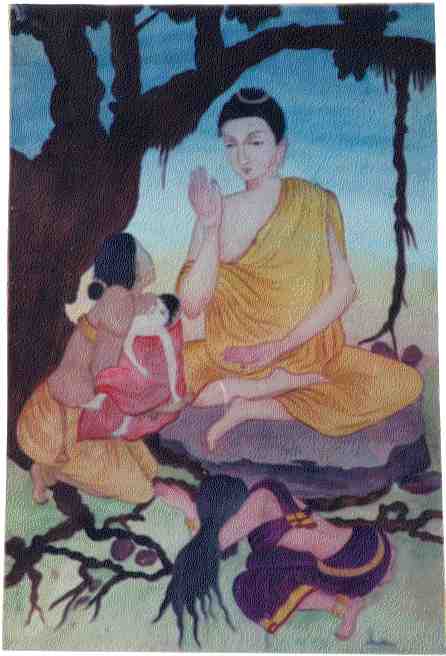
Many came seeking the Buddha's advice after his great awakening, such as Kisagotami (depicted here) asking him to bring her baby back to life. Clever brahmin priests came dispute with a renowned wanderer (shraman) or right their views.

4. Thus have I heard. On a certain occasion the Buddha, soon after attaining buddhahood, was dwelling at Uruvela on the banks of the Neranjara river, at the foot of the Goatherd's Banyan tree. At that time, after remaining in a sitting posture for seven days, experiencing the bliss of emancipation, arose from that meditative state (jhana) at the end of the seventh day.

Now a certain brahmin with a haughty disposition came there and, drawing near, saluted the Buddha. After exchanging compliments of friendship and civility, he stationed himself respectfully at one side. And while standing respectfully at one side said to the Buddha:

"What, Venerable Gautama, is the standard of excellence for a brahmin, and what is the nature of the works he should perform?

The Buddha in this connection, on that occasion, breathed forth this solemn utterance:

"One who has put away doing harm, who is humble, free from
impurity [of mind/heart], self-restrained, versed in knowledge,
leading the high life [not by birth but by one's own actions in
this life], that person may rightly be referred to as a 'brahmin.'
For such a person there are no desires anywhere in the world."

Thursday, July 21, 2011

Path to Enlightenment: No One Strives Alone

Wisdom Quarterly
Young Buddhist novice studies and strives for enlightenment with an entire support network provided free by others (HimalayaCrafts/Facebook)

A bodhisattva is an individual who vows to forego final emancipation until others also find the way to freedom. It is a wonderful -- if often exaggerated, misunderstood, and undermined -- ideal reflecting how we are all interconnected and interdependent.

Everyone must indeed do his/her own striving, but no one need do it alone. Even in the forest, on his quest, Siddhartha could not do it alone. He had a great deal of help, encouragement, and support. Most of this is implicit or ignored because we (as Americans) are "rugged individualists" who prefer stories of remarkable survival, struggle, and success in the face of all odds.
  • But his yogi-gurus Alara Kalama and Uddaka Ramaputra helped
  • Earth-devas (pictured above) helped when they said they would feed the Bodhisattva through his pores if he continued to fast
  • The Five Ascetics (who were his companions on the path of penance and austerities) helped
  • The laywoman Sujata (who fed him a nutritious meal that caused him to realize that the body is not an impediment but a potential boon on the way to enlightenment) helped
  • King Bimbisara (who promised protection and asked him to come back when he accomplished his goal) helped
  • His wife Princess Yasodhara (who watched their son and confidently knew he was out for the good of everyone) helped
  • His family (King Suddhodana, Queen Mahaprajapati, and Maya Devi looking down from the Space World of the Thirty-Three) helped
  • Sakka, King of the Devas of the World of the Thirty-Three (who might have been prompted by Maya Devi to look after the good Siddhartha on his quest) helped protect and later, along with Brahma Sahampati, asked the Buddha to teach the liberating Dharma to the world...
These and perhaps many other beings helped the Bodhisattva until he became the Buddha.

Later bodhisattvas, inspired by such stories of enlightened self-interest manifesting as "sacrifice" for the benefit of others (and therefore of all), also vowed to help save all living beings.


Ksitigarbha Bodhisattva mantra: Om Ba La Mo Ling To Ning Swaha

One excellent example is Ksitigarbha ("Earth-Treasury") Bodhisattva, who vowed:

"Unless the hells become empty, I vow not to attain buddhahood. Until all have achieved ultimate liberation, I shall not consider my enlightenment full..."

There are many "hells" (narakas) in Buddhist cosmology, of incredible duration and unimaginable misery, but none actually eternal.

For this reason, in the Mahayana Buddhist tradition, he is regarded as "caretaker of the world" until the return of the future buddha Maitreya, whose birth is anticipated in 5.7 billion years. (Such is the reckoning of time by the historical Buddha in India, speaking of aeons (kalpas) and the long stretches of time between short periods when the liberating Dharma exists in the world and is able to be learned and practiced.

The wonderful thing, then, is that we are not alone in our quest, our struggle and striving. Others around us -- even apparent, unrelated strangers whom we are connected to -- are helping and ready to help. Beneficial unseen beings are also helping. And we ourselves, often without realizing it, are helping and encouraging others.

Monday, June 20, 2011

Enlightenment blossoms within (gradually)

Sudhir Kumar Jha (Deccan Chronicle, June 19, 2011) with Wisdom Quarterly
Laotian temple wallpainting of the Buddha-to-be undertaking extreme ascetic practices in his quest for enlightenment. A deva or gandharva (messengers of the devas) is overseeing his striving and providing some spiritual protection. The five behind him are said to be his five fellow ascetics, but their head gear suggests they are also devas from one of the many space worlds or "heavens" (squidoo.com).
  • "In a single moment, in one stroke, you can become enlightened. It is not a gradual process [although the Buddha's teaching, the Dharma, is a gradual training], because enlightenment is not something that you have to invent. It is something that you have to discover. It is already there. It is not something that you have to manufacture. If you have to manufacture it, of course, it will take time; but it is already there. Close your eyes and see it there. Be silent and have a taste of it. Your very nature is what I call enlightenment. Enlightenment is not something alien, outside you. It is not somewhere else in time and space. It is you, your very core." — Osho
It took the Buddha years of meditation to re[ach] enlightenment, same with other great thinkers like the Prophet Mohammed, Jesus Christ, Mahavira, and so on.

While each person has a different view about how one can achieve enlightenment, the general notion is that this is a long-term process that involves continuous realization about the integration of the mind, body, and s[pirit].

The truth is that enlightenment is an experience that goes beyond the physical and material realms that we so often exist in.

It is a feeling of being connected to the entire universe, being in sync with it along with the knowledge that you are being surrounded by intelligence and all the information and the vibes that you receive from everything around you is positive.
  • [If this is all "enlightenment" (bodhi) were -- simply "nonduality" (advaita) or "oneness" -- then this article would be correct. But this is not the way Buddhism defines the enlightened state and what it means to attain it.]
During this one realizes that the physical being is just a mask, but what lives is knowledge and the soul.
  • [What is the "soul"? The Buddha defined it as the epiphenomenal result of the Five Aggregates of Clinging. These five groups or "heaps" mean what we call a "soul" is actually a functionally integrated amalgamation of form, sensation, perception, mental formations, and consciousness, none of which is permanent. For this reason it is said that there is no soul or self -- even though there is much to investigate to understand why we are certain there is a self, soul, ego, personality, essence...]
At the core of each of our beings lies the soul [NOT according to the Buddha, who went to great pains to aid in liberated us of the very thing that makes enlightenment and liberation unattainable] -- this is pure and unadulterated.

But now you may ask the question, Why is it then that we have so much negativity in this world if all of our souls are pure? The thing is that a multi-layered fabric called the ego, which is sometimes so tight that it takes much time for the truth to pass through it, covers our souls. [Nonsense gets piled on top of nonsense, nonentity on top of nonentity.]

Getting to the core of one’s being is a process that takes several years, but what keeps one going is the secure knowledge that this is not just an illusion and is something that is within one’s reach. More
A Gradual Training
Access to Insight, Wisdom Quarterly edit


"Just as the ocean has a gradual shelf, a gradual slope, a gradual inclination, with a sudden drop-off only after a long stretch, in the same way this Doctrine and Discipline (Dharma-Vinaya) has a gradual training, a gradual performance, a gradual progression, with a penetration to insight only after a long stretch" (Udana 5.5).

"Meditators, I do not say that the attainment of insight is all at once. Rather, the attainment of insight is after gradual training, gradual action, gradual practice. And how is there the attainment of insight after gradual training, gradual action, gradual practice?

"When confidence has arisen, one visits [a teacher]. Having visited, one grows close. Having grown close, one listens. Having listened, one hears the Dharma. Having heard the Dharma, one remembers it.

"Remembering, one penetrates the meaning of the teachings. Penetrating the meaning, one comes to an agreement through pondering the teachings. There being an agreement through pondering the teachings, desire (dhamma-chanda) arises.

"When desire has arisen, one is willing. When one is willing, one contemplates. Having contemplated, one makes an exertion. Having made an exertion, one realizes with the body the ultimate truth. And having penetrated it with wisdom, one sees it" (MN 70).


The Buddha's teachings are infused with this notion of gradual development. His method of "gradual instruction" (anupubbi-katha), which appears in various forms in countless sutras, always follows the same arc: The Buddha guides newcomers from first principles through progressively more advanced teachings, all the way to the fulfillment of the Four Noble Truths and the full realization of nirvana:

Then the Blessed One, having encompassed the awareness of the entire assembly with his awareness, asked himself, "Now who here is capable of understanding the Dharma?" He saw Suppabuddha the leper sitting in the assembly. And on seeing him the thought occurred to him, "This person here is capable of understanding the Dharma."

So aiming at Suppabuddha the leper, he gave a step-by-step talk: a talk on giving, a talk on virtue, a talk on heaven; he declared the drawbacks, degradation, and corruption of sensual passions, and the benefits of renunciation.

Then when he saw that Suppabuddha the leper's mind was ready, malleable, free from hindrances, elated, and bright, he gave the Dharma-talk peculiar to Enlightened Ones: disappointment, cause, cessation, and path.

And just as a clean cloth, free of stains, would readily absorb a dye, in the same way, as Suppabuddha the leper was sitting in that very seat, the dustless, stainless eye of the Dharma arose within him, "Whatever is subject to origination is subject to cessation" (Ud. 5.3). More

Sunday, May 15, 2011

Buddhism turns 2,600 years old

Dharmachari Seven (Wisdom Quarterly)

"Moon of the Buddha" by Albert Falzon (English overdubbed in Spanish)

May's full moon day (May 17, 2011) will officially mark the twenty-sixth century of Buddhism.

Two-thousand six-hundred years ago, Siddhartha Gautama culminated six years of renunciation, moral-restraint, meditation, and keen investigation of mental phenomena with a startling realization:

"Everything that is of a nature to arise is of a nature to cease." Having purified and balanced his mind by successive practice of the eight meditative absorptions (jhanas), he emerged and began to contemplate Dependent Origination.

The Path to Complete Freedom
This is a formula or technique that leads to insight into the true nature of things -- revealing their radical impermanence, unsatisfactoriness, and impersonal nature. A glimpse of the Truth causes the mind/heart to pull back and away from the corruptions (lust, anger, delusion) like a feather dropped in fire. The mind thus freed perceives nirvana, touches it, enters the first stage of enlightenment.

This momentous step -- after an inconceivably long course of "wandering on" through birth and death (innumerable past lives and states of becoming) -- begins the process of full liberation from suffering.

Under the Bodhi Tree
We are often swept up with the misleading story of the Buddha's heroic effort, fighting temptation and fear: Siddhartha sat down, gritted his teeth, vowed not to stand until he attained his goal of enlightenment even if his blood and skin should shrivel up and turn to dust, in spite of Mara's fearsome attacks and his own self-doubt.

This is exactly the wrong notion that prevented enlightenment. It was not Siddhartha's fierce determination that ultimately allowed his heart/mind to find the Truth. Too much "efforting" fills the heart with yearning, strains the mind, and wearies the body. The breath ("spirit") is then anything but calm, subtle, soothing, or serene.

The Middle Way
In this way, no realization is possible. The Bodhisattva (the buddha-to-be) had for years failed in his efforts exactly because of this sort of strenuous striving and fierce determination. The "Middle Path" avoids extremes of striving/laziness, austerity/luxury, rigidity/limpness, or views. It invites balance and direct-knowledge.

In our world so filled with lust, greed, and lassitude, we need to hear the message of strong determination. But in a world of annoyance, hate, and drive, we need to hear the other side of the story -- the letting go, the letting be, the mindful (or non-thinking, non-striving, non-preference, non-judgmental) attention.

The meditative absorptions allowed Siddhartha to maintain equanimity in the face of keen investigation. He was observing, not "doing." He was practicing mindfulness (bare attention), not discursive thinking.

The purity of heart/mind cleansed by deep concentration/collectedness (samadhi) allowed his insight-practices (vipassana) to succeed. Indeed, two of the most important arms of the ennobling Eightfold Path are "right concentration" and "right mindfulness." "Right" simply means balanced, optimal, effective, not strenuous, dogmatic, or driven.

That First Vesak Day
For a long time (innumerable aeons) we have wandered on this weary trail of rebirth, lusting here, lusting there, ever in search of satisfaction, meaning, and peace. We do not find them for very long. Good states and situations pass away. When the mind is brightened by absorption and brought to bear on insight-practices -- nirvana. That's it! There it is! And finding it Siddhartha, now the Buddha, is reputed to have exclaimed:

"I who wept with all my brothers' tears, laugh and am glad, for there is liberty!"

What was it? What eternal truth did he rediscover? Nirvana, nirvana, what is this "nirvana"?

  • Nirvana. nir-va, to blow out. According to ancient lore, complete freedom; according to Buddhist lore, liberation. The goal of Buddhism is the condition of [enlightened individual,] one who has achieved nirvana: a condition where there is neither earth nor water nor fire nor air; neither infinite space nor infinite consciousness; nor the sphere of void, nor the sphere of perception or non-perception. It is the end of woe. (Yoga Illustrated Dictionary, Kaye & Ward).