The Buddha's All-Seeing Eyes at the great stupa of Boudanath, just outside of Katmandu, Nepal
Wisdom Quarterly translation (Udana, Chapter 1)1. Thus have I heard. On a certain occasion the Buddha, soon after the attaining supreme enlightenment (
buddhahood), was dwelling at Uruvela, on the banks of the river Neranjara, at the foot of the bodhi tree. At that time, remaining in a sitting posture for seven days, he experienced the joy of emancipation.
When the seven days came to a close, the Exalted One arose from that state of jhana (meditative absorption). And in the first watch of the night, he thoroughly intuited/thought out the chain of conditionality in order: "When this (state) is, that (state) comes to be; by the arising of this, that is produced. That is to say (in detail):

 Tibetan monk and novice under an enormous quilted thangka
"From Ignorance spring formations, from formations springs consciousness, from consciousness spring mind and material form (mentality-materiality), from mind and material form, the six sense bases [the sensitive portion of bodily organs capable of receiving impressions], from the six sense bases, contact [the meeting of stimuli, impression, and consciousness], from contact, sensations, from sensations, craving, from craving, attachment, from attachment, being, from being, rebirth, from rebirth spring decay, death, sorrow, lamentation, pain, grief, and despair [all of which are collectively referred to as dukkha, which we translate as suffering, distress, or unsatisfactoriness]. Thus this whole mass of suffering originates." And the Buddha in this connection, on that occasion, breathed forth this solemn utterance:
"When the conditions of existence dawn upon the mindful
meditative ennobled person, when one understands the nature
of the conditional arising of things, then all doubts depart."
2. [Conversely,]..."When this is not, that does not come to be; by the non-arising of this (state), that (state) is not produced. That is to say:
By the dissolution of ignorance, formations are undone, by the dissolution of formations, [the base of] consciousness is undone, by the dissolution of consciousness, mentality-materiality are undone, by the dissolution of mentality-materiality, the [bases of the] six sense organs are undone, by the dissolution of the six sense bases, contact is undone, by the dissolution of contact, sensations are undone, by the dissolution of sensations, craving is undone, by the dissolution of craving, attachment [clinging] is undone, by the dissolution of attachment, [coming into illusory] being is undone, by the dissolution of being, rebirth is undone, and by the dissolution of rebirth, decay, death, sorrow, lamentation, pain, grief, and despair are undone. Thus this entire mass of suffering is brought to an end.
And the Exalted One, in this connection, on that occasion breathed forth this solemn utterance:
"When the conditional constituents of being dawn upon the
mindful meditative ennobled person, when one understands
the dissolution of the causes, then all doubts depart."
3. When the seven days had come to a close, the Buddha One arose from that meditative state. And during the last watch of the night thoroughly intuited/thought out the chain of conditionality from start to finish and back.... Now by the complete dissolution of ignorance, there is a cessation of formations. And the Buddha in this connection, on that occasion, breathed forth this solemn utterance:
"When the conditional constituents of being dawn upon
the mindful, meditative, ennobled brahmin, that person
stands scaring off Mara's armies just as the Sun
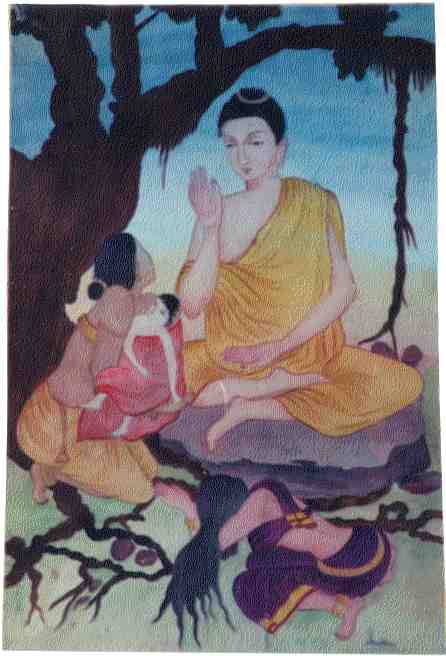
diffusing its rays throughout space [scatters the darkness]." Many came seeking the Buddha's advice after his great awakening, such as Kisagotami (depicted here) asking him to bring her baby back to life. Clever brahmin priests came dispute with a renowned wanderer (shraman) or right their views.
4. Thus have I heard. On a certain occasion the Buddha, soon after attaining buddhahood, was dwelling at Uruvela on the banks of the Neranjara river, at the foot of the Goatherd's Banyan tree. At that time, after remaining in a sitting posture for seven days, experiencing the bliss of emancipation, arose from that meditative state (jhana) at the end of the seventh day.
Now a certain brahmin with a haughty disposition came there and, drawing near, saluted the Buddha. After exchanging compliments of friendship and civility, he stationed himself respectfully at one side. And while standing respectfully at one side said to the Buddha:
"What, Venerable Gautama, is the standard of excellence for a brahmin, and what is the nature of the works he should perform?
The Buddha in this connection, on that occasion, breathed forth this solemn utterance:
"One who has put away doing harm, who is humble, free from
impurity [of mind/heart], self-restrained, versed in knowledge,
leading the high life [not by birth but by one's own actions in
this life], that person may rightly be referred to as a 'brahmin.'
For such a person there are no desires anywhere in the world."