Showing posts with label bodhi tree. Show all posts

Wednesday, October 5, 2011

After the Enlightenment (Inspired Utterances)

The Buddha's All-Seeing Eyes at the great stupa of Boudanath, just outside of Katmandu, Nepal

After the Great Enlightenment
Wisdom Quarterly translation (Udana, Chapter 1)
1. Thus have I heard. On a certain occasion the Buddha, soon after the attaining supreme enlightenment (buddhahood), was dwelling at Uruvela, on the banks of the river Neranjara, at the foot of the bodhi tree. At that time, remaining in a sitting posture for seven days, he experienced the joy of emancipation.

When the seven days came to a close, the Exalted One arose from that state of jhana (meditative absorption). And in the first watch of the night, he thoroughly intuited/thought out the chain of conditionality in order: "When this (state) is, that (state) comes to be; by the arising of this, that is produced. That is to say (in detail):

Tibetan monk and novice under an enormous quilted thangka

"From Ignorance spring formations, from formations springs consciousness, from consciousness spring mind and material form (mentality-materiality), from mind and material form, the six sense bases [the sensitive portion of bodily organs capable of receiving impressions], from the six sense bases, contact [the meeting of stimuli, impression, and consciousness], from contact, sensations, from sensations, craving, from craving, attachment, from attachment, being, from being, rebirth, from rebirth spring decay, death, sorrow, lamentation, pain, grief, and despair [all of which are collectively referred to as dukkha, which we translate as suffering, distress, or unsatisfactoriness]. Thus this whole mass of suffering originates." And the Buddha in this connection, on that occasion, breathed forth this solemn utterance:

"When the conditions of existence dawn upon the mindful
meditative ennobled person, when one understands the nature
of the
conditional arising of things, then all doubts depart."

2. [Conversely,]..."When this is not, that does not come to be; by the non-arising of this (state), that (state) is not produced. That is to say:

By the dissolution of ignorance, formations are undone, by the dissolution of formations, [the base of] consciousness is undone, by the dissolution of consciousness, mentality-materiality are undone, by the dissolution of mentality-materiality, the [bases of the] six sense organs are undone, by the dissolution of the six sense bases, contact is undone, by the dissolution of contact, sensations are undone, by the dissolution of sensations, craving is undone, by the dissolution of craving, attachment [clinging] is undone, by the dissolution of attachment, [coming into illusory] being is undone, by the dissolution of being, rebirth is undone, and by the dissolution of rebirth, decay, death, sorrow, lamentation, pain, grief, and despair are undone. Thus this entire mass of suffering is brought to an end.

And the Exalted One, in this connection, on that occasion breathed forth this solemn utterance:

"When the conditional constituents of being dawn upon the
mindful meditative ennobled person, when one understands
the dissolution of the causes, then all doubts depart."

3. When the seven days had come to a close, the Buddha One arose from that meditative state. And during the last watch of the night thoroughly intuited/thought out the chain of conditionality from start to finish and back.... Now by the complete dissolution of ignorance, there is a cessation of formations. And the Buddha in this connection, on that occasion, breathed forth this solemn utterance:

"When the conditional constituents of being dawn upon
the mindful, meditative, ennobled brahmin, that person
stands scaring off Mara's armies just as the Sun
diffusing its rays throughout space [scatters the darkness]."
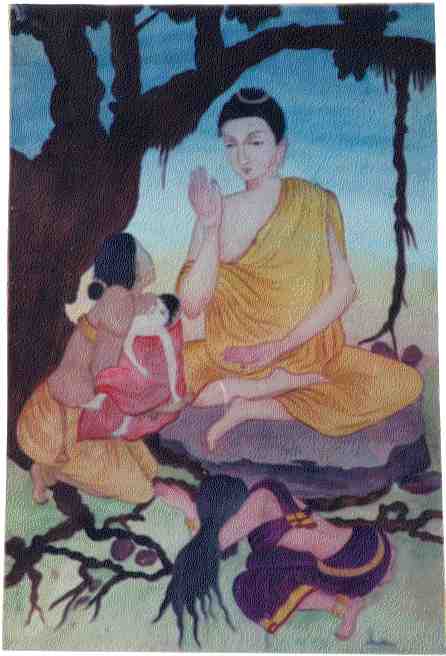

Many came seeking the Buddha's advice after his great awakening, such as Kisagotami (depicted here) asking him to bring her baby back to life. Clever brahmin priests came dispute with a renowned wanderer (shraman) or right their views.

4. Thus have I heard. On a certain occasion the Buddha, soon after attaining buddhahood, was dwelling at Uruvela on the banks of the Neranjara river, at the foot of the Goatherd's Banyan tree. At that time, after remaining in a sitting posture for seven days, experiencing the bliss of emancipation, arose from that meditative state (jhana) at the end of the seventh day.

Now a certain brahmin with a haughty disposition came there and, drawing near, saluted the Buddha. After exchanging compliments of friendship and civility, he stationed himself respectfully at one side. And while standing respectfully at one side said to the Buddha:

"What, Venerable Gautama, is the standard of excellence for a brahmin, and what is the nature of the works he should perform?

The Buddha in this connection, on that occasion, breathed forth this solemn utterance:

"One who has put away doing harm, who is humble, free from
impurity [of mind/heart], self-restrained, versed in knowledge,
leading the high life [not by birth but by one's own actions in
this life], that person may rightly be referred to as a 'brahmin.'
For such a person there are no desires anywhere in the world."

Friday, September 9, 2011

In the Shade of Enlightenment

Anusha Parthasarathy (TheHindu.com)
BODHGAYA, India - The moment our car turned into a narrow, rocky path off NH 2 and I began to hang on for dear life, I knew we had arrived in Bodhgaya ["enlightenment grove"].

[Buddha Gaya is a Buddhist town in Bihar where Siddhartha gained enlightenment].

Here, Presidential Suites are affordable to the common man and barring the occasional ATM there are only small neighborhood shops. There is sparse vehicle traffic. But the large numbers of cow and horse carts and cycle rickshaws, which stalk you till you take a ride, make up for it.

Bodhgaya is ironically small. It is home to colossal statues, picturesque monasteries, a rich religious past, and an ancient tree. But the most important thing to take note of is where you walk. Pavement is scarce, and you need trekking gear to tackle the generous globs of dung and garbage and potholes.

But Bodhgaya still charms with its friendly people and cows that walk up and eat vada out of your hand.

It doesn't take much time to look around the entire town, since there are only four or five streets that you can walk into. You could complete an entire tour in less than three hours.

Accommodation is only average. But the smallest of restaurants boast of "Amrican Chopsew" and "American breakfast" and "multi-cuisine." I pick two of the most popular religious places in Bodhgaya to visit first, the 80-foot Buddha statue and the Mahabodhi ["Great Enlightenment"] Temple. More

Saturday, June 18, 2011

What a Beautiful Tree! Is that Lust?

Amber Dorrian, Wisdom Quarterly response to Figleafforum.com
Bodhisattva under a redwood tree, Sequoia Nat'l Park, CA (AllegoryImaging/Flickr.com)

"Lust" (kama- or raga-chanda, sensual-craving) is a strong desire to possess something. (Desire can seem neutral, but in Buddhism it is translating terms with a negative aspect since there are certainly "good" desires like the will and zeal to realize the liberating truth).

Christians and Muslims have a similar word in is covet. Christians learn that lust and covetousness are "sins" often without considering how or why. What about admiration, the wish to understand, the desire to find harmony? Love, compassion, altruism, and impartiality all express a desire but with a free and happy heart: It does not possess the object of our admiration.

Of course, it is impossible to "possess" things. But what is possible are the harmful mental actions of grasping and clinging, obsession and attachment. The heart is unable to let go. It binds itself. It does not have the object of its craving, yet it does have all the worries and costs of possession.

In a conventional sense, a person may be described as being possessed by objects one clings to. But who -- other than the Five Aggregates -- is clinging? Ultimately, "we" cling to the "factors of clinging." Those factors are called the Five Aggregates. But ultimate truth eludes us.

The title of this article may seem absurd; the story behind the article is even stranger. Our nude Christian friends at Fig Leaf Forum first asked the question in a theistic context. It was like an episode of the Daily Show's "This Week in God." It's beautiful the way things are explicable even with different assumptions about this world.

Do beautiful objects in our perceptual field -- like trees, sunsets, newly nubile gals/guys/ponies -- come about as acts of heavenly Creation or evolve along Evolutionary lines? There's truth in both views, except the polarities won't budge a whit. They thereby turn a blind eye to what is real and what is not. Taking sides is easy, reconciling why the sides exist is less easy but more beneficial. "It's a trap!" we can Admiral Ackbar and Cherry say. Both views are a trap.

No peace is coming between camps, just a few conversions, mostly of sciencey types turning churchy. The truth stands apart, and there would be much more peace if we could see what is right about each pole rather than dismissing one side as kooks and lauding ourselves as the great non-kooks. It's kooky. Keep your view, but keep all eyes open and investigating. Any bias, even a well intended one, causes us to look for confirmation not information. It's our confirmation seeking tendency.

If a particularly stunning tree or model or mountain or magazine cover comes into view, there is great pleasure in taking it in and enjoying its proportions, symmetry, interactive bits, and pleasing fullness (abstract concepts explaining why something strikes us as beautiful that, for less abstract thinkers might just be termed, oh who knows, "God's" handiwork).

Musicians appreciate well performed works and composing skills, jewelers are impressed by well set gems, nature buffs love natural (fractal, Fibonacci, golden mean) beauty. And the wise derive joy from truth, however counterintuitive the Truth may be.

As human beings we find other human beings most beautiful of all -- attractive, creative, evolved, faithful, or intelligent, it hardly matters.

When the mind/heart first hits upon the idea of possessing, we're in line for disappointment and dissatisfaction (dukkha). What if we could be mindful instead, mindfulness being fully aware without thinking, judging, evaluating, planning, or measuring. "It is what it is," people foolishly say, but there's great wisdom in this foolishness. Of course, it itself doesn't say anything, yet something is being said.

Bare awareness means not becoming attached or enmeshed but just seeing, just knowing, just accepting, just allowing. It's very peaceful. It allows the right brain (our silent co-consciousness) to have a say. Of course, it won't speak, but it will communicate with feelings and a bodily sense we react to. ("We" being the left brain thinking portion that thinks, judges, and tries to possess). "Let it be, let it be," the Beatle said.

Will lust help or harm? We can have all that is, but we can possess none of it. What will we choose to try to do?

To carry this analogy further, beauty appears in all sorts of ways. Beauty is not to blame when lust arises. It's not even the reason for admiration. If it were, how would Buddhas, bodhisattvas, and arhats ever be freed from lust (craving, thirst, bondage, disappointment)?

Objects there, responses here. The world is the world; the heart/mind looking out on it can choose to notice this about it or that (the beautiful or the disappointment inherent in it), and then choose to either attempt to possess it or not.

Buddhism is very pleasing because it syncs up with psychology. And we modern Americans love all things psychology. It's no coincidence so many psychologists, therapists, neuroscientists, and the like are Buddhists. The Buddha focused on our internal experience of the external world far more than he spent talking about physics. As interesting and elegant as physics is, it can hardly hold an atomic candle to cognition, perception, emotion, motivation...


The Buddha gave physics its due ("form" means materiality, fine and gross, basic and derivative, four interdependent qualities or characteristics of material bodies). But he elaborated on our experience of the physical by giving psychology the lions share: sensations, perceptions, volitions, and consciousness are what beings cling to and what they can be freed from clinging to.

That freedom comes with enlightenment, is brought on by enlightenment, so much so that many well intentioned teachers and even monastics think nirvana and bodhi are synonyms. But bodhi is enlightenment, insight, awakening, whereas nirvana is complete freedom, peace, the end of suffering.

Oh to be free! Sex is sex. But clinging, attachment, obsession, possession, being consumed instead of consuming, that's just sad. Naturally, in the Sense Sphere (kama-loka) we like sense objects. That's normal. Is it normal to imagine we can "possess" or "keep" or "own" the composed and decaying object of person, be it tree or person, wealth or self?

All are falling away every moment. And in the meantime, we miss what is available -- enlightenment and freedom.

We can't live without trees. Maybe some people can. But we can't. The trees, the trees, rooted in earth, reaching for the sky. Casting shade, dropping figs (and fig leaves), holding my back while I meditate. What meditation? I'm mindful. There is no straining in my striving. I'm just watching. Eventually I'm seeing things as they truly are. Ahhh. No words for it. The right brain knows. It's the left brain that conceives and tries to capture just the right wording.

But completely "detached from sensual objects, O meditators, detached from unwholesome states of mind/heart, a meditator enters into the first absorption, which is accompanied by applied attention and sustained attention, is born of detachment [withdrawal of the senses, samadhi, intensified-concentration opposing workaday dissolute-distraction] and filled with rapture and happiness" [the Buddha defining the first "absorption" or in Pali jhana, Sanskrit dhyana, Japanese zen, Chinese ch'an, Tibetan samten].

Turning this mind to objects of insight -- vipassana practices -- is suddenly fruitful. Loving-kindness! The breath having become a nimitta takes me to equanimity. The factors-of-absorption (jhana-anga) become my best friends. As such where have "my"
  • sensual desire (lust)
  • ill will
  • sleepiness and laziness
  • restlessness and worries
  • doubts
gone? Hindrances fall and opposing states come in peace:
  • applied attention (on my object of meditation)
  • sustained attention
  • rapture
  • happiness
  • concentration.
Turning the wheel (cycle) of "Dependent Origination" in mind, it becomes clear that this is the way to enlightenment. One persisting in this practice, strengthening absorption then applying that laser focus to insight practices, can see freedom in the distance.

Going, going, going beyond, going altogether beyond, O what an awakening, so it is!

It's a nice mantra not learned rote and repeated with bell and drum but uttered spontaneously -- as words fail and contentment overtakes me.
  • Thanks to the editors at Wisdom Quarterly for helping me putting into words.

Lust is discussed in Fig Leaf Forum revisited by Mark Roberts in a debate published in Issue 55/56 of their newsletter. This article is responding to Issue 59.

Fig Leaf Forum realizes that "Lust is a problem of the heart, not of the mind." But in Buddhism heart is mind (citta). Lust is a problem of both. If we were speaking the same technical English, we would agree. Lust does not help perception; it twists (kinks, perverts, distorts) it. "Love others as ourselves," yes! Love everyone! Choose lust at your peril. For what is possible here and what impossible is often found out too late. What is possible? Freedom from the bonds of craving.What is impossible? Actually possessing and controlling what we crave.

Tuesday, May 17, 2011

Buddha Festival: 2,600 years of Buddhism

Images: Dhammakaya, Text: Wisdom Quarterly


The birth of the Bodhisattva, the buddha-to-be, in Lumbini garden on the Indian frontier between 3,000 and 2,600 years ago, exact date unknown.


Vesak: the thrice blessed day because it was on the full moon day of the lunar month of Vesakha (ancient Indian calendar) that the Buddha was born to the Shakyan Queen Maya (apparently, according to Wisdom Quarterly research, a Salabhanjika) under a Sala tree in Lumbini garden, attained supreme enlightenment (which made him a buddha) under a Bo tree in Bodh Gaya ("Enlightenment Grove"), and passed into parinirvana, that is, nirvana without remainder laying down between twin Sala trees.


Siddhartha ("wish fulfilled") Gautama (his family name) became the Buddha of this age and was regarded as a famous karmavadin (teacher of the efficacy and importance of karma) and warrior caste (kshtriya) wandering ascetic opposed to the establish Brahminical tradition that relied on interpretations of sacred scriptures (the Vedas) and elaborate superstitious rituals carried out by a formal priestly caste (brahmins) over direct experience of the Truth. He was a knower and teacher of this world, other worlds, and the pathways leading to all kinds of rebirth.
And with his tremendous following, the brahmins were not too happy about it. Much later, Adi Shankara decided to organize and standardize Buddhist-influenced Vedic Brahmanical schools, thereby creating what we recognize today as "Hinduism." Hinduism recognizes the Buddha but does a great disservice to his teaching by honoring him with the title of avatar, relegating him to a mere incarnation of the God Vishnu. The Buddha was not a God, not a deva, not spirit. He was a human who attained the incomparable status of a fully-enlightened teaching buddha. It is one thing, an accomplishment worthy of great praise and honor, to become enlightened. But it altogether an incomprehensible wonder to become a supreme teacher of the path to enlightenment.


The
devas ("shining ones," deities, divas, godlings, "angels," Earth-fairies, celestial-beings, bright spirits) rejoiced that the Bodhisattva as King Setaketu chose to consummate his quest for enlightenment by taking his final rebirth as a human being on Earth, Prince Siddhartha Gautama.


The Bodhisattva lived in luxury and splendor in Kapilavastu (either near modern Bamiyan, Afghanistan or in the Terai of Nepal, both of which are in view of the Himalayan foothills) but sensed that things were empty.
Suffering (unsatisfactoriness) touched everyone and every endeavor. Touched by the inkling that he had a greater mission, he renounced the throne, the household life, family, and worldly fame. He discarded his fine clothes, cut off his gorgeous hair, and left his family's territory to go East in search of a guru and enlightenment (the final solution to suffering that all beings experience). His mission was not only to become enlightened but to rediscover the path in order to show the way to others; that is the difference between a supremely-enlightened buddha and an arhat ("enlightened individual").


The Bodhisattva's struggle is steeped in lore. His life has been made an allegory to teach the Dharma by way of his example. While the essential facts may have survived, they have been mythologized and elaborated. His five-year struggle with two yogi-gurus to attain the exalted levels of serene meditation they taught are largely left out of the story. What is emphasized instead is his sixth year as he went off on his own, followed by five admirers eager to practice austerities with him. His fierce determination ruined his health and almost led to his death. Insight into the futility of fighting, struggling, and fiercely striving gave way to moderation. He understood that this wonderful body is a vehicle and of great help to reaching the goal. The first foundation of mindfulness, of which there are four, is the body. His mythical battle with internal "demons" is represented as a great offensive by Mara and an army of yakkhas
("demons") representing the psychological defilements we all possess that obstruct clear seeing and liberation.


Taking a balanced approach -- eating well, resting, keeping a regular schedule -- he persisted. He realized that the sublime pleasure born of serenity meditation was not a hindrance but an aid to insight. The defiled mind/heart (contaminated by the hindrances and fetters) cannot free itself. But the heart/mind temporarily freed of these obstructions, if it practices insight-meditation (examining dependently originated nature of unhappiness), can realized the Truth. And it is the Truth that sets one free. While he may have determined to not get up until he found freedom under the Bodhi tree, that resolution was only made after having come so far in his meditation that his mind was now luminous and ready to break through.

  • EDITORIAL NOTE: If we practice with that determination, we are sure to fail -- because most of us have not done the preliminary work of cultivating the eight stages of serenity meditation that make the mind malleable, intensified, wieldy, and luminous. But this so often gets left out of the myth of the Buddha's glorious, take-no-prisoners, gung ho charging into battle against temptation. That is no way to win a war, and it is utterly impossible to win the peace this way.


Having attained the goal, the "Sage of the Shakya clan" (Shakya-muni) revered the Bodhi tree, rejoiced in the liberation of mind and liberation of heart through wisdom and virtue. Having found his way out of compassion for others, he was drawn to teach. But he well understood that it would be difficult to show anyone so subtle a Dharma, so non-polemic an answer, to teach the Middle Way. He decided to remain silent. Sakka, King of the Devas, came to ask him to reconsider out of compassion and particularly to help those who had "only a little dust in their eyes" who, with his help, would surely be able to realize the Truth. A brahma named Sahampati immediately came and repeated this entreaty, and the Buddha consented. He set out to teach his five former companions, seeing that his yogi-teachers had by then passed away. As others followed the practice and became enlightened by the practice, the Dharma grew. The Buddha continued to teach throughout the civilized and very spiritually advanced realm called the Rose "Apple Land" in the Middle Country (Jambudvipa, northern India), living mostly in Magadha.


His goal was not only to teach but to establish the teaching, or Dharma, through the ordination of monks, nuns, and male and female lay followers. The Buddha earned the title "the teacher of gods and men," which refers to the fact that he taught both devas and human beings.
Devas live on Earth and in many extraterrestrial worlds. He and his disciples visited them, and they visited. In fact, more devas reached enlightenment than humans. (And it seems that in straight numbers, not proportions, more lay followers reached at least the first stage of enlightenment than monastics). The Sangha or "monastic community" grew and overtook the Vedic Brahmanism, the established religious authority. Although it is popularly believed that he did not want to ordain women, in fact, he stated that his Dispensation (sasana) would not be complete until all four types of disciples (male and female monastics and male and female lay followers) existed. Only in this way was the Dharma to have longevity. With the loss of nuns, who seem to have been sabotaged by the sexism prevalent in the world and by conspiracies by monks to undermine and subordinate them, the lifespan of the Dharma was threatened. But finally that segment of the Sangha is again on the rise.


Dhammakaya, Thailand's reawakening annual worldwide candlelight celebration in honor of Vesak
. 2011 marks the 2,600th Vesak in Buddhist history. This means that it has been twenty-six centuries since the Buddha sat smiling under the Bodhi tree, having rediscovered the liberating Truth. This celebration takes place every year throughout the world where the Thai Theravada tradition has become established. The Los Angeles branch, perhaps the largest in America, celebrates tonight at 5:00 pm in the foothill city of Azusa.

Monday, April 25, 2011

Why do we love trees?

Zocalo, a Getty Center talk moderated by Bob Sipchen, editor-in-chief, Sierra Magazine Magnificent trees in Kentucky (travelBBB.com)

Why Buddhism LOVES Trees -- Explained

It’s hard to overstate the significance of trees. They provide food, fuel, shelter, shade, beauty, cleaner air, and the raw material for charcoal, paper, and homes. Early manuscripts were printed on birch and beech; the ships that propelled explorers and armies were built from elms and oaks. But beyond their practical use, tress stimulate the spirit and imagination, carrying deep symbolic meaning. Seated in their shade, the Buddha found enlightenment, and Newton found gravity. Laurels meant victory for the Ancient Greeks and Romans; cedars signify revolution and independence for Lebanon; and palms and jacarandas convey the promise of Los Angeles. In conjunction with the Getty exhibition "In Focus: The Tree," Zócalo invites artist Jennifer Steinkamp, environmental studies professor Nalini Nadkarni, and farmer David Mas Masumoto to discuss the beauty and meaning of trees, and why we love them. More

How the talk went: The three participants on a panel called "Why Do We Love Trees" might be expected to have fairly simplistic relationships with the plants in question. READ MORE


Warming killing off trees in Western states (Los Angeles Times)

Tree Dictionary
Million Trees LA
Tree People


Has Age of Environmentalism Brought Us Closer to Nature?
Environmental issues are a bigger part of the collective consciousness than ever before. Recycling has become the norm, water conservation is a major issue in the American West, and environmental... READ MORE
Why Don't Californians Talk About Politics?
Despite widespread public anger at California's broken governing system, its citizens remain disengaged -- and have been unable to fix the system. The voter registration rate is among the lowest... READ MORE