Showing posts with label Buddha. Show all posts

Saturday, September 10, 2011

Going for Guidance to the Three Gems

Wisdom Quarterly edit of "Three Jewels" (en.wikipedia.org)
Buddhist nuns, monks, and lay followers all go for guidance to the Three Jewels.

The Three Jewels, also the Triple Gem, is the center of one of the major practices of mindfulness, recollection, contemplation, and reflection in Buddhism. The qualities of the three are frequently repeated in the ancient texts, where they are called the "Mirror of the Dhamma" (Dhamma Adassa). I go for guidance to the Buddha, the Greatest in the world, the Guru of devas and human beings, who gained enlightenment to teach freedom from suffering to beings. The Cambodian (Khmer) formulation, in Theravada Buddhist tradition, runs as follows.

ចង្អុលឲ្យដើរផ្លូវកណ្តាល មាគ៌ាត្រកាលអាចកំចាត់​ ទុក្ខភ័យចង្រៃអោយខ្ចាយបាត់ អាចកាត់សង្សារទុក្ខបាន។​
Guiding the right Middle Path, the way that can eliminate all suffering.
២.សាសនាព្រះអង្គនៅសព្វថ្ងៃ សត្វមាននិស្ស័យពីបុរាណ​ ប្រឹងរៀនប្រឹងស្តាប់ចេះចាំបាន កាន់តាមលំអានបានក្តីសុខ។
Such teachings now beings have through karmic-destiny accrued in the past by trying to listen, learn, and practice for happiness.
ឥតមានសុខណាស្មើក្តីស្ងប់ បញ្ចប់ត្រឹមសុខឃ្លាតចាកទុក្ខ​ តាំងពីលោកនេះតទៅមុខ ក្តីសុខនឹងមានព្រោះធម៌ស្ងប់។​
There is no happiness as genuine as one free of all suffering from this world and beyond, where happiness prevails because of Dharma.
៣.ខ្ញុំសូមបង្គំឆ្ពោះព្រះធម៌ ព្រះសង្ឃបវរទាំងសព្វគ្រប់ រួមជាត្រៃរ័ត្នគួរគោរព ជាម្លប់ត្រជាក់នៃលោកា
I go for guidance to the Dharma and the Sangha, all combined as the Three Jewels, the cool shade of the world.
ព្រះរូបព្រះធាតុនៃព្រះពុទ្ធ វិសុទ្ធតាងអង្គព្រះសាស្តា​ សូមគុណត្រៃរត័្នជួយខេមរា ឲ្យបានសុខាតរៀងទៅ ៕
May the Triple Gem guide [this country and its people] to happiness forever.

The Mirror of the Dharma
This contemplative practice (anussati) -- often replacing formal sitting meditation -- refers to reflecting on the true qualities of the teacher, teaching, and the taught -- the Buddha, Dharma and Sangha.

These qualities are called the "Mirror of the Dharma" in the Discourse on the Buddha's Last Days. They help practitioners attain a "mind like a mirror" -- a possible reference to the "mind-door" (mind-door cognitive processes) near the physical heart that reflect the contents of consciousness.

In the commentary on the Crossing the Wilderness Rebirth-Tale, the Buddha declares:

Disciples, nowhere between the lowest of the hells below or the highest heavens above, nowhere in all the countless worlds that stretch to the right and left is there the equal, much less one superior, to a buddha. Incalculable is the excellence that springs from keeping the precepts and from other virtuous conduct.
By taking refuge in the Triple Gem, one escapes from rebirth in unfortunate states of suffering. By forsaking such guidance as this, one hase certainly erred. In the past, too, humans who foolishly mistook what was no guide for a true guide met with disaster.

Amaravati Three Gems (triratna) symbols

The Buddha
"The Blessed One is an arhat, perfectly enlightened, accomplished in true knowledge and conduct, fortunate, knower of the world, unsurpassed leader of persons to be tamed, teacher of devas and humans, the Enlightened One, the Blessed One."

In early traditions the Buddha as a worthy guide is taken to refer to the historical Buddha. Later traditions expanded this to include buddhahood or "the full development of mind." In other words, the full development of one's highest potential came to mean our intrinsic buddha nature or ability to reach buddhahood, full enlightenment.

This later interpretation recognizes the possibility of completion, perfection, full development of one's own inherent qualities. Mind in Buddhism does not mean the head; it means the heart. They are one and the same, both involved in consciousness. So the metaphorical head/heart allows for the full development of wisdom and compassion in equal measure.

The Dharma
"The Dharma is well expounded by the Blessed One, directly visible, immediate [timeless], inviting one to come and see, applicable, to be personally experienced by the wise."

Going for guidance to the Dharma, in the Vajrayana tradition, includes reference not only to the words of the Buddha, but to the living experience of realization and the teachings of fully realized practitioners.

In Tibetan Buddhism, it includes both the Kangyur (the teaching of the Buddha) and the Tengyur (the commentaries written by realized practitioners). In an intangible way, it may also include the living "transmission" of those masters, which can be very inspiring.

The Sangha
"The Sangha of the Blessed One's disciples is practicing the good way, practicing the straight way, practicing the true way, practicing the proper way; that is, the four pairs of persons, the eight types of individuals: This Sangha of the Blessed One's disciples is worthy of gifts [a statement which makes it certain that we are not talking about just anyone with a shaved head wearing a saffron robe but instead those ], worthy of hospitality, worthy of offerings, worthy of reverential salutation, the unsurpassed field of merit for the world." (Bhikkhu Bodhi, 2000, The Collected Discourses of the Buddha: A New Translation of the Samyutta Nikaya, Somerville: Wisdom Publications, p. 319–321).

A more liberal definition of "Sangha" may include all practitioners actively following the Buddha's teachings to benefit themselves and others. But it is more strictly defined as the "Realized Sangha" (Arya-Sangha). In other words, it really means those practitioners and historical students of the Buddha who realized the true nature of mind.

The ordinary Sangha means practitioners and students of the Buddha who are using the same methods and working towards the goal of enlightenment and benefiting others by making the Dharma known that brings about the end of suffering (here and now and in the ultimate sense of their own attainment).

Tibetan Buddhism

Threejewels.svg

In Tibetan Buddhism there are three guidance formulations: the Outer, Inner, and Secret forms of the Three Jewels.

The outer form is the "Triple Gem" (Sanskrit, Triratna). The inner is the Three Roots. And the secret form is the "Three Bodies" (trikaya of a buddha). These alternative guide formulations are employed by those undertaking Deity Yoga and other tantric practices in the Vajrayana tradition as a means of recognizing Buddha Nature.

History

The Three Gems are so called because of their treasured value to Buddhists, as well as their indestructible and unchanging nature.

The Three Gems when used in the process of going for guidance become the Three Guides. In this form, metaphors occur very frequently in ancient Pali texts (of Theravada Buddhism). Sangha always really means those persons (ordained or not) who have reached at least the first stage of enlightenment, which is very hard to know about others. So for practical purposes most use the term to refer to the Sangha of Buddhist monks and Buddhist nuns.

I go to the Buddha for guidance and to the Dharma and to the Sangha.

Tuesday, August 2, 2011

Harmonious vs. Quarrelsome Communities

Wisdom Quarterly
Real Buddhist monastic life in the original forest tradition, modern Sri Lanka

PARILEYYAKA FOREST, India - The Buddha stood in the woods. Ven. Anuruddha welcomed his teacher and led him to the wilderness abode he shared with two other Buddhist monks, Nandiya and Kimbila.

They welcomed the Buddha and were overjoyed on account of his visit. They saw to it that he was able to rinse his feet and drink and sit in a prepared seat. They prostrated, happy at the rare opportunity to show their teachers all the customary marks of respect.

The Buddha asked about their progress along the path-of-practice and in terms of securing the allowable requisites (almsfood, robes, shelter, medicine, etc.). They answered that they lived a quiet, peaceful, and harmonious life. As such, their needs were met and they were able to use the suitable conditions to make progress in their meditation practice, encouraging one another along the Dharma path.

The Buddha asked how their relationship as fellow practitioners was going. And Anuruddha replied, "We meditate separately and come together to discuss the Dharma on a regular basis. We live in harmony mixing like milk and water. My companions are a great blessing. Before I do or say anything, I ask myself how they would react. Instead of following my own impulse, I defer to them. If I question that my actions might offend, I refrain. We may be three, but we are of one mind."

The Buddha indicated his approval and turned to the other two recluses. Kimbila added, "What Anuruddha says is true: We live in harmony with great consideration for one another."

Nandiya added, "We share not only the offerings we collect but also encouragement and meditation experience."


The Buddha expressed delight and offered them praise, noting how they lived in contrast to the quarreling monks of Kosambi:
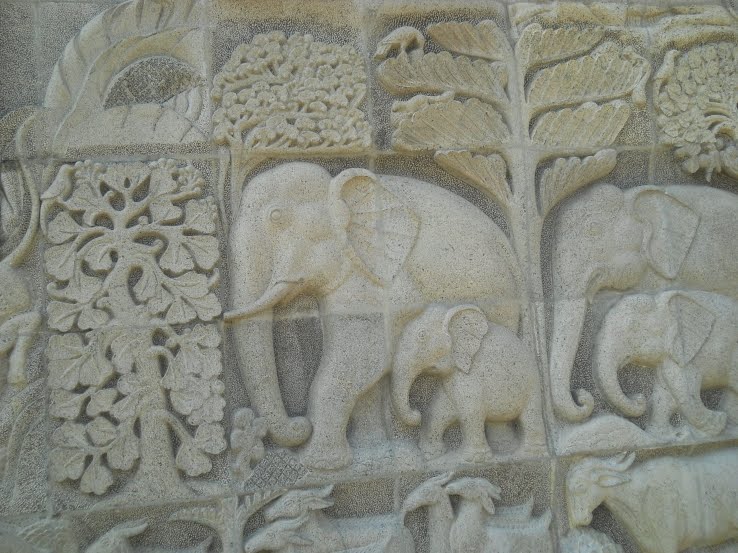
  • Nine years after he began teaching, the Buddha was residing in Kosambi when a quarrel arose between two groups of monastics. Some were experts in the disciplinary code (Vinaya), others in doctrinal matters (Dharma). He tried to settle their quarrel. But when his efforts failed, he left them without a word, taking only his bowl and robes, and retired to the Paileyyaka Forest without an attendant. There, an elephant ministered to his needs, clearing a portion of the forest to reveal a stone cave and each day bringing him fruits as an offering. A monkey observing this brought an offering of his own, a honeycomb. And when the people of Kosambi found out that the Buddha had gone into the forest alone because of the quarrels, they stopped offering alms to them. As soon as news reached Ananda, who was spending the rainy season in Savatthi, he decided to visit the Buddha and told him that people everywhere were eager to hear the Dharma, particularly in Savatthi. The monks in Kosambi settled their quarrels and came to seek the Buddha's forgiveness, resulting in a sutra with the message that:
"One should associate with the wise, not the foolish.
It is better to live alone if good friends cannot be found.
For there is no companionship with the foolish."


He praised Anuruddha, Nandiya, and Kimbila by saying, "Excellent! Harmony is the way. A spiritual community is only a real Sangha when there is harmony and mutual encouragement. It is because of authentically awakening [penetrative insight leading through the stages of enlightenment culminating in arhatship] that you live in harmony.

The Buddha stayed with these monastics for weeks observing how they went out on almsround after morning meditation. Whoever returned first prepared seats for the others, fetched water, and set out an additional clay bowl [bowls were made of clay at that time]. Before eating, he placed some of his food in the empty bowl to share. When they finished eating, they gathered their leftovers and donated them to creatures on land or in the stream. They shared duties not keeping track of who did more or who less and they made sure to meet regularly and otherwise lived together in silence.

Before the Buddha departed, he spoke in praise of harmony and declared six principles to achieve it:
  1. sharing a living space whether in a city or forest
  2. sharing duties essential to life
  3. observing the precepts
  4. uttering only words that contribute to harmony, leaving unsaid words that might split the community or ruin its harmony
  5. meeting together to share their insight and understanding of the Dharma
  6. respecting others' viewpoints without coercing others to follow their views.
A community living in accord with these principles lives in happiness and harmony. The monks were delighted at this teaching. The Buddha went from Parileyyaka Forest to Rakkhita Forest, took a seat under a lush Sal tree, and decided to spend the following rainy season alone in the woods.


Sunday, June 19, 2011

The Seven Treasures of the Noble

Soma Thera (Buddhist Publication Society), edited for clarity by Wisdom Quarterly
(theinteriorgallery.com)

The treasures (Pali, dhana) of the noble [accomplished, enlightened] disciples of the Buddha are not precious stones and pearls, silver and gold, or fields and houses.

Nor are the noble treasures connected with the power and glory of earthly sovereignty. These are the seven treasures of the noble:

Confidence*, virtue, a sense of circumspection-and-dread
[over wrongdoing],
Learning, generosity, and right understanding.
Not poor is the person endowed with these,
Not empty is a life of worthy things.
Therefore should one who is in understanding fixed
[one who has entered into the first stage of enlightenment]
Be diligent working to gain [more] confidence,
Virtue, clarity, and vision of the truth,
Mindful of the Dharma of the Enlightened One who understood.

(Buddha-eyefetch-com)

On a certain occasion Ugga, the chief minister of the King of Kosala, came to the Buddha, saluted him, sat respectfully to one side, and said: Wonderful, venerable sir, marvellous, venerable sir, is the amount of riches, wealth, and possessions of Migara Rohaneyya.

What is the extent of his vast treasures, his vast wealth, Ugga?

Of gold alone he has 100,000. What should one say of silver?

Ugga, I do not deny that there is treasure of that kind. But, Ugga, such treasure is the common victim of fire, water, kings, robbers, and greedy heirs. But there are seven kinds of treasure that are not the common victim of fire, water, kings, robbers, and greedy heirs. What are the seven?

The treasure of confidence, virtue, circumspection-and-dread
[about wrongdoing], learning, generosity,
and of right understanding,
These are the seven treasures the noble have.
Confidence, virtue, the sense of shame and fear,
Learning, bounty, and understanding right.
Not poor is the woman or man with this great wealth,
Unlosable in the world of gods and men.
Therefore should he who is in understanding fixed,
Be diligent working to gain confidence,
Virtue, clarity, and vision of the truth,
Mindful of the law of him who understood.

In order to gain these treasures of the noble a person would be devoted to the Dharma (doctrine) of the Buddha. Therefore men of old said this:

“Except the doctrine of the Perfectly Enlightened One,
There is no father and no mother here.
The doctrine is your guide and support
And in the doctrine is your shelter true,
So hear the doctrine, on the doctrine reflect
And spurning other things live up to it.”

*I. Confidence (Saddhā)
A noble disciple is confident: trusts in the enlightenment of the "Perfect One" (Tathāgata): Thus indeed is the Blessed One: He is an arhat, fully enlightened, endowed with wisdom and perfect conduct, sublime, knower of the worlds, a guide for those wishing to be taught, a teacher of devas and human beings, liberated and blessed.’

Confidence, according to a great Buddhist writer, is the entrance to the ocean of the Buddha’s Dharma, and insight-knowledge is the ship in which a person travels in that ocean.

Says the Buddha, "In these places, Ānanda, should you establish, fix, and make firm your friends, companions, and kith and kin, who think they ought to hear the Dharma. In what three places? In wise confidence concerning the Buddha, the Dharma, and the Sangha should you establish them, fix them, and make them firm.

"There may be change, Ānanda, in the four great elements [characteristics of materiality called] earth, water, fire, and air. But the noble disciple who is endowed with wise confidence concerning the Buddha, the Dharma, and the Sangha cannot change.

"That is to say, it is impossible for one [who has reached the first stage of enlightenment] to be reborn in hell, or as an animal, or where unhappy spirits dwell." More

Tuesday, May 17, 2011

Official "Buddha Day 2600" Song (Sri Lanka)

Famous moments in the life of the Buddha with official Sinhalese song

SRI LANKA 2011 - This year's Vesak Full-Moon Observance Day marks the 2600th year of the Buddha attaining enlightenment. Sri Lanka has made arrangements to commemorate the event as a country safeguarding the Buddha-Dharma and a nation built on those principles. The government and the Buddha Dispensation Ministry have taken the initiative of building a virtuous society, bringing together Buddhists as well as followers of other religions.

How Sri Lanka commemorates the Buddha Day Festival (Sambuddathva Jayanthi)

Buddha Festival: 2,600 years of Buddhism

Images: Dhammakaya, Text: Wisdom Quarterly


The birth of the Bodhisattva, the buddha-to-be, in Lumbini garden on the Indian frontier between 3,000 and 2,600 years ago, exact date unknown.


Vesak: the thrice blessed day because it was on the full moon day of the lunar month of Vesakha (ancient Indian calendar) that the Buddha was born to the Shakyan Queen Maya (apparently, according to Wisdom Quarterly research, a Salabhanjika) under a Sala tree in Lumbini garden, attained supreme enlightenment (which made him a buddha) under a Bo tree in Bodh Gaya ("Enlightenment Grove"), and passed into parinirvana, that is, nirvana without remainder laying down between twin Sala trees.


Siddhartha ("wish fulfilled") Gautama (his family name) became the Buddha of this age and was regarded as a famous karmavadin (teacher of the efficacy and importance of karma) and warrior caste (kshtriya) wandering ascetic opposed to the establish Brahminical tradition that relied on interpretations of sacred scriptures (the Vedas) and elaborate superstitious rituals carried out by a formal priestly caste (brahmins) over direct experience of the Truth. He was a knower and teacher of this world, other worlds, and the pathways leading to all kinds of rebirth.
And with his tremendous following, the brahmins were not too happy about it. Much later, Adi Shankara decided to organize and standardize Buddhist-influenced Vedic Brahmanical schools, thereby creating what we recognize today as "Hinduism." Hinduism recognizes the Buddha but does a great disservice to his teaching by honoring him with the title of avatar, relegating him to a mere incarnation of the God Vishnu. The Buddha was not a God, not a deva, not spirit. He was a human who attained the incomparable status of a fully-enlightened teaching buddha. It is one thing, an accomplishment worthy of great praise and honor, to become enlightened. But it altogether an incomprehensible wonder to become a supreme teacher of the path to enlightenment.


The
devas ("shining ones," deities, divas, godlings, "angels," Earth-fairies, celestial-beings, bright spirits) rejoiced that the Bodhisattva as King Setaketu chose to consummate his quest for enlightenment by taking his final rebirth as a human being on Earth, Prince Siddhartha Gautama.


The Bodhisattva lived in luxury and splendor in Kapilavastu (either near modern Bamiyan, Afghanistan or in the Terai of Nepal, both of which are in view of the Himalayan foothills) but sensed that things were empty.
Suffering (unsatisfactoriness) touched everyone and every endeavor. Touched by the inkling that he had a greater mission, he renounced the throne, the household life, family, and worldly fame. He discarded his fine clothes, cut off his gorgeous hair, and left his family's territory to go East in search of a guru and enlightenment (the final solution to suffering that all beings experience). His mission was not only to become enlightened but to rediscover the path in order to show the way to others; that is the difference between a supremely-enlightened buddha and an arhat ("enlightened individual").


The Bodhisattva's struggle is steeped in lore. His life has been made an allegory to teach the Dharma by way of his example. While the essential facts may have survived, they have been mythologized and elaborated. His five-year struggle with two yogi-gurus to attain the exalted levels of serene meditation they taught are largely left out of the story. What is emphasized instead is his sixth year as he went off on his own, followed by five admirers eager to practice austerities with him. His fierce determination ruined his health and almost led to his death. Insight into the futility of fighting, struggling, and fiercely striving gave way to moderation. He understood that this wonderful body is a vehicle and of great help to reaching the goal. The first foundation of mindfulness, of which there are four, is the body. His mythical battle with internal "demons" is represented as a great offensive by Mara and an army of yakkhas
("demons") representing the psychological defilements we all possess that obstruct clear seeing and liberation.


Taking a balanced approach -- eating well, resting, keeping a regular schedule -- he persisted. He realized that the sublime pleasure born of serenity meditation was not a hindrance but an aid to insight. The defiled mind/heart (contaminated by the hindrances and fetters) cannot free itself. But the heart/mind temporarily freed of these obstructions, if it practices insight-meditation (examining dependently originated nature of unhappiness), can realized the Truth. And it is the Truth that sets one free. While he may have determined to not get up until he found freedom under the Bodhi tree, that resolution was only made after having come so far in his meditation that his mind was now luminous and ready to break through.

  • EDITORIAL NOTE: If we practice with that determination, we are sure to fail -- because most of us have not done the preliminary work of cultivating the eight stages of serenity meditation that make the mind malleable, intensified, wieldy, and luminous. But this so often gets left out of the myth of the Buddha's glorious, take-no-prisoners, gung ho charging into battle against temptation. That is no way to win a war, and it is utterly impossible to win the peace this way.


Having attained the goal, the "Sage of the Shakya clan" (Shakya-muni) revered the Bodhi tree, rejoiced in the liberation of mind and liberation of heart through wisdom and virtue. Having found his way out of compassion for others, he was drawn to teach. But he well understood that it would be difficult to show anyone so subtle a Dharma, so non-polemic an answer, to teach the Middle Way. He decided to remain silent. Sakka, King of the Devas, came to ask him to reconsider out of compassion and particularly to help those who had "only a little dust in their eyes" who, with his help, would surely be able to realize the Truth. A brahma named Sahampati immediately came and repeated this entreaty, and the Buddha consented. He set out to teach his five former companions, seeing that his yogi-teachers had by then passed away. As others followed the practice and became enlightened by the practice, the Dharma grew. The Buddha continued to teach throughout the civilized and very spiritually advanced realm called the Rose "Apple Land" in the Middle Country (Jambudvipa, northern India), living mostly in Magadha.


His goal was not only to teach but to establish the teaching, or Dharma, through the ordination of monks, nuns, and male and female lay followers. The Buddha earned the title "the teacher of gods and men," which refers to the fact that he taught both devas and human beings.
Devas live on Earth and in many extraterrestrial worlds. He and his disciples visited them, and they visited. In fact, more devas reached enlightenment than humans. (And it seems that in straight numbers, not proportions, more lay followers reached at least the first stage of enlightenment than monastics). The Sangha or "monastic community" grew and overtook the Vedic Brahmanism, the established religious authority. Although it is popularly believed that he did not want to ordain women, in fact, he stated that his Dispensation (sasana) would not be complete until all four types of disciples (male and female monastics and male and female lay followers) existed. Only in this way was the Dharma to have longevity. With the loss of nuns, who seem to have been sabotaged by the sexism prevalent in the world and by conspiracies by monks to undermine and subordinate them, the lifespan of the Dharma was threatened. But finally that segment of the Sangha is again on the rise.


Dhammakaya, Thailand's reawakening annual worldwide candlelight celebration in honor of Vesak
. 2011 marks the 2,600th Vesak in Buddhist history. This means that it has been twenty-six centuries since the Buddha sat smiling under the Bodhi tree, having rediscovered the liberating Truth. This celebration takes place every year throughout the world where the Thai Theravada tradition has become established. The Los Angeles branch, perhaps the largest in America, celebrates tonight at 5:00 pm in the foothill city of Azusa.

Monday, May 16, 2011

Buddha Jayanti 2600 (video seminar)


() Buddha Festival 2600 Seminar: "PATH TO LIBERATION" is a dialogue of the three main Buddhist traditions on Sunday, May 22, 2011 at the Nalanda Centre, Selangor, Malaysia. As seen live on Justin.TV
  • PHOTO: Vesak 2011 marks 2600 years since the Buddha's enlightenment as celebrated in Singapore (Linkway88/Flickr.com)

Friday, April 22, 2011

The Buddhist Attitude Towards Nature

Prof. Lily de Silva (abbreviated and edited by Wisdom Quarterly)

...Buddhism strictly limits itself to the delineation of a way of life designed to eradicate human suffering (dukkha or disappointment, dissatisfaction). The Buddha refused to answer questions that did not directly or indirectly bear on the central problem of human suffering and its ending.

Furthermore, environmental pollution is a problem of the modern age, unheard of and unsuspected during the time of the Buddha. It is therefore difficult to find any specific discourse that deals with the topic. Nevertheless, because Buddhism is a full-fledged philosophy of life reflecting all aspects of experience, it is possible.

BUDDHIST LANGUAGE
The word "nature" means everything in the world that is not organized and constructed by humans. The Pali (an exclusively Buddhist language) equivalents that come closest to "nature" are loka ("world") and yathabhuta ("things as they really are") and dhammata ("natural law") and niyama ("natural way") -- or the "order of things."

Nature as Dynamic
According to Buddhism, [cyclical] changeability (anicca, impermanence) is a principle of nature. Everything formed or composed is in a constant process of alteration, vibrating. The world is defined as that which disintegrates (lujjati ti loko); it is dynamic and kinetic; it is constantly in a process undergoing change. In nature there are no static and stable "things"; there are only ever-changing, ever-moving processes.

Rain is a good example illustrating this: Although we use the noun "rain," which appears to denote a "thing," rain is only a process of water drops falling. Apart from the process -- the activity of raining -- there is no rain.

The building material of nature -- the elements of solidity (pathavi), liquidity (apo), heat (tejo), and mobility (vayo) -- are ever-changing phenomena. Solid looking mountains wear away, Earth shifts. One sutra explains how the massive king of mountains -- Mount Sineru, rooted into the sea and sky -- also gets destroyed by heat, without leaving even ashes, with the eventual appearance of multiple suns in the distant future (A. IV, 100).

Nature and Morality?
The world passes through alternating cycles of evolution and dissolution. [Things are created in between, hastening the evolution.] Buddhism believes that "natural" (impersonal and orderly) processes are affected by the morals and ethics of humans.

According to the Aggañña Sutra (DN 27, "Buddhist Genesis" on the beginnings of life on Earth), the appearance of greed in the primordial beings -- who at that time [devolved from higher order beings from space who] were self-luminous, subsisting on joy, and traversing in the skies -- caused the gradual loss of their radiance and their ability to subsist on joy and to move about in the sky.

The moral and ethical degradation had effects on the external environment too. At that time the entire Earth was covered over by a very flavorful and fragrant substance similar to butter [or mushrooms]. When beings started partaking of this substance with more and more greed, on the one hand, their subtle bodies became coarser and, on the other hand, the flavorful substance started diminishing.

With the solidification of gross form, bodily differences appeared; some were beautiful, while others were unattractive. So conceit arose in those beings, with the beautiful ones looking down on the others. As a result of these moral blemishes, the delicious edible Earth-substance completely disappeared.

Sexual Differences
In its place appeared less easily obtainable edible mushrooms and later another kind of edible creeper. The beings who subsisted on them underwent sexual differentiation, and spontaneous birth was replaced by pregnancy and childbirth or common sexual reproduction.

Self-growing rice appeared. But through laziness to collect each meal, humans grew accustomed to hoarding food. As a result of this hoarding habit, the growth rate of food could not keep pace with the rate of demand. The land had to be divided among families (clans, extended family groups). When private ownership became the order of the day, those who were of a more greedy disposition started robbing from others' land. When they were detected, they denied it.

Through greed, vices like stealing and lying to cover it up arose. To curb wrongdoers and punish them, a ruler was elected by the people. Thus the original simple society became complex and with many complications.

The Buddha explained that these adverse natural effects resulted from unnatural (man made) moral degeneration. The richness of the Earth diminished and self-growing rice disappeared. Humans had to till the land and cultivate rice for food, which became coarser and more difficult, enveloped in chaff, and needing to be cleaned.

This evolutionary legend while impersonal was affected by humans and other living beings in the environment, seen and unseen. The dominant beings, which first came from space then became terrestrial, deteriorated morally. This affects our well being and happiness.

The Cakkavatti Sihanada Sutra (DN 26, "The Wheel-Turning Emperor") predicts the future course of events when humans become more degenerate: Gradually human health will deteriorate so much that life expectancy will diminish until the average human lifespan is reduced to 10 years and the marriageable age is 5 years. [While this may sound incredible, more incredible is the fact that at times the average lifespan is 90,000 years or more].

At that time all delicacies such as honey will have disappeared from the Earth. And what is considered the coarsest food today will be considered a delicacy. The Buddha was pointing out the close link between our moral and ethical choices and the natural resources available to us.

When wanton lust, greed, and debased values grip the human heart and become widespread in society, timely rain does not fall. When timely rain does not fall, crops get various pests and plant diseases. The lack of nourishing food increases human mortality rates.

The forest in India after respect was lost for maintaining nature (Goutamendu/Flickr)

Early Buddhism recognized the close relationship between human behavior and the natural environment. This idea was systematized in the theory of the Five Natural Orders (pañca niyama dhamma) in later commentaries (Atthasalini, 854). According to the theory, there are five natural forces at work in the cosmos:

  1. order of seasons (utu-niyama)
  2. order of seeds (bija-niyama)
  3. order of mind (citta-niyama)
  4. order of deeds (karma-niyama)
  5. order of things (dhamma-niyama).

These may be translated as physical laws, biological laws, psychological laws, moral laws, and causal laws, respectively. While the first four orderly processes operate within their respective spheres, the law of causality operates within each of them as well as among them.

This means that the physical environment of any given area conditions the growth and development of its biological component, its flora and fauna. These in turn influence the thought pattern of the people interacting with them. Modes of thinking determine moral and ethical standards.

The opposite process of interaction is also possible. Our morals influence not only the psychological makeup of people in an area but the biological and physical environment of the area as well.

The commentary on the The Wheel-Turning Emperor discourse goes on to explain the pattern of mutual interaction further (Dh.A III, 854):

  • When humankind is demoralized through greed, famine is the natural outcome;
  • when moral degeneration is due to ignorance, epidemic is the inevitable result;
  • when hatred is the demoralizing force, widespread violence is the ultimate outcome.

PARADISE IS COMING
If and when we realize that large scale devastation has taken place as a result of our moral degeneration, a change of heart takes place among the few surviving human beings. With gradual moral and ethical regeneration, conditions improve through a long period of cause and effect. And humans again start to enjoy gradually increasing prosperity and longer life.

The world, including nature and humans within it, stands or falls with the type of moral/ethical force at work. If irresponsibility grips society, humans and nature deteriorate. If responsibility reigns, the quality of human life and nature improves.

So greed, hatred (including fear), and delusion produce pollution within and without. Generosity, compassion (including fearlessness), and wisdom produce purity within and without.

This is one reason the Buddha said the world is led by mind (intention precedes action, determining the moral quality of it, which in turn builds our outer world or circumstances): Cittena niyati loko (S. I, 39). Life is interdependent.


Human Use of Natural Resources
For survival, humankind has to depend on nature for food, clothing, shelter, medicine, and other requisites.

For optimum benefits humans have to understand nature so that we can utilize natural resources and live harmoniously with nature. By understanding the workings of nature -- seasonal rainfall patterns, methods of conservation, soil types, physical conditions required for growth of food crops, etc. -- humans can learn to get better returns.

But this learning has to be accompanied by ethical restraint if we are to enjoy the benefits of natural resources for a long time. We must learn to satisfy our need and not feed our greed.

The resources of the world are not unlimited, whereas our greed knows neither limit nor satisfaction.

Conspicuous consumerism is acceptable today. One writer says that within 40 years Americans alone have consumed natural resources to the quantity of what all humankind has consumed for the last 4000 years [quoted in Vance Packard, The Waste Makers (London 1961), p. 195]. We waste non-recyclable fuels.

Buddhism advocates such virtues of non-greed, non-hatred, and non-delusion in all human pursuits. Greed breeds sorrow and unhealthy consequences, whereas "contentment" (santutthi) with what is sufficient is praised (Dhp. 204). The person leading a simple life with few wants that are easily satisfied is upheld and appreciated as an exemplary character (A. IV, 2, 220, 229).

Miserliness (Dh.A. I, 20 ff.) and wastefulness (Dh.A. III, 129 ff.) are criticized as two degenerate extremes. Wealth has instrumental value when utilized for satisfying needs. Hoarding is a senseless anti-social habit. The vast hoarding of wealth and the methodical destruction of large quantities of agricultural produce to drive market prices higher while the world is malnourished is a sad paradox of our affluent age.

Frugality is a virtue in its own right according to Buddhism. Once Ananda explained to King Udena the economic use of robes by monastics: When new robes are received, the old robes are used as coverlets, the old coverlets as mattress covers, the old mattress covers as rugs, the old rugs as dusters, and the old tattered dusters are kneaded with clay and used to repair cracked floors and walls (Vinaya II, 291). Nothing is wasted.

Those who waste are derided as "wood-apple eaters" (A. IV, 283). If one shakes the branch of a woodapple tree, all the fruit falls, ripe as well as unripe. One collects only the ripe leaving the rest to rot. Such a wasteful attitude is anti-social and criminal.

But agribusiness and energy industries do the same thing in the name of "business" and are praised and rewarded, excessively exploiting natural resources that belong to us all.

Buddhism is about a gentle, non-aggressive attitude towards nature. According to the famous Advice to Householders sutra, someone living a good lay life should accumulate wealth the way a bee collects nectar from a flower:

The bee neither harms the fragrance nor the beauty of the flower, but gathers nectar to turn it into sweet honey. Similarly, humans (whether as moral individual farmers or ethical corporate boards) are expected to make legitimate use of nature.

Attitude Towards Animal and Plant Life
The well-known Five Buddhist Precepts form the minimum code of ethics that every lay Buddhist strives to adhere to. The first precept is abstaining from injuring life. It is explained as the casting aside of all forms of weapons and being conscientious about not depriving any living being of life. In its positive sense it means the cultivation of compassion and sympathy for all living things (DN 4, "The Qualities of a True Brahmin" discourse). This means abstaining from trading in meat too (A. III, 208).

The Buddhist monastic has to abide by an even stricter code of ethics than the Buddhist layperson: abstaining even from practices that could involve unintentional injury of living beings.

Buddhism prescribes the practice of "loving-kindness" (metta) towards all creatures. The Karaniya Metta Sutra cultivates loving-kindness towards all in every direction. They are suffused with a loving attitude. Just as one's own life is precious to one, so the life of others is precious to them.

Humans and beasts can live and let live without fear of one another if only we cultivate sympathy that regards all life with compassion.

The understanding of karma and rebirth, too, helps us adopt a sympathetic attitude towards animals. Human beings can be reborn in subhuman states among animals, ghosts, in tormented states just as they can be reborn in the skies, with great power, glory, beauty, and long life.

It is said that if one throws dish water into a pool where there are living creatures with the intention that they feed on the tiny particles of food washed away, one accumulates merit even by this seemingly trivial act of generosity (A. I, 161).

According to the Macchuddana Rebirth Story (Jataka), the future Buddha threw his leftover food into a river in order to feed the fish. By the power of that merit, he was saved from an impending disaster (Jat. II, 423). Kindness to big and small animals [and the unseen beings associated with plants and trees] is a source of merit -- merit needed for human beings to improve their circumstances in the cycle of rebirths and to approach the ultimate goal of nirvana.

But Buddhism expresses a gentle and nonviolent attitude towards the vegetable kingdom as well. It is said that one should not even break the branch of a tree that has given one shelter ("Ghost Stories," Petavatthu II, 9, 3). Plants are so helpful in providing us with all the necessities of life that we are expected to adopt a sensitive attitude towards them rather than being callous. The rules prevent Buddhist monastics from injuring plant life (Vinaya IV, 34).

Before Buddhism, people regarded natural phenomena such as mountains, forests, groves, and trees with a sense of awe and reverence (Dh. v. 188). They considered them the abodes of powerful non-human beings (such as Earthbound-devas) who can assist human beings in times of need.

Although Buddhism gave us a far superior Triple Guidance (tisarana) in the Buddha, Dharma, and Sangha, these places continued to enjoy public patronage at a popular level. The acceptance of terrestrial non-human beings such as devas (S. I, 1-45) and yakkhas (yetis or guardians of the forest, S. I, 206-215) does not violate the belief system of Buddhism. Therefore, even today among many Buddhists there is a reverential attitude towards nature, particularly long-standing gigantic trees. They are vanaspati, "lords of the forests" (S. IV, 302; Dh.A. I, 3).

Huge trees, such as the ironwood (Sal) and fig (Bodhi), are also recognized as the enlightenment trees of former buddhas. So a particularly deferential attitude towards trees is further strengthened.(D. II, 4). It is well known that the Bodhi tree (Ficus religiosa) is still held as an object of great veneration reminding us of our potential for enlightenment.

Not only is the forest preserved and protected, the construction of parks and "pleasure groves" for public use is considered a great meritorious act (S. I, 33).

Sakka, ruler of many devas, is said to have reached his status partly as a result of social services such as the construction of parks, pleasure groves, ponds, reservoirs, and roads (Jat. I, 199 f).

The open air, natural habitats, and forest trees have a special fascination for the Eastern mind as symbols of spiritual freedom. The homebound life is regarded as a fetter that keeps one in bondage and subject to all kinds of misery.

Renunciation or letting go (not necessarily of things and obligations but at least of the strong attachment and identification with them) is like the open air, nature unhampered by human activity (D. I, 63).

The Life of the Buddha and Nature
The important events in the life of the Buddha took place in nature: He was born in a garden park at the foot of a Sal tree in Lumbini, [possibly modern Afghanistan or ancient Gandhara, northwest India, though some still argue for southern Nepal]. He attained enlightenment at the foot of the Bodhi tree in Bodhgaya, India. He began his missionary activity in the open air in a Sal tree grove belonging to the Malas in Pava. As a wandering ascetic with a large company of monastics, he frequently chose to stay in mango groves on the outskirts of villages and large cities. He lived on the peak of a hill in the Royal City (Rajagaha) and often spent the day in the Bamboo Grove in the Squirrel's Feeding Ground. He alternated residences, always wandering as he taught throughout northern India, often also residing in a great park called Jeta's Grove in Savatthi, a city on the banks of a river. And finally he chose to pass away between two magnificent Sal trees in Kushinagar, India.

The Buddha's constant advice to his disciples was to resort to natural habitats such as forest groves and glades where they would find quiet and peace of mind undisturbed by human activity (M. I, 118; S. IV, 373). It was such a good place for zealous meditation that he also periodically went alone into retreat.

Attitude towards Pollution
Environmental pollution has assumed such vast proportions today that humans are forced to recognize the ecological crisis. We can no longer ignore the situation because we are already threatened with new pollution-related diseases. Pollution to this extent was unheard of during the time of the Buddha.

But there is sufficient evidence in the canon to give us insight into the Buddhist attitude towards our pollution problem. Several Vinaya rules prohibit monastics from polluting green grass and water with saliva, urine, and feces (Vin. IV, 205-206). These were the common agents of disease known in the Buddha's day, and rules were set up against such polluting.

Cleanliness was highly commended by the Buddha both in terms of one's person and one's environment. Buddhists were very concerned about keeping river, pond, and well water clean. These sources were for public use and were to be used with proper public-spirited caution for everyone's good.

Green grass rules were prompted by ethical and aesthetic considerations. But grass is also food for animals, and it is one's duty to refrain from polluting it even unintentionally.

But "environment" is bigger than that. We must be mindful of the noise we inject into the environment. [There is a famous Zen saying that runs, "It is best to remain quiet unless one can improve on silence."]

Indeed, today noise is recognized as a serious personal and environmental contaminant. It causes stress, irritation, deafness, breeds resentment, saps energy, and inevitably lowers efficiency {Robert Arvill, Man and Environment (Penguin Books, 1978), p. 118]. The Buddha's attitude towards noise is very clear from the canon. More