Showing posts with label thich nhat hanh. Show all posts

Friday, September 16, 2011

Teach Yourself Walking Meditation (video)

Carole Fogarty (thehealthylivinglounge.com) and Wisdom Quarterly
“Make the effort to let go of your worries” - Thay (Zen Master Thich Nhat Hanh, Walking Meditation DVD/CD-ROM).

Walking meditation is the perfect alternative if body and mind are too restless to sit and rest in stillness. Its also a lovely change from the usual, less active meditation practices. No great skill or understanding is required. Simply give attention to (just knowing, not evaluating or thinking about) the breath, foot steps, or the ground. Adjust to a slow, gentle pace. Wherever one can walk, one can meditate along the way.

Healing

  • Body and mind become one (united by breath).
  • Calm strong emotions by living in the present moment(rather than reflecting on the past or worrying about possible futures).
  • Focus on the internal world in the senses of the body rather than the outer.
  • Draw excess energy and emotions (stray thoughts upsetting the heart/mind) out of the head down into the body.

“Live your daily life in a way that you never lose yourself. When you are carried away with your worries, fears, cravings, anger, and desire, you run away from yourself and you lose yourself. The practice is always to go back to oneself.” - Thay

() Free weekly wisdom. From Walking Meditation: What if every step taken deepened our connection with all life and imprinted peace, joy, and serenity on Earth?

Deepen the practice with the highly recommend book Walking Meditation by Zen Master Thich Nhat Hanh and his student Nguyen Anh-Huong. It is short, simple, and very easy to read with super clear instructions and an added bonus -- an instructional DVD and a CD that includes 5 walking meditations. Remember, there is no goal to walking meditation. The destination is here and now...one breath at a time.

“Walking meditation is meditation while walking.” - Thay

4 Key Steps

  1. Breathing - stay aware of what is happening now. What is happening? Breathing. Breathe using a gentle, full belly (not a full chest) to calm thoughts, relaxing the hips, elbows, muscles, legs, face, eyes, ears, and brain. Maybe place hands on the belly to feel the rise and fall (optional). Breath in “resting,” breath out “softening.”
  2. Walking - with soft eyes, moving slowly and gently. Feel the sensation of each foot as it presses down on the earth. Notice it as it lifts up, touches the ground, and is lifted up again. Follow every foot step with mind and breath.
  3. Counting - if staying focused on each step is a struggle, count the number of steps to each inhale and each exhale. This encourages attention (discourages distraction).
  4. Smiling - smiles, half smiles, upside down frowns, grins... It is said a smile brings lightness to the feet, inviting the body to relax, helping us settle more easily into walking meditation.

“Don’t bring anxiety and stress to the ground with your feet.” - Thay

(Ven. ) This is the third in a series of six videos on how to practice meditation without religious dogma or spiritual mumbo-jumbo.

Thursday, September 15, 2011

A visit with Thich Nhat Hanh (video)

Wisdom Quarterly

Singing monastics and wall to wall crowds at Deer Park (Ashley Wells/Wisdom Quarterly)

Deer Park monastics and Thay's large entourage serenading Thay (sitting in the front row facing them accompanying them with a large singing bowl) and visitors to free day at the monastery preceding a sold out, week-long retreat. Wisdom Quarterly visited Deer Park Monastery in Escondido, California on September 3, 2011. Thich Nhat Hanh (Thay) was there after speaking in Pasadena and preparing for a retreat.
Events
DeerPark@dpmail.net
Mindfulness Retreat in Vietnamese - Opening the Door of the Heart
Sept. 16, 2011: 5-day mindfulness retreat with Thich Nhat Hanh, monks, and nuns.
Day of Mindfulness with Thich Nhat Hanh
Sept. 25: Opening the door of the heart, a day with Thay and the fourfold community of Deer Park Monastery
Meditation & Education Retreat - The True Student
Nov. 4: bi-annual retreat for university educators and college students at all levels who are interested in meditation and its correlation to our life at school, in our family, and in our minds.
Retreat and Weekend Schedule Fall 2011 - Fall 2012 Overview of retreats and theme weekends at Deer Park for coming year

Wednesday, September 14, 2011

Seeing the famous Zen Master (Deer Park)

Yogi Seven, Ashley Wells, T. Nguyen (Wisdom Quarterly)
Buddhist monastery, Escondido (Emeraldsrain). More at Hidden San Diego.net

Zen Master Thay (Thich Nhat Hanh) came to Pasadena last week. His organization graciously provided third row seat tickets to Against the Stream, Los Angeles.

I sat and squirmed. It is always odd to be in the ritzy Pasadena Civic Auditorium with 5,000 mindful, meditative Zen devotees. And they do seem unusually devoted to the charismatic Thay in a world of inauthenticity that is so often out of integrity.

I browsed the brochure and relaxed. It told me to. To take notes or try to achieve anything would be to make myself like hard earth the rain could not penetrate. But to soften like a flower with rain in its face, my roots would soon be refreshed.

I exhaled. This year Thay really seemed to be saying something. The last time Wisdom Quarterly was here, we laughed at his bag of meditation rocks for kids and how he stretched that into a talk to a crowd that was all about the feeling and nothing about the intellectual content.

No Pain or No Suffering?
But this time, to my surprise, there was a point. An arrow strikes. It hurts. How would it feel if another arrow struck the very same spot? It would hurt hundreds of times worse. This is exactly what happens when we are injured (by harsh words or circumstances or failures). The second arrow is our own condemnation, our going over and over what happened, what we suffered. Someone abused us, and now we abuse ourselves with those painful words.

Pain may be necessary in life; suffering is strictly optional. Pain is sensation we regard as unpleasant. "Suffering" is the mental reaction, the rejection, the denial...the resistance. Why do we resist reality when we can acknowledge, accept, and heal instead?

It's not fair! It's not right! It should be that way not this way! And so on we go catastrophizing everyday events. Pain should be experienced mindfully rather than reactively. In this way, it is not very painful at all. The pain is much worse in the mind -- the fear, the worry, the bracing and contracting. But if we open, it comes and it passes.

"No Mud, No Lotus"

The flower metaphor was apt. I was a blossom, and it was raining. And the rain felt good on my face and soaked into my thirsty roots. "A lotus is made entirely of non-lotus elements," Thay explained. There are clouds, rain, mud, nutriments... All of these go toward making a fragrant flower, but none is the flower.

In just the same way, non-suffering is made entirely of suffering elements. Suffering made our character, gave us our compassion, brought us to where we are. It was not out of extreme pleasure that one ended up in a luxurious auditorium in an affluent suburb of Los Angeles desperately seeking enlightenment and Zen satori.

It was the sense of disappointment with materialism, the sense of lack in affluence, the emptiness of worldly pursuits that brought us around to a search for meaning. We are not getting younger, not growing happier with more stuff, not finding the answers we thought would come on their own. So we search.

Our quest is our response to the suffering (unsatisfactoriness and disappointment) we experience in the midst of our hedonism and sensual indulgences. We are rich and the poorest of all. And we see the poor on TV, at the nonprofit, at the shelter, homeless on the street, and sometimes they seem far happier. Is this the ghostworld (preta-loka) of Asian lore? Or is this the Great Western Paradise (Pureland) of Mahayana cosmology?

It is what we make it. Suffering and nonsuffering intermingle here. Would "heaven" be better for its utter lack of suffering, or would we be cloyed. Thay, who mixes in an uncomfortable number of Christian/Catholic references (perhaps due to Vietnam's French Catholic colonial past or the belief that he is forever addressing closet Christians) defined God and light and breath with uniquely Buddhist acceptance.

And God said, "Let there be light!" But light said "no."

"No!?" God asked.

"No, not until there's dark," light answered.

Nonsuffering without suffering? What would that even mean, or how would it be comprehensible. Granted, it is a trite insight from Religious Studies 101. But it points out something silly about us: Why do we crave for perfect painlessness when we can experience, accept, and even benefit from disappointment, discomfort, distress, and that thing the Buddha never failed to mention as central to life: dukkha?

Deer Park, California

It might have ended there. But it was the long Labor Day weekend. And Gary from ATS told me Thay would be at a free day at Deer Park Monastery near San Diego. But it would crowded. And we would have to leave very early if we were to have any hope of finding a parking spot or cushion space. Thay only visits rarely, and many come to see him.

Seeing him there up close was even more comforting and satisfying than visiting with him on tour. Would I have time? Would there be space? Was it worth the drive from Los Angeles? The watches on sale in the lobby were the answer I needed.


What time is it? It's always the same time of course!

We meditated. We ate. Yogi Seven was asked to teach yoga at the big Wake Up House meeting. We made friends with a great sangha (community), many of whom were from LA and nearby San Diego. And we joined WKUP ("Wake Up," Thay's new youth organization).
  • PHOTOS: All unlinked photos by Wisdom Quarterly: Kwan Yin, the Bodhisattva of Compassion by Emeraldsrain (flickr.com); Thay surrounded by monastics at Deer Park (WQ); Thay teaching in the enormous barn-like Deer Park meditation hall (WQ); Thai "inviting" the singing bowl surrounded by children (WQ); total body relaxation for hundreds of visitors, 75 percent of them women, led by Thay's elderly French singing nun (WQ); God (baloscartoonblog.blogspot.com); Thich Nhat Hanh invites small bell to sing (hometown-pasadena.com); the Now Watch (bluecliffmonastery.org); after the yoga, there were three-breath-full-bodied hugs for the 21 who attended (photo by Yogi Seven, WQ).

Monday, September 5, 2011

Buddhism on Campus "Wakes Up"

Carlin Green, Wisdom Quarterly, US.wkup.org, Plumvillage.org, UK.wkup.org


I'm quite busy as school starts again. My personal experience with insight-meditation scholar-practitioner Sayalay Susila is brief but has really impacted me. I met her a month before the vipassana retreat she conducted at The Bhavana Society, West Virginia. I was at her public talks around Washington, DC. Somehow I ended up being the youngest person in attendance.

Later, when I was asking Sister Susila a question, she instead asked me my age. She told me it was inspiring to her to see someone so young practicing and wanting to learn about the Dharma.


us.wkup.org (indiegogo.com)

Honestly, I have no groundbreaking insights, no inspiring anecdotes, no moving stories of dazzling lights in absorption. I'm just eager to learn, and I was in the right place at the right time to meet a Buddhist nun who knows so much.

It was beneficial for me to attend Buddhist talks in public libraries staring at Mark Twain and a raft of magazines about dieting and cooking, dating and being happy, economic news and war. It was beneficial because she spoke about things never heard before -- the "Exposition of the Elements" (Dhātuvibhanga Sutta) and the Five Aggregates in her talks.
These two topics formed the basis of the insight-meditation (vipassana) instructions she gave us during the retreat, so I was glad I had been familiarized with them beforehand. If I could encourage others to hear such thing, what a change it might make in the country. But I'm only in college; what can I do?

Something To Do:
Waking Up
What should we do when we feel overwhelmed by despair, despair coming from inside of us and despair about the world's situation? How can we find the energy, the strength to do something about it?


Speaking at Plum Village in 2011, Thay uses the Buddha's own life to encourage us. Youth, let's nourish ourselves with the joyful energy of sisterhood/brotherhood and the strength of a clear aspiration to do something helpful.

Saturday, September 3, 2011

TODAY: Thich Nhat Hanh in Los Angeles

TNHtour.org

"On the Road with Thich Nhat Hanh" from Max Pugh


The North America tour stops in Pasadena, the American Varanasi. Zen master "Thay" (Thich Nhat Hanh) will wow the devoted crowd with long pauses and few words. He continues his peace activism, engaged Buddhism, and efforts at establishing Buddhist mindfulness meditation communities in California and elsewhere, making him the second most popular Buddhist figure in the world, behind a famous Tibetan activist. His reputation is well deserved. He is the embodiment of the peace he advocates.

CALIFORNIA EVENTS
September 3, 2011 :: Public Talk :: Pasadena, CA
September 4, 2011 :: Day of Mindfulness :: Deer Park Monastery
September 6 - 11, 2011 :: Mindfulness Retreat in English :: Deer Park Monastery
September 16 - 20, 2011 :: Mindfulness Retreat in Vietnamese :: Deer Park Monastery
September 25, 2011 :: Day of Mindfulness :: Deer Park Monastery More

Thursday, August 25, 2011

Thich Nhat Hanh tours US (video)

TNHtour.org

"On the Road with Thich Nhat Hanh" from Max Pugh


Organizers are very happy to announce a 2011 North American Teaching Tour for Zen master "Thay" (Ven. Thich Nhat Hanh). His continuing peace activism and efforts at establishing Buddhist mindfulness meditation communities in France, California, Vietnam, and elsewhere have made him the second most popular Buddhist figure in the world, just behind a certain Lama. His reputation is well deserved, for he is an embodiment of the peace he advocates. Neither intellectual or dynamic as a speaker -- in our opinion -- he is nevertheless a powerful for of integrity and authenticity to behold. His devoted followers are themselves an amazing bunch of engaged Buddhists who make attendance at his events half the experience.

CALIFORNIA EVENTS
September 3, 2011 :: Public Talk :: Pasadena, CA
September 4, 2011 :: Day of Mindfulness :: Deer Park Monastery
September 6 - 11, 2011 :: Mindfulness Retreat in English :: Deer Park Monastery
September 16 - 20, 2011 :: Mindfulness Retreat in Vietnamese :: Deer Park Monastery
September 25, 2011 :: Day of Mindfulness :: Deer Park Monastery


MISSISSIPPI EVENTS
September 28 - October 2, 2011 :: Mindfulness Retreat :: Magnolia Grove Monastery
October 2, 2011 :: Day of Mindfulness :: Magnolia Grove Monastery


NEW YORK EVENTS
October 5 - 10, 2011 :: Mindfulness Retreat :: Blue Cliff Monastery
October 14, 2011 :: Public Talk :: New York City, NY
October 15, 2011 :: Day of Mindfulness :: New York City, NY
October 16, 2011 :: Day of Mindfulness :: Blue Cliff Monastery


WASHINGTON DC EVENTS
October 25, 2011 :: Public Talk :: Washington DC

Tuesday, August 2, 2011

Harmonious vs. Quarrelsome Communities

Wisdom Quarterly
Real Buddhist monastic life in the original forest tradition, modern Sri Lanka

PARILEYYAKA FOREST, India - The Buddha stood in the woods. Ven. Anuruddha welcomed his teacher and led him to the wilderness abode he shared with two other Buddhist monks, Nandiya and Kimbila.

They welcomed the Buddha and were overjoyed on account of his visit. They saw to it that he was able to rinse his feet and drink and sit in a prepared seat. They prostrated, happy at the rare opportunity to show their teachers all the customary marks of respect.

The Buddha asked about their progress along the path-of-practice and in terms of securing the allowable requisites (almsfood, robes, shelter, medicine, etc.). They answered that they lived a quiet, peaceful, and harmonious life. As such, their needs were met and they were able to use the suitable conditions to make progress in their meditation practice, encouraging one another along the Dharma path.

The Buddha asked how their relationship as fellow practitioners was going. And Anuruddha replied, "We meditate separately and come together to discuss the Dharma on a regular basis. We live in harmony mixing like milk and water. My companions are a great blessing. Before I do or say anything, I ask myself how they would react. Instead of following my own impulse, I defer to them. If I question that my actions might offend, I refrain. We may be three, but we are of one mind."

The Buddha indicated his approval and turned to the other two recluses. Kimbila added, "What Anuruddha says is true: We live in harmony with great consideration for one another."

Nandiya added, "We share not only the offerings we collect but also encouragement and meditation experience."


The Buddha expressed delight and offered them praise, noting how they lived in contrast to the quarreling monks of Kosambi:
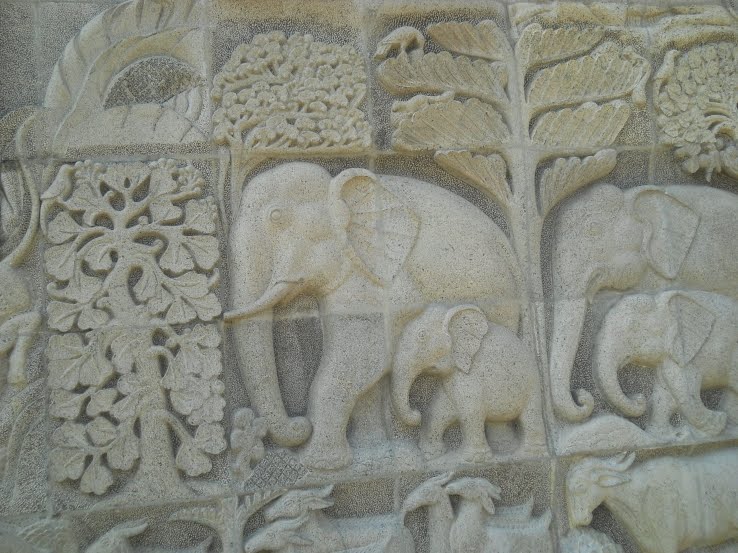
  • Nine years after he began teaching, the Buddha was residing in Kosambi when a quarrel arose between two groups of monastics. Some were experts in the disciplinary code (Vinaya), others in doctrinal matters (Dharma). He tried to settle their quarrel. But when his efforts failed, he left them without a word, taking only his bowl and robes, and retired to the Paileyyaka Forest without an attendant. There, an elephant ministered to his needs, clearing a portion of the forest to reveal a stone cave and each day bringing him fruits as an offering. A monkey observing this brought an offering of his own, a honeycomb. And when the people of Kosambi found out that the Buddha had gone into the forest alone because of the quarrels, they stopped offering alms to them. As soon as news reached Ananda, who was spending the rainy season in Savatthi, he decided to visit the Buddha and told him that people everywhere were eager to hear the Dharma, particularly in Savatthi. The monks in Kosambi settled their quarrels and came to seek the Buddha's forgiveness, resulting in a sutra with the message that:
"One should associate with the wise, not the foolish.
It is better to live alone if good friends cannot be found.
For there is no companionship with the foolish."


He praised Anuruddha, Nandiya, and Kimbila by saying, "Excellent! Harmony is the way. A spiritual community is only a real Sangha when there is harmony and mutual encouragement. It is because of authentically awakening [penetrative insight leading through the stages of enlightenment culminating in arhatship] that you live in harmony.

The Buddha stayed with these monastics for weeks observing how they went out on almsround after morning meditation. Whoever returned first prepared seats for the others, fetched water, and set out an additional clay bowl [bowls were made of clay at that time]. Before eating, he placed some of his food in the empty bowl to share. When they finished eating, they gathered their leftovers and donated them to creatures on land or in the stream. They shared duties not keeping track of who did more or who less and they made sure to meet regularly and otherwise lived together in silence.

Before the Buddha departed, he spoke in praise of harmony and declared six principles to achieve it:
  1. sharing a living space whether in a city or forest
  2. sharing duties essential to life
  3. observing the precepts
  4. uttering only words that contribute to harmony, leaving unsaid words that might split the community or ruin its harmony
  5. meeting together to share their insight and understanding of the Dharma
  6. respecting others' viewpoints without coercing others to follow their views.
A community living in accord with these principles lives in happiness and harmony. The monks were delighted at this teaching. The Buddha went from Parileyyaka Forest to Rakkhita Forest, took a seat under a lush Sal tree, and decided to spend the following rainy season alone in the woods.


Saturday, July 16, 2011

What does God want today? (Compassion)

In the opinion of Ian Morgan Cron on FOX News


This morning I woke up and asked God the question, “What do you want from me today?”

Since God rarely capitulates to my demand for an instant answer, I didn’t wait for a response. [Atheist Mother Theresa also explained her "communication" with the ultimate Christian deity as one of "mutual silence."] I jumped out of bed and into my day.

It was in the [bathroom] shower that I heard God’s reply. This happens so frequently that I’m beginning to wonder if my bathroom should be designated a religious shrine.

“Be compassionate,” God said. “That’s what I want you to do today.”

As [Buddhist monk and peace activist] Thich Nhat Hanh says, “Compassion is a verb.” Unlike someone who is merely empathic, the compassionate person not only feels the pain of the other but actively does something to alleviate their suffering as well.


Why is compassion in such short supply these days? Radical self-concern, our spiritual nemesis, militates against our practicing it. We are so preoccupied with our own struggles that we become inured to the unseen difficulties others are surely facing. More


The mystic experience of Oneness (while dancing)

Monday, May 16, 2011

Zen tourism takes shape in Vietnam

English.vietnamnet.vn, edited by Wisdom Quarterly


With a 2,500-year Buddhist history and over 10 million Buddhists at present and a hundred pagodas (ornate reliquaries), Vietnam can become an attractive destination for Zen tourism.

Zen is a school of Mahāyāna ("Larger Vehicle") Buddhism that is most famous in Japan. Zen emphasizes experiential wisdom in the attainment of enlightenment. As such, at least in legend (legend contradicted by the Western scholar and former Zen Buddhist monk Prof. Robert Buswell, UCLA) Zen de-emphasizes theoretical knowledge in favor of direct self-realization.


Sitting Zen in Vietnam in front of image of Bodhidharma (phathoc.net)

Realization (satori, minor awakening or "epiphany") comes through meditation and Dharma practice. The teachings of Zen include various sources of Mahāyāna thought, including the "Perfection of Wisdom" (Prajñāpāramitā) literature, particularly the Heart Sutra, and the teachings of the Yogācāra and Tathāgatagarbha schools.

The emergence of Zen as a distinct school of Buddhism was first documented in China in the 7th century ACE. From China, Zen spread south to Vietnam very early, around 580. It developed strongly under the Ly -- Tran and Trinh -- Nguyen (pronounced "Win") dynasties.

As a result, Vietnamese culture and lifestyle has been influenced by Zen philosophy, particularly its most famous advocate, Ven. Thich Nhat Hanh.


A senior Vietnamese Buddhist monk, previously detained in an alleged plot to finance disorder against the communist regime, is in custody again (Rev. Danny Fisher).

Zen tourism has been developed in Vietnam with tours to pagodas (ornate reliquaries) and pagoda festivals, which enable tourists to visit Buddhist architectural works, observe and participate in the activities of Buddhist priests, monks, and nuns, as well as enjoy and admire characteristics of Zen arts like flower arranging, the tea ceremony, bonsai tree cultivation, and vegetarian food.


There are about 120 pagodas available for Zen tourism in Vietnam, including popular names such as Dau in northern Bac Ninh Province; Ba Da and Tran Quoc in Hanoi; Truc Lam Tay Thien in northern Vinh Phuc Province; Tu Dam, Thien Mu, and Tu Hieu in central Thua Thien-Hue Province; and Tu An, Giac Lam, and Giac Vien in Ho Chi Minh City. Source