Seven Dharmachari (Wisdom Quarterly), LiveScience.com The MINOS neutrino experiment is located in a cavern half a mile deep in the Soudan Underground Lab, Minnesota. (Yet people doubt there are DUMBs in the US). A mural of famous scientists is painted onto the rock wall (Fermilab).
Buddhist Physics made visible
 It shocked me that at a meditation retreat, the revered monk and scholar was explaining how particles-of-perception could literally be observed. The mind purified and intensified through absorption- (jhana) and honed by insight- (vipassana) practice became able to perceive the smallest particles in Buddhist physics.
I had always thought these things theoretical and, although terribly interesting, beside the point. But they were the point. To gain enlightenment, one would have to examine and analyze these ephemeral objects. The purpose of doing so is direct realization that "everything that is of a nature to arise is of a nature to pass away." This is the teaching of radical impermanence.
It is not that eventually things crumble; rather in every moment in every way, things are changing and transforming.
 One startling aspect of this teacher (Pa Auk Sayadaw)'s instruction, derived from the Abhidharma and Path of Purification, was the notion that particles-of-perception had "flavor" and "odor." This went against everything I understood about such gross physical phenomena. But had I known then as I know now that ordinary meditators in attendance were seeing them, were enjoying absorption and gaining liberating insight, I should have been much more amazed at that.
What is invisible and transient will become visible through practice. It will not, however, become any less transient. So how in the world will the mind/heart ever see a subatomic particle? The answer is easy to understand, hard to accomplish. The mind perceives it and, like a photograph, lays down a memory trace. That trace can be reviewed even if what it is a trace of happened so incredibly quickly as to be incomprehensible.
 Stanford Univ., Los Alamos National Lab (particleadventure.org/KarlTate/LiveScience)
Seeing the transition (anicca, transition or flux), instability (dukkha, disappointment or unsatisfactoriness), and composite nature (anatta, impersonality or emptiness) first hand is what liberates the heart/mind from clinging to things as if they are real, able to yield satisfaction or able to be possessed.
If the mind/heart (other more subtle particles called cittas, the elements or moments of consciousness in Buddhist psychology) sees the "true nature" of things, it withdraws. It naturally lets go. And unbound, unentangled, detached from them, it is freed just for an instant.
But that instant is enough to undo the hold of samsara, this clinging to self, suffering, and rebirth -- giving way to the first stage of enlightenment (stream entry), the gateway, the all important noble attainment. Imagine what surprise, then, to hear science use the term "flavor" to describe the transitory nature of these same unbelievably small and short lived particles! Here's the story LiveScience.com:
Exotic Particle Changes Flavor as Scientists Watch
 Scientists have observed the rare phenomenon of one type of exotic particle transforming into another, which could reveal secrets about the evolution of the universe.
The particles are two types of chargeless, nearly massless species called neutrinos, which come in three flavors: muon, electron, and tau. In past experiments, physicists have measured the change of muon neutrinos to tau neutrinos and electron neutrinos to muon or tau neutrinos. But no one has definitively seen muon neutrinos turn into electron neutrinos.
Now two separate experiments -- one in Japan and one in Minnesota -- have both found evidence for this transformation as well. More
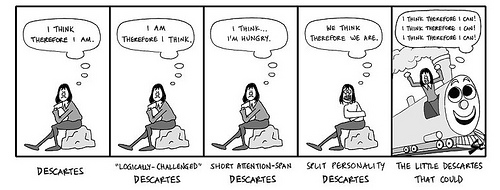 (Leashcolon26/Flickr)
 By the way, Rene Descartes was wrong. He is a famous philosopher in the Western tradition. He is most famous for deducing the maxim, "I think therefore I am."
 The "I" he posited was assumed. There was identification with the thinking. And viewing it as personal, he was logically trapped: A self exists. And it has all of these problems, thinking being one of them.


