Showing posts with label taliban. Show all posts

Tuesday, September 27, 2011

The Boy Mir: Struggle as the West’s war fails

() Following the international hit "The Boy who Plays on the Buddhas of Bamiyan," THE BOY MIR covers not one year but ten. It tracks the cheeky, enthusiastic Mir from a childish eight to a fully grown 18-year-old, a journey to adulthood in one of the toughest places on Earth, a journey that mirrors the story of Afghanistan.
The Boy Mir: One boy’s struggle and the failure of the West’s war [on Afghanistan]
Socialistworker.co.uk/Art
John Clossick thinks that The Boy Mir offers a stunning account of the trials of life in Afghanistan.

Six months before 9/11, shocking media images appeared of the Taliban government dynamiting the 1,450-year-old Buddha statues at Bamiyan in central Afghanistan. The demolition in March 2001 followed a Taliban edict that all statues be destroyed.

It brought the regime’s determination to impose a severe interpretation of Islam on Afghanistan into sharp international focus. The act shocked the West, although previously there had been little interest in the disastrous effects of a Western economic blockade on the country.

No one had commented much on the thousands of children who suffered from malnutrition as a result or were maimed by land mines. The visual shock of this destruction is both the starting point and the counterpoint for this affecting and strikingly shot documentary. More

Afghanistan: Living Through War (video)

AsiaFoundation.org, Wisdom Quarterly
Treasures from Afghanistan (davidderrick blog)

() What does daily life look like for the average Afghan being attacked by the American military machine?

While Americans threaten the people of Afghanistan and Afghans whither in the face continued threats to their peace and security, many of the people in the ancient Buddhist land remain optimistic regarding their country's future. (The original Kapilavastu, Siddhartha's hometown, may well have been in the Bamiyan Valley). The Asia Foundation puts us on the ground in Afghanistan to see what life on the streets looks like for many of the nation's citizens. More

They had the nerve to shoot at us, the invading force there to rape them.
Could you believe that? We had to kill them. They had no reason to shoot.

Thursday, July 28, 2011

Rebuilding the Buddhas of Afghanistan (NPR)

Morning Edition (National Public Radio)
PHOTOS

Bit By Bit, Afghanistan Rebuilds Buddhist Statues
(July 27, 2011) The larger of the two Buddha statues that towered over the Bamiyan Valley [thought by some archeologists and historians to be near the original Kapilavastu, where the buddha-to-be grew up], in central Afghanistan.
Foreign Troops Hand Over Province To Afghan Police
(July 17, 2011) Bamiyan province is one of seven areas going to Afghan security control this month in a first round of the transition.

Afghan Government Gathers In Bamiyan Province
(May 25, 2010) About half of the Cabinet ministers traveled to the remote capital of Bamiyan province to spend three days planning for this summer's donor...

The Buddha, once the largest in the world, overlooking the Bamiyan Valley

Notes from Afghanistan: Bamiyan
(October 28, 2006) She tells Scott Simon what has become of Bamiyan, home to the giant Buddha statues destroyed by the Taliban. ... Notes from Afghanistan: Bamiyan. ...R.

Afghans Frustrated by Slow Pace of Development
(May 19, 2008) Of all the roads in Afghanistan's mountainous Bamiyan province, only one mile is paved. ...

Preserving Memory of Afghanistan's Giant Buddhas
(December 13, 2006) ...An undated photo shows one of two huge Buddha statues in Bamiyan before they were destroyed by the Taliban in 2001.


Rebuilding the Buddhas of Bamiyan
(August 15, 2004) Miranda Kennedy visits Afghanistan's Bamiyan Valley, where two giant Buddha statues once stood.

NPR: The Buddhas of Bamiyan
(February 23, 2002) Weekend Edition Saturday's Scott Simon visits Bamiyan, the Afghanistan town where the Taliban destroyed two giant Buddha statues.

Demand Increases for Women to Join Afghan Police
(May 03, 2007) Detective Nahid Rezaie pages through a magazine before an interrogation at Bamiyan police headquarters.

Buddhas of Bamiyan
(February 23, 2002) Giant Buddhas stood vigil over the Afghan town of Bamiyan until the Taliban destroyed the statues, causing worldwide outrage.

Tuesday, July 5, 2011

"Democracy Now!" live with WikiLeaks


In one of his first public events since being held under house arrest, WikiLeaks founder Julian Assange appeared in London Saturday for a conversation with Slovenian philosopher Slavoj Žižek, moderated by Democracy Now!’s Amy Goodman.

They discuss the impact of WikiLeaks on world politics, the release of the Iraq and Afghanistan war logs, and Cablegate -- the largest trove of classified U.S. government records in history.

“From being inside the center of the storm, I have learned not just about the structure of government, not just about how power flows in many governments around the world that we’ve dealt with, but rather how history is shaped and distorted by the media,” Assange said.

Assange also talks about his new defense team, as well as U.S. Army Private Bradley Manning, the accused Army whistleblower who has been jailed for the past year.

Assange is currently under house arrest in Norfolk, outside London, pending a July 12 appeals hearing on his pending extradition to Sweden for questioning in a sexual misconduct case. He has now spent six months under house arrest, despite not being charged with a crime in any country.

Monday, May 2, 2011

Why the Media misses the story

Indo-Greek Gandhara Triad (Asoka: Buddhism from Asia to Scandinavia/Flickr)

This early Buddhist triad from the 2nd-3rd century CE is from Gandhara (Musée Guimet, personal photograph). Left to right: A Kushan devotee, Bodhisattva Maitreya (future buddha), the historical Buddha, Bodhisattva Avalokitesvara, and a Buddhist monk.


AfPak invasions in ancient Buddhist areas
Wisdom Quarterly
In spite of its long Buddhist history, spanning back to Siddhartha's renunciation and search for supreme-enlightenment, Afghanistan-Pakistan (ancient Gandhara) were invaded for reasons having more to do with strategic advantage and natural resources than obscuring Buddhist history. They border Iran and are therefore lumped into the "geopolitical Middle East."

The Taliban brought the giant Bamiyan Buddha statue to the world's attention -- by blowing it up and attempting to cover up its rich pre-Islamic cultural history. The area was until only recently a part of greater India.

But protecting artifacts, women, innocent civilians, and above strategic advantage prompted the CIA, NATO, and US forces to invade, oppress, and colonize these two war-torn countries. Why? And why will the media not provide sensible explanations?

Wisdom Quarterly recently spoke to Paul Fitzgerald about the Buddhist history of Afghanistan, a connection he was already aware of and intrigued by. As he explained, the region has a spiritual feel that is difficult to explain.

Moreover, an official secretly revealed a figurine he found that struck him because of the Buddha's obvious non-Asian features. It was long believed that the Buddha was westernized as the Dharma moved west, when in fact it originated in the northwest region of frontier India.

Gandhara-style Buddha figures, which appear Greco-Indian, more likely represent how he actually looked. The media overlooks this, but its not the only history of Afghanistan and Pakistan it ignores:

Rory O'Connor (invisiblehistory.com)
A unique husband and wife team, Paul Fitzgerald and Elizabeth Gould have reported for decades on the issues and conflicts in Afghanistan and Pakistan. In the spring of 1981 they received the first visas to enter Afghanistan granted to an American TV crew and produced an exclusive news story for the CBS Evening News.

They also produced a documentary for PBS, returned in 1983 for ABC Nightline, and later worked under contract to Oliver Stone on a film version of their experience.

In 1989 the Soviet Union finally withdrew its forces from Afghanistan. And the Cold War soon ended with the dissolution of the USSR in 1991. But as civil war followed in Afghanistan, the United States also walked away.

And in 1994, a new strain of religious holy warrior called the Taliban arose, sweeping into Afghanistan from Pakistan. By 1998, as the horrors of the Taliban regime began to grab headlines, Fitzgerald and Gould began collaborating with Afghan human rights advocate Sima Wali, filming her return from exile and producing another film.

In the years since 9/11 they continued to follow the Af/Pak story closely, ultimately writing a book entitled Invisible History: Afghanistan’s Untold Story. Their latest effort, Crossing Zero: The AfPak War at the Turning Point of American Empire, examines what they call “the bizarre and often paralyzing contradictions of America’s strategy” in the region.

Crossing Zero has been hailed by Daniel Ellsberg as “a ferocious, iron-clad argument about the institutional failure of American foreign policy in Afghanistan and Pakistan.” And it has been praised by filmmaker Stone, who noted that Fitzgerald and Gould “have been most courageous in their commitment to telling the truth -- and have paid a steep price for it. Their views have never been acceptable to mainstream media in our country, but they deserve accolades.”

Media reformer Norman Solomon, author of War Made Easy: How Presidents and Pundits Keep Spinning Us to Death, called their latest work “a searing expose of distortions that have fundamentally warped U.S. perceptions and actions in the ‘AfPak’ region.”

And onetime CIA Senior Soviet Analyst Melvin A. Goodman said it should be “required reading at the National Security Council and the Pentagon.”

Rory O'Connor recently interviewed the authors about how the media has reported -- and misreported -- the ongoing story of the “AfPak war” during the past three decades. Read the full interview

Pakistan once had a large Buddhist population. Gandhara (northwestern Pakistan/eastern Afghanistan) was mostly Mahayana Buddhist but also a stronghold of Vajrayana Buddhism. The Swat Valley (ancient Uddiyana) was a kingdom tributary to Gandhara. There are many Buddhist archaeological sites in Swat (Matloob Ali/Flickr).

Although raised in Kapilavastu (near Bamiyan, Afghanistan), the historical Buddha was born in Lumbini, close to his mother's parent's territory. Indologist Dr. Pal posits that this garden park was in Baluchistan, in the vicinity of modern Kandahar province, Afghanistan, close to northwest Pakistan, near modern Iran, an area of great strategic to the US military to exploit and the stridently Islamic populations to conceal.

Peace declared? We can leave Afghanistan!

Wisdom Quarterly (ANALYSIS)

Can Osma bin Laden's death bring peace?

Mission accomplished. "USA, USA, USA!" Al Qaeda "decapitated," Taliban destroyed (except for that pesky prison break where everyone was released), hundreds of billions expended on revenge for 9/11 and the way they were treating women. Hooray for our side! So we can come home now, right? No? Another surge? Still haven't misappropriated all the resources we planned on? ...O, you mean "Osama bin Laden" wasn't even in Afghanistan after all?

Why does everyone want to invade Afghanistan? What does it have? What makes it special?

Aryan invaders
Indian frontier expansion
Alexander the Great
Indo-Greco kings
Islamic Arabs
Mahmud of Ghazni and the Ghaznavids
Genghis Khan
Tamerlaine
The Turks
The Moghuls
The British Empire
The Union of Soviet Socialist Republics 1979-1989
CIA
NATO
USA

Afghanistan was once treated as an en-route country. One had to go through it to get anywhere, and it is valuable because it is well-endowed with natural resources. The Greeks, Arabs/Moghuls, Turks, British, USSR, and CIA/USA saw it as the route to India and conquered it to secure "safe" transport for travelers and for goods (such as an oil pipeline). The same was true for the Mongols from the east.

In the 19th century, Afghanistan became a buffer state in "The Great Game" between the British Empire in India and Russian Empire. On August 19, 1919, following the third Anglo-Afghan war, the country regained full independence from the United Kingdom.

For the rest of 20th century, the British had an additional reason to continue to work in Afghanistan: It was a spying post on the Soviet Union. But that was not a military occupation.

When the British finally moved out after about 1975, a vacuum existed between Afghanistan and the rest of the region. The USSR invaded to prevent numerous incursions into their territory. The Russians' Afghan experience was not successful and collapsed completely after reform (perestroika) 1985, when Red Army funding was reduced. Its invasion is referred to as "Russia's Vietnam."

NATO is there now as a front for the USA in our so called "War on Terror," which has included the overthrow of the Taliban regime. The official belief is that Osama bin Laden is holed up in Afghanistan (or maybe Pakistan, or maybe Iran, or maybe Yemen, or maybe Libya, or maybe any other place we want an excuse to attack with drones).

In addition, America wants to control the opium trade, which is centered in the country. Since the USA invaded Afghanistan in 2001, opium output has increased by an estimated 22 per cent in value; Osama bin Laden has not been found (and Pres. Bush said it wasn't really important if we ever found him); the Taliban seems to have more adherents than ever (as planned because we need an enemy or how do we justify occupation and exorbitant military expenditures?); Army atrocities (war crimes) are reported regularly, as is CIA backed torture; and thousands of non-Afghans have died violently (to say nothing of the many thousands of civilians we've killed, sometimes as "collateral damage," other times as targeted victims, as revealed in famous WikiLeak footage). No one knows, and no one keeps track of, how many Afghan civilians have died violently.

There may be other reasons for American and other Western involvement: Afghanistan's natural resources include rare earth minerals, gold, silver, copper, zinc, and iron ore; precious and semi-precious stones such as lapis lazuli, emerald, and azure; and potentially massive petroleum and natural gas reserves as yet untapped. The country also has uranium, coal, chromite, barites, sulphur, lead, and salt.

Afghani Buddhism in the Gandharan-style

The wondrous riches found in a Buddhist monastic complex at Mes Aynak, Afghanistan

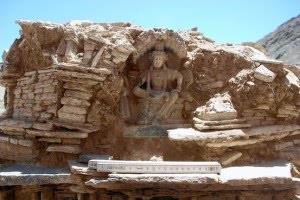
More precious, but apparently less important to American military forces, are the pre-Arab, pre-Islam cultural riches of a region which was once a part of ancient India called Gandhara. The Buddha of Bamiyan was once the largest Buddha statue in the world -- and for good reason. The real Kapilavastu, Siddhartha's hometown, was nearby. One of the world's greatest Buddhist monastic sites, built near a copper and gold mine used in the making temple ornaments as was the custom of artisans in ancient times, is Mes Aynak. The Afghan government signed a contract with China to extract ore and rare earth minerals before the site was discovered. China has said it will give just enough time to begin to list and document all the magnificent riches and archeological artifacts that are there before destroying them in the interest of extracting the resources for the benefit of the Chinese mining interest, a massive corporation tied to the Chinese government.


From the perspective of profiteering and neo-colonialism (the practice of going into countries and making them our imperial colonies), Afghanistan is quite a good place to occupy. Our businesses "invest" billions to control production and movement of resources, the allocation of booty. That is, in imperial terms, we "extract resources" for profit. War is very profitable, not for the taxpayers that pay for it, but for individuals, US officials, and businesses with government contracts loosely referred to by Pres. Eisenhower as the "military-industrial complex."

The country seems set for another century of occupation and civil war by unfriendly powers. It seems that Pashtun culture actually has no history of "warlords" and provincial chieftains bent on selling drugs and in fighting. That was imported from adjoining countries at the behest of Americans preparing for an extended stay starting three decades ago. "Charlie Wilson's War," a movie about CIA involvement starring Tom Hanks, is misleading propaganda promoting a narrative that ignores the complexities of what has been happening this side of the Durand or Zero line.

Crossing Zero: The Afpak War at the Turning Point of American Empire

The Wikipedia entry on Afghanistan is interesting but often inaccurate: It presents the current situation as progressive and encouraging, although very few Afghans would agree. Two expert American scholars who have long been used by the media for their expertise on this largely impenetrable region are Elizabeth Gould and Paul Fitzgerald (who visited LA's Whittier College and the Levantine Center in April).

This question was originally addressed on Yahoo! Answers by an anonymous contributor claiming regular contact with business colleagues in Kandahar and Kabul, including university professors and engineering directors.