Indo-Greek Gandhara Triad (Asoka: Buddhism from Asia to Scandinavia/Flickr)
This early Buddhist triad from the 2nd-3rd century CE is from Gandhara (Musée Guimet, personal photograph). Left to right: A Kushan devotee, Bodhisattva Maitreya (future buddha), the historical Buddha, Bodhisattva Avalokitesvara, and a Buddhist monk.

AfPak invasions in ancient Buddhist areasWisdom Quarterly
In spite of its long Buddhist history, spanning back to Siddhartha's renunciation and search for supreme-enlightenment, Afghanistan-Pakistan (ancient Gandhara) were invaded for reasons having more to do with strategic advantage and natural resources than obscuring Buddhist history. They border Iran and are therefore lumped into the "
geopolitical Middle East."
The Taliban brought the giant Bamiyan Buddha statue to the world's attention -- by blowing it up and attempting to cover up its rich pre-Islamic cultural history. The area was until only recently a part of greater India.
But protecting artifacts, women, innocent civilians, and above strategic advantage prompted the CIA, NATO, and US forces to invade, oppress, and colonize these two war-torn countries. Why? And why will the media not provide sensible explanations?

Wisdom Quarterly recently spoke to Paul Fitzgerald about the Buddhist history of Afghanistan, a connection he was already aware of and intrigued by. As he explained, the region has a spiritual feel that is difficult to explain.
Moreover, an official secretly revealed a figurine he found that struck him because of the Buddha's obvious non-Asian features. It was long believed that the Buddha was westernized as the
Dharma moved west, when in fact it originated in the northwest region of frontier India.
Gandhara-style Buddha figures, which appear
Greco-Indian, more likely represent how he actually looked. The media overlooks this, but its not the only history of Afghanistan and Pakistan it ignores:
Rory O'Connor (invisiblehistory.com)

A unique husband and wife team, Paul Fitzgerald and Elizabeth Gould have reported for decades on the issues and conflicts in Afghanistan and Pakistan. In the spring of 1981 they received the first visas to enter Afghanistan granted to an American TV crew and produced an exclusive news story for the CBS Evening News.
They also produced a documentary for PBS, returned in 1983 for ABC Nightline, and later worked under contract to Oliver Stone on a film version of their experience.
In 1989 the Soviet Union finally withdrew its forces from Afghanistan. And the Cold War soon ended with the dissolution of the USSR in 1991. But as civil war followed in Afghanistan, the United States also walked away.
 And in 1994, a new strain of religious holy warrior called the Taliban arose, sweeping into Afghanistan from Pakistan. By 1998, as the horrors of the Taliban regime began to grab headlines, Fitzgerald and Gould began collaborating with Afghan human rights advocate Sima Wali, filming her return from exile and producing another film.
In the years since 9/11 they continued to follow the Af/Pak story closely, ultimately writing a book entitled Invisible History: Afghanistan’s Untold Story. Their latest effort, Crossing Zero: The AfPak War at the Turning Point of American Empire, examines what they call “the bizarre and often paralyzing contradictions of America’s strategy” in the region.
Crossing Zero has been hailed by Daniel Ellsberg as “a ferocious, iron-clad argument about the institutional failure of American foreign policy in Afghanistan and Pakistan.” And it has been praised by filmmaker Stone, who noted that Fitzgerald and Gould “have been most courageous in their commitment to telling the truth -- and have paid a steep price for it. Their views have never been acceptable to mainstream media in our country, but they deserve accolades.”
Media reformer Norman Solomon, author of War Made Easy: How Presidents and Pundits Keep Spinning Us to Death, called their latest work “a searing expose of distortions that have fundamentally warped U.S. perceptions and actions in the ‘AfPak’ region.”
And onetime CIA Senior Soviet Analyst Melvin A. Goodman said it should be “required reading at the National Security Council and the Pentagon.”
Rory O'Connor recently interviewed the authors about how the media has reported -- and misreported -- the ongoing story of the “AfPak war” during the past three decades. Read the full interview
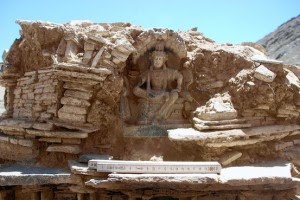
 Pakistan once had a large Buddhist population. Gandhara (northwestern Pakistan/eastern Afghanistan) was mostly Mahayana Buddhist but also a stronghold of Vajrayana Buddhism. The Swat Valley (ancient Uddiyana) was a kingdom tributary to Gandhara. There are many Buddhist archaeological sites in Swat (Matloob Ali/Flickr).
Although raised in Kapilavastu (near Bamiyan, Afghanistan), the historical Buddha was born in Lumbini, close to his mother's parent's territory. Indologist Dr. Pal posits that this garden park was in Baluchistan, in the vicinity of modern Kandahar province, Afghanistan, close to northwest Pakistan, near modern Iran, an area of great strategic to the US military to exploit and the stridently Islamic populations to conceal.

 KPFK Evening News (July 21, 2011 6:00 pm)


More than 400 inmates remain on hunger strike at the California State Prison in Corcoran...