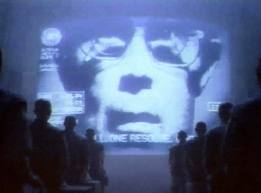
Nineteen Eighty-Four is a classic book everyone should read at some point. We are living it now. It is by British author George Orwell (who lived in Burma). Written in 1948 (which led to the title by simply reversing the last two digits) and published in 1949, it is set in an unknown year (at least a year no one can be certain of).
It focuses on a repressive, totalitarian regime. The story follows the life of one seemingly insignificant man, Winston Smith. He is a civil servant at the "Ministry of Truth" (a kind Times building which serves as the document of record) tasked with falsifying records and political literature.

He effectively perpetuates propaganda, knowing what is true yet making sure the records show otherwise, disappearing people, rewriting history, and so on. He grows disillusioned with his meager existence and so begins a rebellion against the system.
The novel has become famous for its portrayal of secret surveillance and society's increasing encroachment on the civil liberties and natural human rights of the individual. Since its publication the terms "Big Brother" and "Orwellian" have entered the popular language.
Orwell, who had "encapsulated the thesis at the heart of his novel" in 1944, wrote most of Nineteen Eighty-Four on the island of Jura, Scotland, during 1947-1948. He was critically ill with tuberculosis. He sent the final typed manuscript to his friends Secker and Warburg in 1948, and the book was published on June 8, 1949.
Nineteen Eighty-Four has been translated into more than 50 languages (like his popular children's story of totalitarian tactics Animal Farm). The novel's title, its terms, its new language ("Newspeak"), and its author's surname are bywords for personal privacy lost to national state security.
The adjective "Orwellian" denotes totalitarian action or organization, as well as governmental attempts to appropriate and misuse information (disinformation) for the purposes of controlling, pacifying, and subjugating its population.

"Orwellian" can also refer to twisting language so that it says the opposite of what it really means (like Citizens United, Secure Communities, No Child Left Behind, Helping America Vote Act, Clean Water Act, Department of Defense, etc.). Specifically it is governmental propagandizing by the misnaming of things: the "Ministry of Peace" in the novel is actually the Department of War; the "Ministry of Love" actually tortures people; the "Ministry of Truth" is all about lying and fomenting propaganda.
Since the novel's publication, "Orwellian" has in fact become somewhat of a catch-all for any kind of governmental overreach and dishonesty.
The phrase "Big Brother is Watching You" refers to invasive surveillance. In the novel most information is gathered through the "telescreen," a sort of screen that spies on watchers. There are also surveillance cameras, helicopters, countless spies and informants, entrapment schemes, and microphones. (Most of this is now accomplished through iPhones, computers with cameras, CoIntelPro, and unwarranted wiretaps of all kinds).
Although the novel has been banned or challenged in some countries -- along with Aldous Huxley's Brave New World, We by Yevgeny Zamyatin, Kallocain by Karin Boye, and Fahrenheit 451 by Ray Bradbury -- among the most famous literary representations of dystopia (an anti-utopia).

In 2005, Time Magazine listed it among the hundred best English-language novels published since 1923.
The book has often been misinterpreted as an attack on socialism. But Orwell himself had occasion to refute such claims, both privately and in public.
In a letter to Francis A. Henson of the United Automobile Workers (dated June 16, 1949 or seven months before he died), excerpts from which were reproduced in Life (July 25, 1949) and the New York Times Book Review (July 31, 1949), Orwell stated the following:
"My recent novel [1984] is NOT intended as an attack on Socialism or on the British Labour Party (of which I am a supporter) but as a show-up of the perversions... which have already been partly realized in Communism and Fascism.... The scene of the book is laid in Britain in order to emphasize that the English-speaking races are not innately better than anyone else and that totalitarianism, if not fought against, could triumph anywhere."
In his 1946 essay "Why I Write," Orwell described himself as a Democratic Socialist.
Nineteen Eighty-Four is set in Oceania, one of three intercontinental totalitarian super-states (the future Euro, Amero, and Other-o Zones).
The story occurs in London, the "chief city of Airstrip One," itself a province of Oceania that "had once been called England or Britain."
Posters of the ruling Party's leader "Big Brother" (a kind of Gen. Than Shwe, Hitler, Stalin, Churchhill, Bush, Cheney), bearing the caption BIG BROTHER IS WATCHING YOU, dominate the cityscapes.
Two-way screens (the "telescreen") dominate the private and public spaces of the population.
Oceania's people are in three classes -- the Inner Party, the Outer Party, and the Proles (or 99%). The Party government controls the people via the Ministry of Truth ("Minitrue" in Newspeak), the workplace of protagonist Winston Smith, an Outer Party member.
As in the Nazi and Stalinist regimes, propaganda is pervasive; Smith's job is rewriting historical documents to match the current party line, the orthodoxy of which changes often.
The job (like that of Douglas Dietrich at The Presidio library) includes destroying evidence, amending newspaper articles, and deleting the existence of people identified as "unpersons" (the disappeared).
The only hope is a revolutionary party led by Emmanuel Goldstein. But that is a myth or an appropriated reality used by the Inner Party to entrap rebels like Winston Smith and his love interest Julia, who only pretends to be a member of the Anti Sex League.
Here are more details on the story if reading it still seems impossible. It is also available as an audio book, Kindle, and a more modern movie was made, which is not nearly as good as the original BBC version.