The fact is most Americanized "Mexican" food, while recognizable to Mexicans, is about as authentic as Americanized "Chinese" food, which is original enough to be sold in Asia as American-Chinese food with even Chinese and Koreans scratching their heads. We're a land of innovation, after all. I mean, we invented pizza here. That was never found in Italy before someone in New York concocted it. But food brings us together.
 The Buddha in Mexico in the shape of our headless Zen figurine, but in the "Buddha Bar"
My big Mexican family is not Buddhist but nominally Catholic. (It's the duty of every Mexican mother to be as Catholic as every Irish mother, as guilt-inspiring as every Jewish mother, and as warmhearted as every Midwestern farmer). It's the culture. Here's a hug!
Growing up I always admired the headless Zen Buddha and Japanese Virgin Mary figurines my mom had in the living room. We'd glue the head back on, but it would always comes off again. When I was old enough to realize it was "the Buddha" and Gwan Yin, I was overjoyed that my mom was so liberal. She inadvertently introduced me to Buddhism!
She swore blind that that might well be the Buddha (who could tell without a head?) but there's no way that wasn't the
Virgen de Guadalupe. When I explained Kwan Yin and the worldwide manifestation of the divine feminine and Mother Goddesses, she was satisfied that that was close enough. That's what happens when you shop in nearby China Town and buy things that look familiar.
Well she was positively stunned when I showed her evidence that Buddhism preceded the arrival of Catholicism to Mexico and Mesoamerica by centuries. NO WAY, she insisted. "Everybody" knows the Mexicans were all born Catholic.
Tibetan wanderers, who might have first crossed the Bering Straits land bridge 30,000+ years ago to establish the Eskimo and North American native "Indian" populations, now go as missionaries to Mexico.Of course, the truth of the matter is that we were once proud Native Americans, caretakers of the Earth, and astro-theological admirers of feathered dragons from space (
nagas and
devas, apparently) -- just like East Indians, Khmer Cambodians (whose great jungle empire built the civilization anchored in the enormous metropolis of Angkor and Angkor Wat), early Europeans, and the amazing
Dogon Africans.
But more amazing is the history of Buddhism in America Rick Fields uncovered in his tremendously influential, but largely unacknowledged (because it's unacceptable and turns everything we think upside down) book:
 (Shambhala, Boston/London, 1992)
How the Swans Came to the Lake:
A Narrative History of Buddhism in AmericaBut generally few care what American historians say. Moreover, no one wants to know how clean, civilized, and cultured the indigenous peoples were when colonists from
Norway (Vikings), France, Spain, Portugal, and
johnny-come-lately England arrived in the future United States to label them "savages," "heathens," and kill them to save them with the hypocritical Word of the Lord God, smallpox, private property, free trade, and so on. (Reading Howard Zinn, Noam Chomsky, and other obscure uncoverers of the unpopular truth might teach one this much).
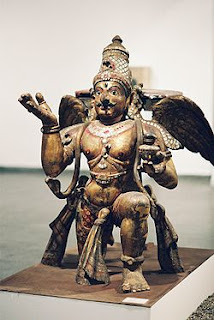

Mexico was established where the
garudas symbolically slayed the
nagas, Eagle beings versus Serpent beings leading to the symbolism of the Mexican flag.
But the pre-Mexican cultures that culminated in Mexico (Aztecs, Mayans, Olmecs...) have seen their memory largely wiped out or sanitized by Christian
conquistadores (genocidal "conquerers").
Mexico was once an unexplained marvel with pyramids and connection to the "gods"
(devas arriving from space and imparting advanced knowledge).
Now it's a good place to import and export drugs, undermined by our CIA, its leaders deposed and friendly politicians installed and manipulated. Sadly, it's no longer safe to travel to as a haven of college drinking and debauchery streaming in from Texas and [upper] California. California was Mexico until the 1850s.

But what does historian Rick Fields add to the strange and wonderful history of the Americas pre-Spanish Catholic conquest? The nub of the story is that Asian Buddhist monks set out on a boat and were blown far, far off course, eventually landing on the other side of the Pacific rim, on the coast of this continent. They shared the advanced technological knowledge they had with the native peoples and revolutionized ceramics, language, art, culture, and philosophy.
Many place names are echoes of the religion they brought with them:
Gautama (the Buddha's surname) and
mala (necklace) combined to form the name Guatemala. Maya (the Buddha's mother's name, as well as a popular Eastern Philosophical term for "illusion" or "beauty") may have formed the basis of the Mayan culture.

There are, of course, Tibetan Buddhist (Vajrayana) centers in Mexico. Mahayana missionaries have also gone in, either because Gwan Yin is so recognizable to "Virg Yin" (Mother Mary) lovers or because the missionary zeal of Christianity is rooted in the missionary manner of spreading the Buddha established. Theravada, the oldest extant form of Buddhism, is being spread in Mexico as well.
One of the few African American Theravada Buddhist monks in the world is from Los Angeles. He now divides his time between Sri Lankan and Vietnamese traditions. But he is living and spreading the Buddha-Dharma in the most dangerous city in the world,
Ciudad Juarez near El Paso at the Texan-Mexican-American border. He is a great friend of Wisdom Quarterly and will be interviewed when he next returns to Los Angeles.
The more things change, the more they stay the same: So happy
Cinco de Mayo from the again increasingly Buddhist and Mexican City of Angels!


